

ENSO is a phenomenon of climate variability. Its occurrence—in either of the two phases: El Niño or La Niña—produces different, and sometimes unpredictable, effects in different regions of the continent and the world. Knowing in time the climatic disturbances associated with each phase allows for making intelligent decisions for planned development that protects communities and their livelihoods.
* This article was published in Geociencias SURA Journal | Issue 1 | November 2016.
What is ENSO, how does it manifest and what are its characteristics?
In climate variability, we often talk about two phenomena known as El Niño and La Niña. Both manifestations are part of one phenomenon: ENSO, which stands for El Niño Southern Oscillation.
ENSO is a phenomenon of climate variability that significantly affects the dynamics of atmospheric winds and precipitation patterns in the tropics, caused by the rise or fall in the average surface temperature of the equatorial Pacific Ocean.
This phenomenon occurs due to the interaction between the ocean and the atmosphere over the equatorial Pacific. Depending on its phase, certain regions of the equatorial Pacific Ocean increase their surface temperature, causing warm air to rise into the atmosphere, which, when condensed, can generate a considerable increase in rainfall in certain regions.
ENSO intensity can be classified into three levels: weak, moderate and strong. To estimate each level of intensity, there are different macroclimatic indices that are built from the comparison of climatic variables observed in different regions of the equatorial Pacific Ocean, such as ocean surface temperature, atmospheric pressure, surface wind speed and cloud cover.
Because each index is built from the observation of different climatic variables, the values obtained may vary from each other, so the final intensity of each ENSO event is defined by a consensus made by experts belonging to entities such as the National Oceanic and Atmospheric Administration of the United States (NOAA), the International Center for Research on the El Niño Phenomenon (CIIFEN) and the International Research Institute for Climate and Society (IRI), in addition to other entities around the world, coordinated by the World Meteorological Organization.
Suramericana continuously monitors the ENSO seasonal (quarterly) forecast, generated by international and national agencies delegated by the World Meteorological Organization (WMO), in order to inform its clients in a timely manner of the probability of the phenomenon developing.
Why are its effects perceived differently in Latin America?
ENSO is a macroclimatic phenomenon that, together with other climatic, geographic and topographic variables, such as the proximity of a given place to the tropics, the orographic configuration, the proximity to the Amazon basin, and the ocean currents of the Pacific, affects the dynamics of local climatic behavior.
The ENSO phenomenon is highly complex and, although its probability of occurrence can be predicted, its duration and intensity are difficult to predict. and their impacts depend on the particular climatic conditions of each country.
It is important to be aware of the climatic effects caused by this phenomenon in each region and its probability of occurrence. To do so, the agencies in charge permanently monitor the oceanic-atmospheric state and have communication channels to inform and offer the essential elements that allow planning the actions to be taken by the different sectors, in case El Niño or La Niña develop, in order to mitigate their impacts.
Why is the phenomenon called “El Niño”?
During the warm phase of ENSO (El Niño), surface temperatures over the equatorial Pacific Ocean reach their maximum values in the month of December. This fact directly affects the thermal structure of the ocean, especially in the eastern Pacific, on the Peruvian coast, where the mixing of surface waters with deep waters is inhibited, which prevents nutrients from emerging to the surface layers from the seabed. For this reason, a large part of the marine fauna migrates to other regions in search of food.
The first to notice this situation were the fishermen of the Peruvian coasts, who associated the phenomenon with the birth of El Niño Dios. due to the time in which this anomaly occurred, which is why they began to refer to the phenomenon as El Niño. The scientific community adopted this name for the warm phase of ENSO, and named the counterpart of the phenomenon (cold phase) as “La Niña”.
How does it behave in ENSO?
The phenomenon shows its first signs in the variation of the surface temperature of the equatorial Pacific Ocean, approximately in the quarter March - April - May (MAM), it strengthens in the period between June and November, and reaches its maximum intensity approximately in the month of December, at which time it begins to weaken.
The variation in the average monthly temperatures of the equatorial Pacific Ocean does not immediately affect the climatic disturbances of each region where the effects of this phenomenon are perceived. The decreases or increases in average precipitation may take several months after the ENSO signals in the ocean, depending on the geographic location of each region.
ENSO exhibits an irregular cycle, meaning that its phases do not always alternate, i.e. an El Niño phase is not necessarily followed by a La Niña phase and vice versa.An example of the irregularity that can be presented by the occurrence of each of its phases is the La Niña period that occurred in 2010-2011, of moderate intensity, which was followed by another La Niña period in 2011-2012, of weak intensity.
ENSO and climate change
Oceanographer Rodney Guillermo Martínez Güingla, director of the International Center for Research on the El Niño Phenomenon (CIIFEN), explains that the scientific community still maintains an open debate on the behavior of ENSO associated with climate change and this has become evident in the latest discussions of the Intergovernmental Panel on Climate Change (IPCC).
However, A tangible fact that makes the effects of the phenomenon more noticeable - and makes us more vulnerable to its effects - is the unplanned development of society.
Extensive livestock farming, the disorderly settlement of the population in cities and in risk areas, as well as misinformation, among other aspects, mean that, when there are seasons of intense rainfall or prolonged droughts, the consequences are more noticeable.
Viability of effects
When we talk about ENSO, we find that each event associated with its warm or cold phase can present different characteristics in terms of its duration and severity, which is why the climatic repercussions of a season with the development of the El Niño phase, in a certain region, are not the same as those that could be generated by another season associated with the same phase.
In relation to its impacts, the phenomenon presents a differentiated behavior by regions, even within the same country.For example, the El Niño phase generates excessive precipitation on the Peruvian coast and an increase in air temperature in the Andean region. In Colombia, its behavior is also different, because in the Andean region there is a marked decrease in precipitation compared to other areas of the country.
If we refer to countries such as Argentina, Uruguay, Chile or Brazil, we must explain that, due to their geographical characteristics and the weakening of the trade winds, it is to be expected that there will be more rain when we are in the warm phase (El Niño).
“The effects of ENSO are felt more intensely in the north of South America than in the south. Depending on the geographic region, the effects vary. In Colombia, La Niña causes an increase in rainfall that causes flooding and landslides; while in Chile and in large areas of the Paraná and La Plata River basins, droughts intensify,” explains Ph.D. Germán Poveda, an expert in hydroclimatology and climate change and research professor at the National University of Colombia.
Which sectors are most affected by ENSO?
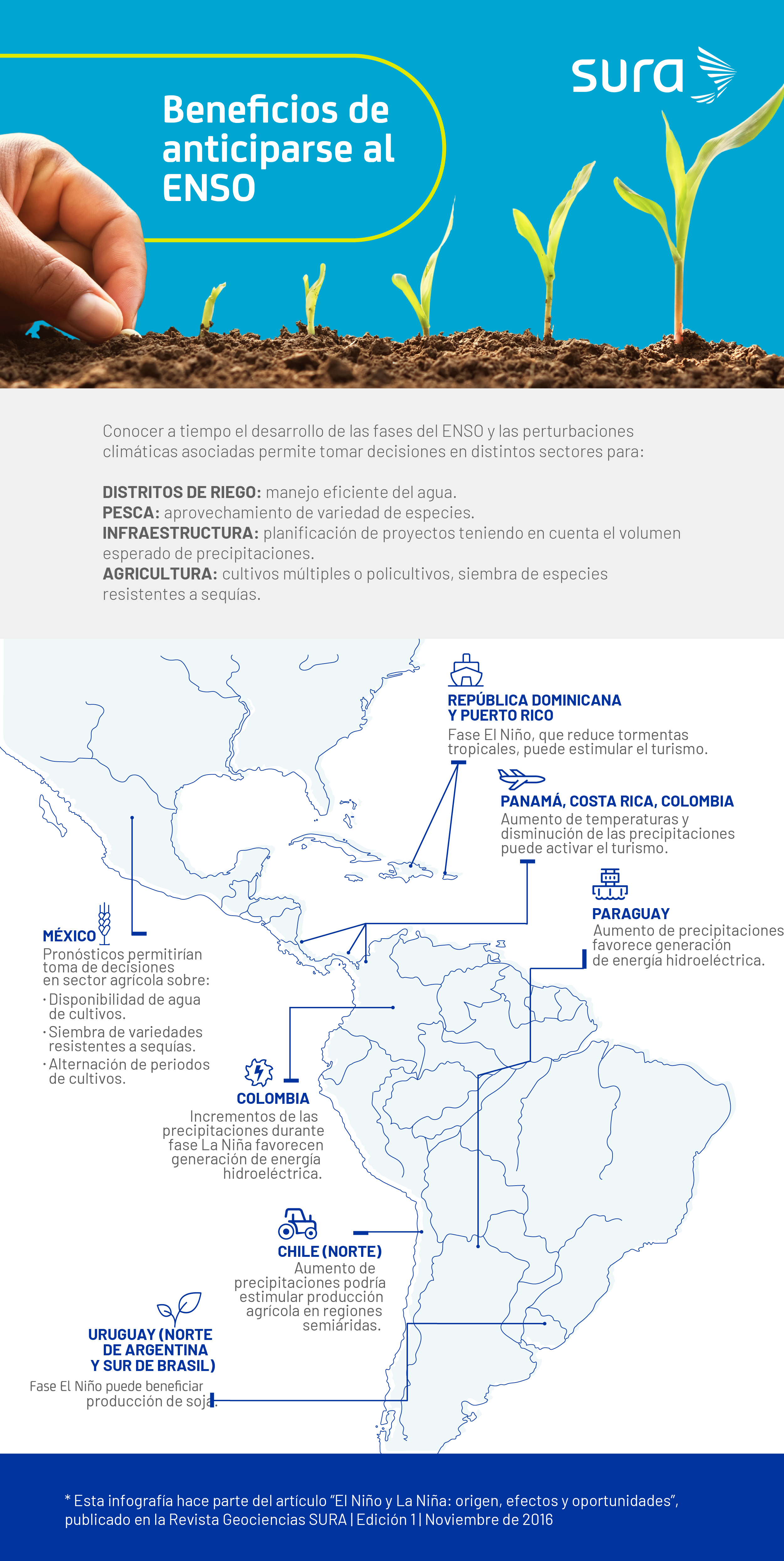
According to Ph.D. Poveda, all productive sectors can be positively or negatively impacted by this phenomenon; for example, the agricultural, fishing, energy, tourism and health sectors, among others.
For this reason, it is very important to know in real time the status of the climatic variables that define El Niño or La Niña, to mitigate their negative effects through urban planning and implementation of protection measures, and to enhance the positive effects on business opportunities and economic development.
Smart hydroclimatic decisions
Oceanographer Martínez stresses that it is vital to assimilate the concept of climate-smart development. “This means that hydroclimatic information must be another input for the decision tree of national and local governments, as well as for business leaders who want to maintain their competitiveness in the market and have sustainable economic activities. Of course, this means staying informed to make decisions in time.".
The goal is to find solutions that allow for timely decision-making, because Latin America must move towards strategic planning, “otherwise we will be improvising all the time and, from a productive point of view, this would imply losses and little resilience in economic activity,” he explains.
Managing risk and opportunities, a challenge
According to oceanographer Martínez, it is necessary to acquire knowledge about forecasting, mitigation and preparation for these types of events. “We have the challenge of preparing ourselves adequately for the effects of ENSO, that is the concept of risk management, especially when we are so vulnerable.” His logic is simple: “If we take into account this precautionary principle, we will be prepared in case the phenomenon occurs or not, and we will have a territory ready to face its consequences.”
The different productive sectors must try to take early actions to mitigate the negative impacts that any of the ENSO phases can generate. However, these measures should not be limited to managing the risk of direct material damage, but should also consider the risk of supply chains (which include suppliers, infrastructure, logistics and customers, among others) to make preventive decisions and guarantee the sustainability of businesses.
An interesting point in the discussion is that Not all ENSO impacts are negative, as is the case of El Niño for the Caribbean tourism industry., due to the decrease in hurricanes, which invites us to reflect on how these conditions can be taken advantage of “and not only anticipate possible losses, but also benefit from predicting the phenomenon,” as mentioned by Ph.D. Germán Poveda.
Therefore, it is possible to make intelligent decisions regarding the way in which businesses are managed, by having the possibility of knowing in time the climatic disturbances associated with each phase of ENSO.
Fonts
- Rodney Guillermo Martinez Güingla. Oceanographer, international director of the International Center for Research on the El Niño Phenomenon (CIIFEN), retired officer of the Ecuadorian Navy.
- German Poveda Jaramillo. Ph.D. in Water Resources Engineering from the National University of Colombia and the University of Colorado. Professor at the Faculty of Mines of the National University of Colombia.