

SURA created the Trend and Risk Management (TRM) model as a way of managing for sustainable competitiveness. The proposal puts the client at the center of the strategy, and provides them with a reading of the environment that allows them to anticipate their actions and manage uncertainty.
* This article was published in Geociencias SURA Journal | Issue 1 | November 2016.
Kodak, Blockbuster and Remington did not go out of business because of smuggling, competition or a natural phenomenon. It was the inability to anticipate a trend, to react and adapt, which led them to an irreversible point.
In a global scenario, it is not enough to be covered against fires, earthquakes or any other operational or market risk. Today, organizations must protect themselves from those risks and trends that are not obvious. or easy to foresee, but which in the short, medium or long term can become strategic and threaten the competitiveness and sustainability of companies.
Insurance market penetration in Latin America is 3,1% of the Gross Domestic Product, while in the world it is 6%, which shows that the insurance business still has room to grow. To achieve this, it is necessary to offer added value.
This is how SURA understood it and for two years it has been working on exploring alternatives that do not limit themselves to offering insurance solutions, but rather manage risk in multiple dimensions. A response to the speed at which the world is moving and the need to adapt.
“We want to go beyond being solution providers to become strategic allies.”
Nicolás Bedoya, Risk Management Manager at SURA-Colombia.
How to move from risk to opportunity?
Given this context, in mid-2014, SURA's Risk and Trend Management (GTR) was created, a model that goes beyond what the insurance industry traditionally proposes and establishes connections between trends and the strategic risks of a company.
For Gonzalo Pérez, CEO of Suramericana, GTR, more than a product, It constitutes a management model that adds value to the client by generating awareness through the management of uncertainty.
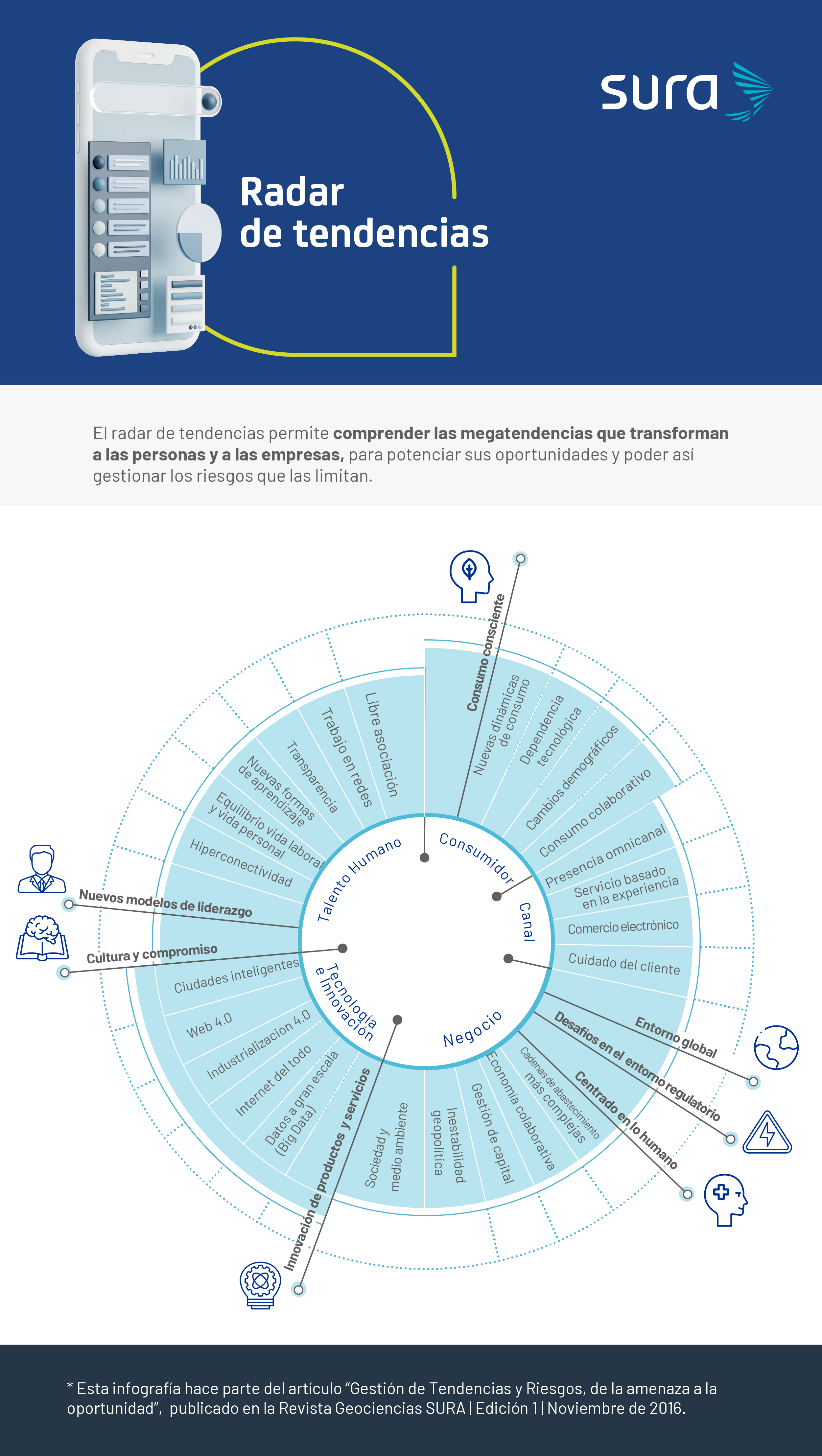
Additionally, the model provides information on how the world is moving, establishes priorities and connections between trends and risks. Thus, it becomes a valuable tool for decision-making focused on competitiveness and organizational sustainability.
“Risk is not only a problem for organizations, it can also be an opportunity if it is properly addressed,” says Juana Llano, Vice President of Insurance at Suramericana, to explain how the GTR model gives a new meaning to the insurance business by incorporating the possibility of managing all types of trends and risks and putting the client at the center of the strategy.
What is the GTR model?
In the current environment, companies operate in two ways: wait for the market to show them the way and perhaps disappear, or stop, rethink the business and develop opportunities. This is what GTR is aiming for.
The model is applied as a team with companies, and the most relevant thing is that it involves senior management, because when we talk about Trend and Risk Management we are talking about the strategy to guarantee not only competitiveness, but also permanence over time.
The process starts with a series of workshops in which the environment in which a company operates is analyzed. and, based on its strategic objectives, trends and risks are identified, and their interrelations are reviewed.
With the information obtained, a matrix of trends and risks is built., a map that shows the degree of exposure and the great opportunities for organizations, so that it can be established how to manage these trends and risks, whether they are transferred, retained or what strategic options can be developed.
In analyses of the interrelations of natural risks with supply chains and production systems, for example, quantifications have been achieved in monetary terms, which allows managers to identify key points to make adjustments in logistical and production aspects.
With this information, the company can:
- Mitigate the effects on business results of a possible suspension of operations.
- Direct efforts and investments to ensure sustainability and competitiveness.
- Identify deficiencies or inefficiencies in the supply chain.
- Transform unfavorable situations into business opportunities and resilience generation.
The results and benefits will be different, depending on the type of organization, the sector to which it belongs, and the interrelations that you are interested in analyzing. The important thing is that This model is already available and is an invaluable tool for anticipating anything that may affect an organization. or even to detect opportunities that guarantee their permanence and optimize their results in the market.
Fonts
- Gonzalo Alberto Perez Rojas. Lawyer from the University of Medellín, Insurance specialist at Swiss Re in Zurich, CEO's Management Program at the Kellogg Graduate School of Management in Chicago.
- Juana Francisca Llano Cadavid. Lawyer, specialist in Financial and Business Law, Civil Liability Law and Insurance, from the Universidad Pontificia Bolivariana, and Reinsurance specialist, from the Universidad Pontificia de Salamanca.
- Nicolas Bedoya Zapata. Mechanical Engineer from Eafit University, M.Sc. in Administration from the Monterrey Institute of Technology.