


A connected world not only brings great benefits. It can also cause a series of 'secondary' effects that affect, above all, culture. Find out more details.
Connectivity is making us live in an absolutely new and unprecedented time. According to the SURA Insurance Trends Observatory, this is a time characterized by hyperconnection and, with it, the exponential speed of advances in science, technology, international mobility, cultural and economic globalization. A time in which borders are increasingly permeable and, therefore, relative. All these changes are undeniable, inevitable and classifiable.
Among the positive aspects of this process of globalization are the progress and ease of communications, and the extension of human rights. While, in the On the negative side, we see cultural uniformity and economic inequality.Some of the risks that are seen in the near future of this new era are the disappearance of languages, transculturation, and - as we have already witnessed - global epidemics/pandemics.
In theory, globalization could facilitate the expansion of languages since, through technological advances, their learning could be made easier. However, in practice, it has proven to be a disadvantage for many languages that are now at risk of extinction.
Studies by UNESCO's team specializing in the preservation of the world's languages determined that more than 7,000 languages are spoken worldwide, of which approximately 6,700 are indigenous languages, and 40% of them are disappearing. In the last 70 years alone, more than 230 languages have disappeared.
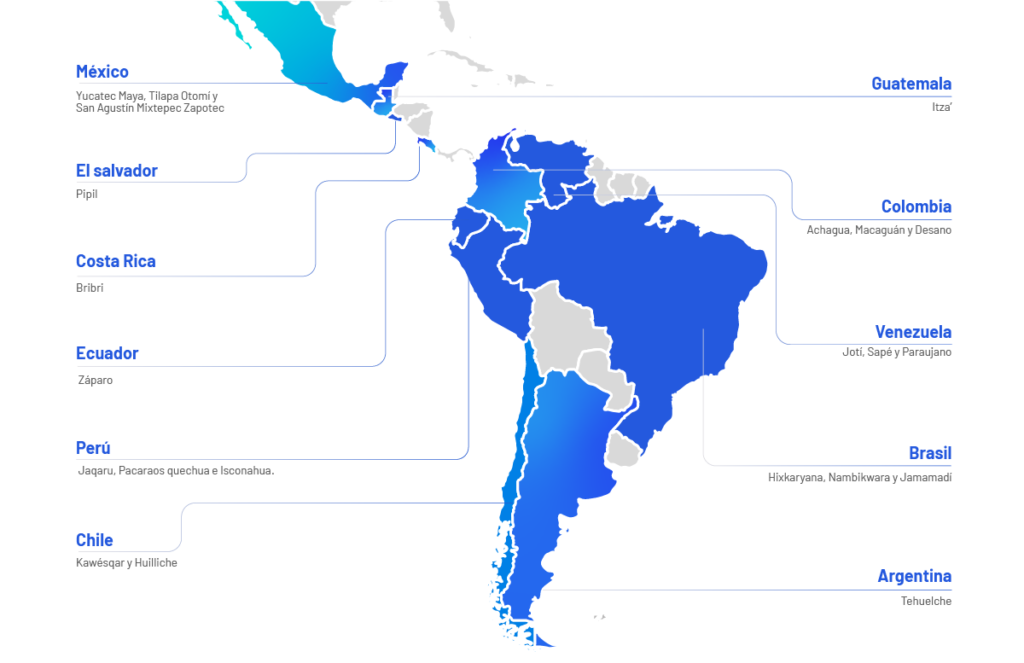
These are, according to researchers, some of the native languages at risk of extinction in Latin America:
- Argentina: Tehuelche.
- Brazil: Hixkaryana, Nambikwara and Jamamadi.
- Chile: Kawésqar and Huilliche.
- Colombia: Achagua, Macaguan and Desano.
- Costa Rica: Bribri.
- Ecuador: Zaparo.
- El Salvador: Pipil.
- Guatemala: Itza'.
- Mexico: Yucatec Maya, Tilapa Otomí and San Agustín Mixtepec Zapotec.
- Peru: Jaqaru, Quechua Pacaraos and Isconahua.
- Venezuela: Jotí, Sapé and Paraujano.
As the prestigious Italian semiologist Umberto Eco stated: “The great danger of globalization is that it pushes us towards a common megalanguage.” There is pressure on indigenous communities to integrate into the dominant culture. Speakers of these minority languages are increasingly abandoning them in favour of more widely used and therefore more useful languages, such as English, Spanish and Chinese.
Transculturation, another danger
On the other hand, another risk that the era of hyperconnection poses is the transculturation. This phenomenon refers to the mutual influence that is generated between various cultures when they are in continuous contact, and the danger that one will impose itself and absorb the others.
With globalization, the cultures of the countries that dominate the hegemonic Western capitalist system are those that expand most rapidly over those of countries that are comparatively vulnerable.
In an increasingly grotesque way, we see how cultures are becoming more and more unified and monotonous, guided by a set of hegemonic values of the countries that dominate the geopolitical, economic and social world.
According to experts from Make Sure to Live, “Global connection through the media and social networks contributes significantly to the deepening of the phenomenon”, and “the consequences are the loss of identity and roots, which lead to a lack of commitment and confidence of people in the affairs of their native territories and their country, hindering in this way both national cooperation, as well as the global cooperation required to face the challenges common to the entire planet.”
A risk that is perhaps more palpable, having experienced it first-hand over the past two years, is the arrival of global pandemics. The coronavirus pandemic is the phenomenon of the era of globalization par excellence. This represents a world hyperconnected with the good, but also with the bad.
The report on 'Megatrends' by Seguros Sura explains that “The high connectivity and mobility of people allowed the rapid expansion of infections among all countriesIt is important to mention that this risk has its positive side, because it is thanks to globalization that an active interaction between multiple governments and international organizations is taking place, thus enabling the creation of global cooperation strategies to deal with disasters of this magnitude.
Many believe that the coronavirus pandemic was the first of many, and fear the possibility – and likelihood – that future viruses will be more lethal than this one, putting governments and entire populations in jeopardy. As expert observers at Make Sure You Live mention, “The consequences of a prolonged pandemic, with high severity and mortality, could have consequences for demographics, as was the case with previous pandemics such as the 1918 flu or, more remotely, as happened with the Black Death in Europe during the Middle Ages.".
In short, we are going through a point in history from which there is no turning back. A process of global convergence that encompasses technological, economic, social, cultural and political factors, among others. A process that, as well as involving shortcuts and opportunities, also involves risks and disadvantages that must be addressed before it is too late. The theoretical and practical challenge of modern societies is how to formulate strategies to address these threats.