


Remote work. Remote work. Telecommuting. Home office. Terms that began to be used and concepts that were applied from the pandemic and confinement established by different governments. Many companies were forced to embrace a change that, prior to Covid-19, they did not even have on their agenda.
This shake-up in lifestyle led many people to rethink how they lived and what they wanted for their lives. A clear example is the United States and a phenomenon called the big resignation, that is, a massive wave of people who quit their jobs. According to Forbes, in August 2021Near 4,3 million people left their jobs. What still confuses analysts of this trend is where they go or what they do after they resign. Of these Americans, 40% were in the food, hotel, tourism and health sectors.
Benefits of telecommuting
The first edition of 2022 of the Randstad Workmonitor report reveals the expectations, moods and behavior of workers in 34 countries. In this regard, it shows that the 25% of Argentine workers would rather be unemployed than feel unhappy in a job, compared to 33% of workers globally.
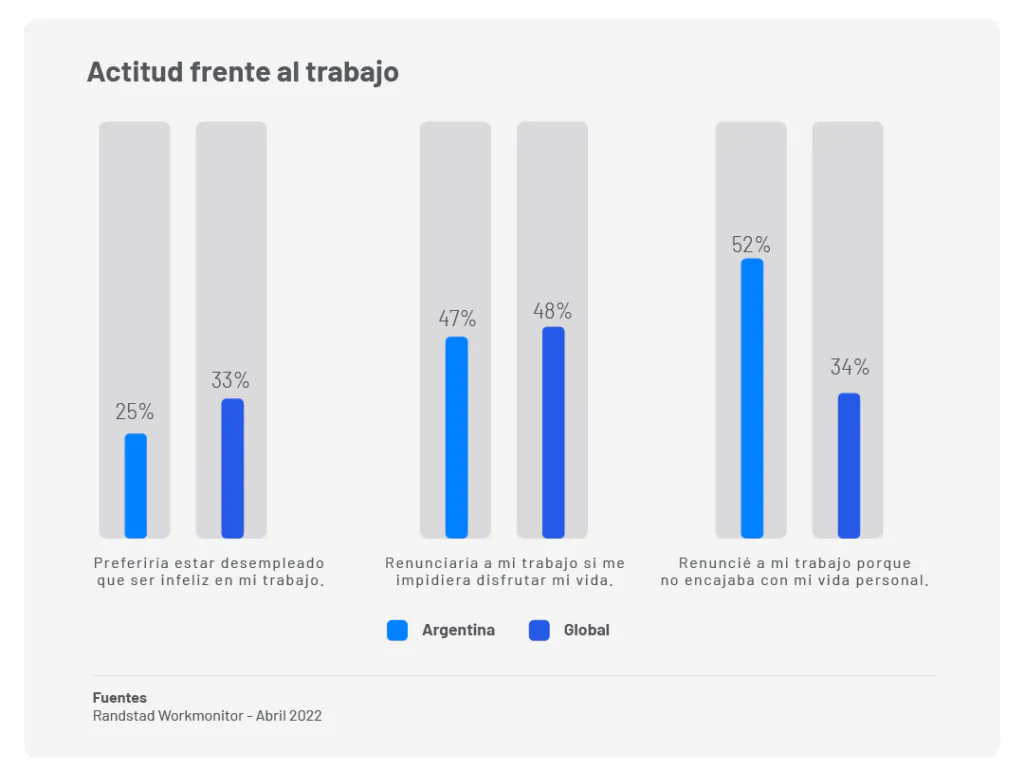
Other data indicate that the 82% of Argentine workers consider flexibility to be very important in terms of work schedules and 71% consider it very important to arrange it for the location of the workplace, this includes the possibility of working from home or remotely.
In the case of Brazil, 55% of employeess would quit their job to enjoy life. Globally, this figure drops to 48%. 41% left their job because it did not fit in with their personal life, because they feel that is more important than work (51%), while for a 90% flexibility In terms of working hours it is important.
For its part in Chile, 50% left their jobs because it did not fit in with their personal life while 63% value their personal life over their professional life. As for the Flexibility 83% prioritize this point and 80% value the fact that they have flexibility depending on the location of the place.
Regarding these results, Andrea Ávila, CEO of Randstad for Argentina and Uruguay, stated: “The data provided by the Workmonitor show the pivotal moment in which we currently find ourselves, driven by the change in priorities and expectations in relation to work and career that it generated the impact of the pandemic on people, and especially on Millennials (born between 1982 and 1995, estimated) and Centennials (born between 1996 and 2012).
Viviana Díaz, Director of the Diploma in Union Negotiation, Business School of the Catholic University of Argentina (UCA) explains Make sure you live the profiles of these groups. “The Millennials They need technological support and change. They want to grow quickly, they live in the moment and value the intellectual and emotional.” And he sums up that “for them, innovative spaces are motivating, that is why Virtuality is the key to retaining their talents, but always combined with emotional management".
Diaz, differentiates them from the Generation Z or Centennials. “They are the first generation digital native. They are people with a more global mindset, accustomed to the simplification of tasks and almost unlimited access to information. In terms of work, they seek 100% teleworking, because they need a dynamic environment that allows them to manage their time and do what they like best: multitasking. It is not easy for them to adapt, because they prefer to break the mold, act freely and prioritize their autonomy, which is why virtuality is their faithful companion".
Another survey of Deel with the consultant momentary more than 700 workers – aged 25 to 34 – remote in 86 countries, between February and March 2022. Some of the results were that More than half (59%) of workers hired through Deel say that remote work allowed them to access a pay rise, while 53% say that it gave them the opportunity to access a more flexible work modality and 51% that remote work allowed them to increase productivity.
This type of work and its flexibility made 64% of respondents increase their savings because they have less expenses on transportation and food, among others. And also 83% of mothers, and 73% of fathers with minor children stated that the “home office” and Their flexibility helps with parenting and at the same time fulfill their work responsibilities.
Teleworking regulation in Latin America
Although each country has its own particularities, the laws establish regulations on working hours and the duties and obligations of companies towards their employees. Below is a brief detail of the legal regulations and their application in different places in Latin America.
- Argentina: “Law 27.555, which regulates the legal regime of the teleworking contract, introduces changes such as, for example, the task of care and the right to digital disconnection. Regarding the latter, it is part of the humanization of technology, of how we take care of our nervous system and how we prevent burnout syndrome, digital burnout (Bo.D), through the GNT methodology.“explains Diaz.
- Brazil: In her article Pandemic and teleworking in Brazil, Lawyer Giselle Gonzalez Gonçalves mentions that: “in Brazil the percentage of home-based workers jumped from 3,8 million people in 2018 to 7,9 million in April 2021 (IBGE, 2021). In 2011, with the arrival of Law 12.551, remote work was equated to face-to-face work by modifying article 6 of the CLT (Consolidation of Labour Laws). In 2017, the Labour Reform introduced the concept of teleworking, adding to article 75 of the CLT letters A, B, C, D and E, in chapter II – A, “TELEWORKING”.
- Chile: At present the teleworking It is regulated. The Chilean Chamber of Deputies approved the bill in November 2018, but it was not until the pandemic that it was discussed again in October 2019. The 24 March 2020, the project for the regulation of teleworking was enacted.
- Colombia: government signed on April 11, 2022 el Decree 555 regulating the Law of Entrepreneurship and Remote Work. Teleworking is regulated by the Law 1221 of 2008 where the National Network for the Promotion of Teleworking is created and by decree 884 of 2012 that regulates it.
- El Salvador: On March 20, 2020, by Legislative Decree No. 600, the Teleworking Regulation Law was approved According to the work of Researcher Maria Jose Erazo, Teleworking in El Salvador. Feasibility and challenges in the face of the Covid-19 pandemic, “The most important thing about this law is that it established rules for proper communication between employers and workers, and a series of basic guidelines to protect the worker against abusive practices by the employer, in the event that both parties voluntarily agree to carry out the work under this modality.”
- Mexico: In 2020, the reform to article 311 was carried out and the addition to Chapter XII BIS of the Federal Labor Law (LFT). Among the points it establishes It is considered that employers must provide work equipment and assume part of the internet, telephone and electricity services. And although the economy has been reactivated in this country, there has also been an increase in informality.
- Panama: Six regulations on teleworking, four executive decrees and two laws were approved. The following stand out: Law 126, of 2020 and an article of the Labor Code is modified. “The law provides for the Creation of a National Teleworking Network that includes private companies, universities, the public sector and social organizations to promote cooperation and the exchange of learning, research and good practices where we can actively participate from the academy and the Think Tanks at a national level," he explains. Jessica Hidalgo.
- Uruguay. The Teleworking Law is promulgated in August 2021 Law No. 19.978. The objective is to regulate in a general manner this teleworking benefit for all employees dependent on the private sector or non-state public law.
To conclude, Ávila recognizes that "we are facing a moment of change in mindset, expectations and priorities on the part of people and that demands from the organizations greater flexibility and a new approach to be able to adapt quickly to attract and retain talent and remain relevant in terms of employer branding.”
Changes are in sight and some, more than others, have the ability to adapt and live according to their principles. Therefore, to take risks and feel protected, SURA has different insurance policies, such as business, education, life and pension. Life is today.