


According to a World Bank study, Two out of five workers in Latin America are unbanked. Virtual wallets are becoming the answer to this situation and are increasingly being used by people and companies.
Latin America is undergoing a process of financial digitalization. The coronavirus pandemic accelerated this phenomenon and it is expected that by the end of the decade, a large part of the region will adopt virtual solutions as the main method for transacting money.
In this context, the digital wallets They are positioned as one of the most prominent tools. “There are two issues to consider because they are different contexts. The first is that most of the digital wallets that are coming out now are from the banking industry itself to add digitalization to their products,” he explains. Freddy León, director of digital development research at SURA Seguros Latin America.
On the other hand, the expert mentions the virtual wallets of financial startups that are 100% digital for unbanked users. “This brought challenges in regulatory matters. Many people avoid banking because they want to keep their business in cash or to save the costs it has, much less declare income or taxes,” León points out. And he adds: “But inevitably, with Covid many people turned to digital to pay this way.”
Digital wallets in Latin America
According to the World Bank, Two out of five workers in Latin America still do not have a bank account to make their transactionsThe agency also notes that 42% of adults in Latin America use digital payments in stores, and 11% recently adopted this type of payment in the context of COVID-19.
“All Latin American countries have digital payment solutions, but the leaders are Brazil, Argentina, Mexico and Colombia. Chile and Peru must also be included,” says León.
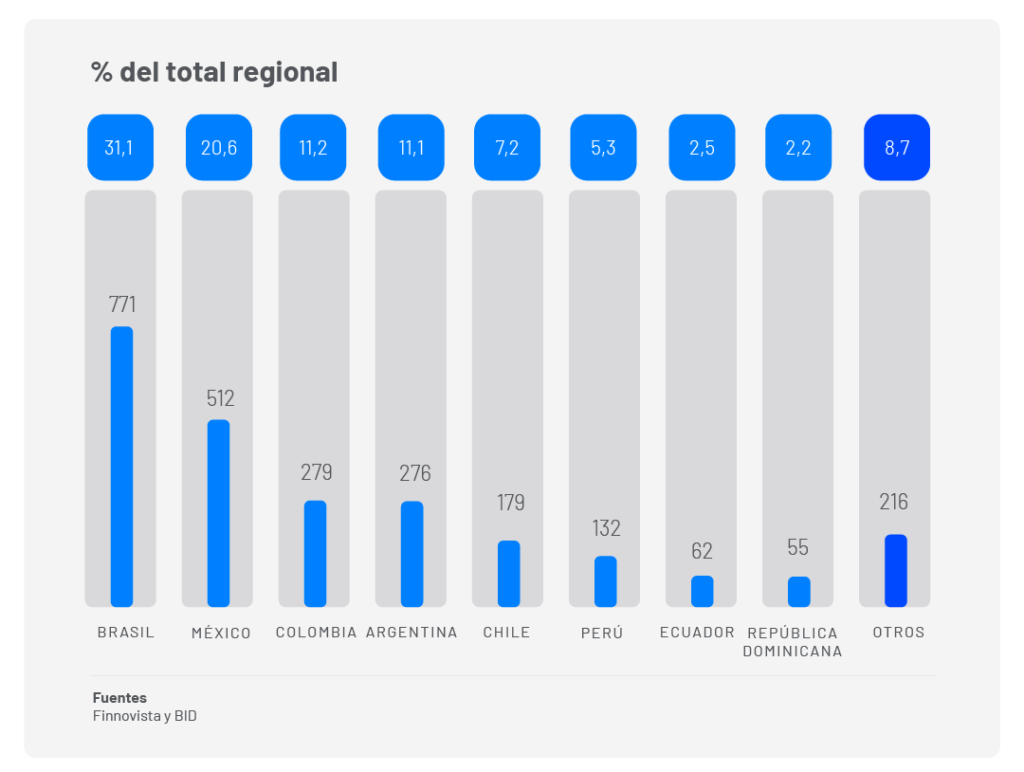
Latin American countries with the most fintechs.
In this line, the study The Global Payments Report 2021, prepared by FIS Worldpay, highlights that in 2021 digital wallets experienced the greatest growth among e-commerce payments in Latin America. “They grew by 43,5%, going from 13,8% in 2019 to 19,8% in 2020. Together with debit cards, they are the only e-commerce payment methods for which growth is forecast until the end of 2024,” they say.
An Infobip, a telecommunications and information technology company, complements this information with data by country. “Argentina is on the podium of the ranking with 52.5% adoption. Then comes Mexico with 38.2%, Peru with 37.8%, Colombia with 37% and finally Brazil with 33.3%,” they say.
Who uses virtual wallets and why
Intuition leads one to think that young people are the ones who use digital wallets the most. However, Leon explains that this is not true. “There is no complete demographic. Sometimes it is very segmented into millennials and centennials to see who uses one technology more than another, but with digital wallets, all generations got involved in these issues.”
To exemplify this situation, the director of digital development research at SURA Insurance Latin America He mentions use cases. “There are mothers, fathers and grandparents who receive money from children who help them. There are also senior entrepreneurs who have a business and enable payment through social media with digital wallets,” he points out. He adds: “In addition, there is a new trend of freelancers, from professionals to delivery platform couriers, who work with virtual wallets for the ease of payment without having to use banking.”
However, a study carried out by the firm Transity highlights some population sectors with greater use of virtual wallets. “Argentina and Brazil had the fastest growth rates, especially among young people, women and middle and lower strata, usually the most excluded,” he details. Mariela Mociusky, CEO of Trendsity.
As for the advantages of this type of digital payment solution, first of all, there is the possibility of accessing a financial system without being banked. However, there is another benefit that León highlights.
“Users often highlight security. We are facing a huge problem related to identity theft. But it is much more difficult to access a virtual wallet because they are included in devices such as cell phones,” says the expert. And to finish, he adds: “In addition, many of these digital solutions have biometric confirmation, so the presence of the person is needed to make a payment. This has almost completely eradicated security problems.”
Taking advantage of digital wallets
For individuals, the main use of virtual wallets is the transaction of money without the need for the intervention of a banking institution.
“The pandemic somehow 'helped' the digital transformation and the adoption of all these issues. People who sell products and services had to choose to offer the possibility of paying with digital wallets because there was no cash. There was no possibility of going to a bank to withdraw money. Either they got on board with the digital transformation or they would lose their jobs. Today, after two years, people have adopted and gotten used to this issue, so the boom will be even greater,” León reflects.
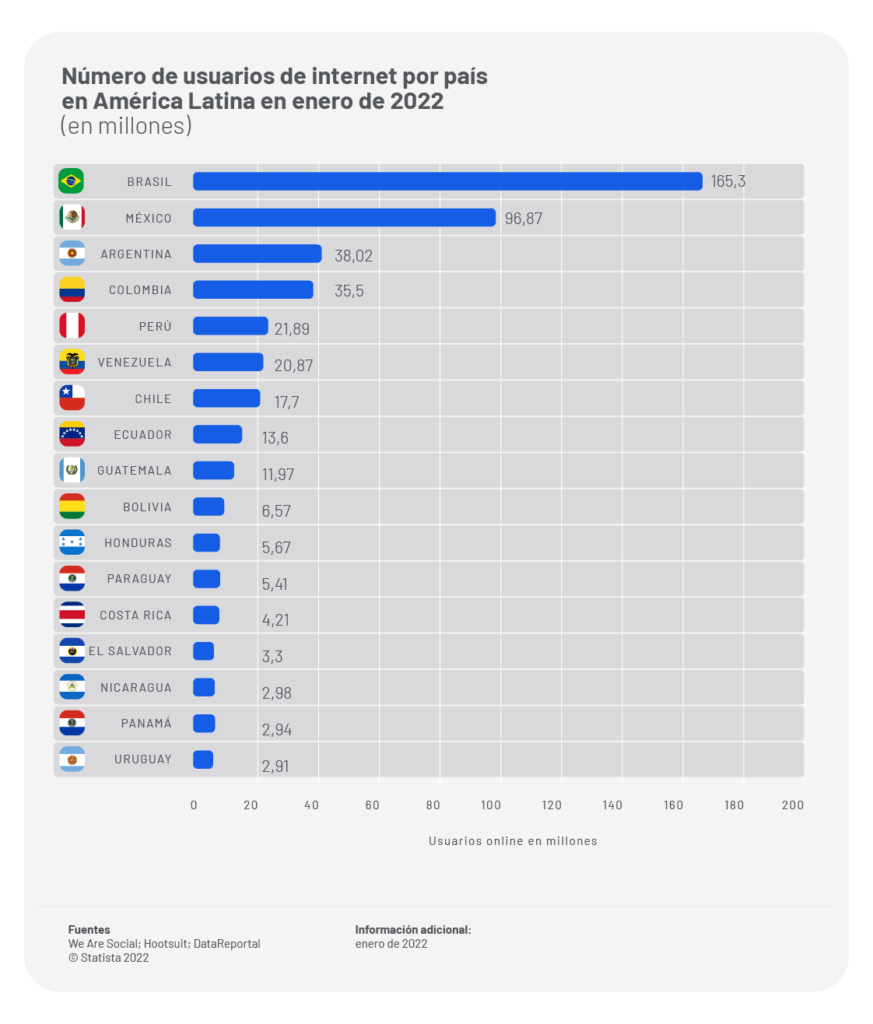
Number of internet users by country in Latin America in January 2022 (in millions)
Many companies have also adopted digital payment solutions during this time because these tools provide them with benefits. “They help companies to operate with each other quickly and safely, allowing money to be managed digitally and being able to trace it when necessary,” he says. Nicolás Velazco, FrontEnd Director at Snoop Consulting.
The company produced a document outlining some of the main advantages of digital wallets for the corporate sector. It highlights that a single person is able to manage the balances of all employees. In addition, this payment option streamlines daily tasks because, by not depending on physical money, manual processes involving paperwork are left behind.
“Added to this is the possibility of receiving and sending transfers to clients and suppliers immediately, free of charge and unlimitedly,” the report states. “In turn, the digital wallets that companies use can be part of their own existing applications. In this way, the client would feel more inclined to use it and the company could collect valuable information from them. The idea is that it is not just a digital wallet, but another benefit of the company’s application,” it continues.
Banks also join in
Another point to keep in mind is that virtual wallets are not only driven by fintech startupsBanks also launched their own electronic wallets with the aim of attracting people outside of these institutions.
According to BIDLatin America is made up of 33 countries, has a population of more than 650 million and more than 56% is outside the traditional financial system. Therefore, there is a large number of potential users that banks want to add.
“The use of electronic wallets also expanded due to a strategy by banks to try to bank more people,” says León. “This process is accelerating more and more because there are more countries that have compatibility with virtual wallets, both Android on Google and Apple Pay on Apple. So, for these banks it turned out to be easier to make their products compatible with these platforms instead of creating a virtual wallet. And so customers can make their payments online,” concludes the expert from Seguros SURA.
At present, Digital wallets are used in Latin America as one of the main means of paymentThis trend will be even more noticeable in the coming years, and whether with insurance for mobile devices or other related tools, Seguros SURA seeks to give people a better user experience. Although security regarding this technology has improved, it is still necessary to take precautions to avoid problems and enjoy these virtual implementations on a daily basis.