

Trust in institutions allows democracy to function. Depending on the historical moment, the population believes or not. Which are some of the institutions that have lost the most credibility?
When we talk about believing in institutions, it is related to trust. Trust between institutions, people and citizenship. But also interpersonal trust. Dozens of studies show almost in unison one reality: institutions such as religion, political parties and even science are losing prestige among citizens. Although there are exceptions by country and age, among other aspects, this rupture is permeating regional culture.
“Trust is an emotional bond,” says Hugo Rabbia, a Conicet researcher at the Institute of Psychological Research (LIPSI) of the National University of Córdoba (UNC) and a professor at the Catholic University of Córdoba (UCC), Argentina. To which Carmen Le Foulon Morán, a doctor in Political Science and member of the Network of Political Scientists Not Without Women and researcher at the Center for Public Studies (CEP), warns that “trust in institutions is important for both its legitimacy, as well as for the functioning of democracy, for citizen participation".
The writer and journalist agrees with this idea Sergio Sinay“In a democratic system, institutions have the function of guaranteeing the fulfillment of what Hannah Arendt called the promise of politics. That is, the prioritization of the common good and mutual respect over personal or sectoral interests. There is no common good without justice, equity, health and education.”
The writer adds: “When institutions stop fulfilling their function, the system itself becomes unreliable and, feeling abandoned and betrayed, people trust whoever promises them, in a magical and immediate way, what the institutions no longer guarantee. Thus, populisms are established and maintained, with the belief in providential figures, with the belief in justice by one's own hand and with the belief that what matters is to save oneself and benefit oneself, even if it is at the expense of others. Societies then become violent, cannibalistic, indifferent to the needs of each individual and to civic duties.”
In recent decades, there has been a global phenomenon of lower levels of trust in institutions. Of course, each country or region has its own particularities.It has fluctuations with higher levels of trust than other times,” Rabbia says. He argues that, in the region, “if you think about institutions such as political parties, Congress or the Government, the levels of trust “Citizens’ trust depends on historical moments.” For example, he mentions the crisis of 2001 and 2002 in Argentina, which shattered the institutional confidence of Argentines, and in In the last four or five years, distrust has grown.".
Confidence is low
Among the institutions most affected in terms of trust are: political institutions. Le Foulon Morán mentions that “just as in countries of the Organization for Economic Cooperation and Development (OECD), on average, 51% trust the government (OECD, 2020), in Latin America it is lower, where on average, less than a third do so. (LAPOP, 2019).
She explains that “trust in government – which can be understood as citizens’ confidence that governments do what is right and fair – and their institutions affects the success of public policies that depend on how people act, that is, the degree to which people comply with the measures that governments seek to implement.”
Regarding distrust, Rabbia argues that “it may have to do with the fact that citizens do not feel represented by their politicians. They do not feel that political institutions are providing solutions to their daily problems; it has to do with the economy.”
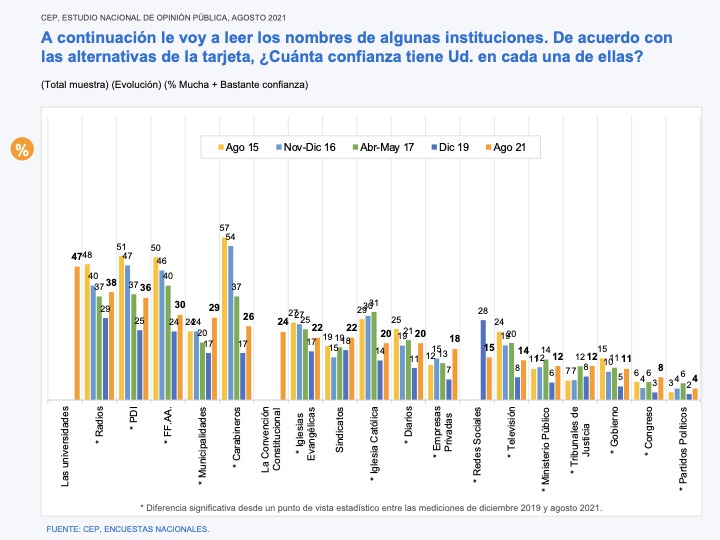
Le Foulon Morán analyzes in detail the case of Chile: “According to the CEP survey data, very low levels of trust in the Government and Congress have been observed for many years. Other institutions, such as the Carabineros and the Armed Forces, which historically had higher levels of trust (between 40 and 50%), fell since 2017 and, like many other institutions, experienced an abrupt drop for the social outbreak of October 2019. Although their trust rose in the last CEP survey of 2021, they are at lower levels than before the outbreak.
Church and science
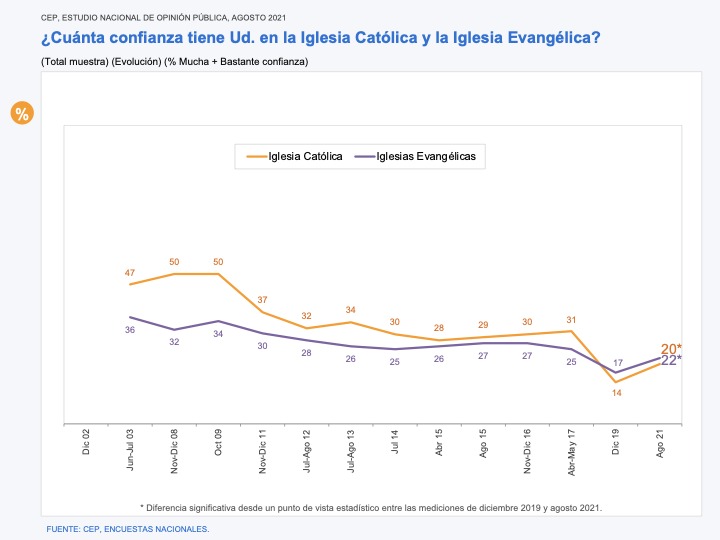
Just as distrust towards the government and political institutions has grown in Latin America, Hugo Rabbia highlights that the trust in the church has also decreased, compared to other institutions. “There has been an increase in those who express little or no confidence in the Catholic Church.”
According to Latinbarometer non-profit organization, Chile is the country in the region that has suffered the most changes in its religious beliefs in the last 10 years. Confidence in the Church in this country fell from 72% in 1995 to 31% in 2020, a drop of 41 percentage points. While today it is one of the most agnostic countries in the region (35%) and Catholicism decreased by 23 percentage points in the same period.
Just as there is greater distrust in the Church, Rabbia also referred to the distrust of science. Especially in the context of the pandemic. “The political polarization of citizens in various countries such as Brazil, Chile, the United States and Argentina affects the bonds of trust. It is much more likely that higher levels of distrust will be expressed in institutions that are being managed by someone who does not share my political ideology or who has completely different political attitudes than mine, than vice versa.”
“This rift has also been encouraged, for example, by Jair Bolsonaro in Brazil with his followers, in the distrust that they may have represented in science and scientific and medical discourses in the management of the pandemic,” he adds.
In conclusion, researcher and professor Hugo Rabbia is hopeful: “It is not good for any society to experience major crises of institutional confidence. Otherwise they become societies with high levels of anomie, difficulties in imposing collective agreements and consensus. But it has positive aspects, such as the search for more flexible links, more comfortable ways to develop the different expectations of what each person desires and wants.”
The view of Latin American artists
“Generally, in the history of Latin America, the representation of the institution has always been something that does not accompany, but rather subjugates,” they say from Agroart“There is no way to trust the State because of the level of impunity that can exist, for example, with vaccines; there is no one to regulate that. On the other hand, in the specific case of Colombia, there is the issue of migration, for which there is no clear policy, just as there is with the housing problem, and that is very painful.”
In conversation with Make Sure You Live, the artist 'Aka' He notes that “there are no structural changes to the deep problems”. For the Agroarte representative, art has been an important part of the processes of encounter in this climate of mistrust that Latin America is experiencing”.
“What has brought people together is not the institutions, it is art; art in the neighbourhoods, art made with the people, action, the story that is collected through paintings and music. That is what has brought people together,” concludes the artist.