

Resilience capacity is a great challenge for global seismic engineering. The learned two earthquakes of September 7 and September 19 of 2017 in Mexico showed very positive elements aimed at achieving this great goal.
* This article was published in Geociências SURA Magazine | Edition 3 | March 2018.
Each earthquake brings with it learning to achieve this great objective. There are many global efforts, such as the case of Marco Sendai (2015-2030), committed to disaster risk reduction to achieve societal resilience and response to the urban planning megatrend.
Its main focus is on the design, construction and recovery, rehabilitation and reconstruction processes after earthquakes, considering the expected seismic performance of the structures., in such a way that life, property, business sustainability, governmental and social stability in two countries are protected.
The effects of two earthquakes will allow us to develop technologies to care for them, some of them aimed at saving lives and uniting society in the recovery process of affected areas and people.
However, this attention must also be oriented so that the results of the processes of reconstruction, rehabilitation and reinforcement and repair of buildings after the earthquake become an opportunity to achieve more resilient cities. It requires ethical values, well-structured regulatory mechanisms, professionals with knowledge, experience and conviction of society.
A path traveled in Mexico since 1985
The earthquake of September 19, 1985 represents a framework, not only in the seismic history of Mexico, but also in the development of seismic engineering. The lessons learned from this large earthquake are of fundamental relevance for Mexico and the world, because they will indisputably show the preponderant role of seismic response in the profiles of only the ground movements and their effects on the performance of buildings.
A huge amount of studies and investigations were carried out based on a large earthquake and, as of today and last week, The conviction of the fundamental role of characterization of only two seismic design codes has grown.
The earthquake of September 19, 2017 confirmed the discoveries of September 19, 1985 and showed the validity and relevance of the demarcation of responses in Mexico City, established in its seismic regulations.
In the 19S 2017 earthquake, the collapsed buildings were predominantly concentrated in solid clay deposits 25 to 40 m thick, which have fundamental vibration periods between 1.0 and 1.5 and are predominantly classified in zone IIIa alone and in a very minor proportion. in zone IIIb.
The variations between the location and the height of the buildings where the collapses and major damage will be concentrated in the earthquakes of September 19, 1985 and 2017 are due to the differences in the frequency content and the distance between the source of the earthquake and the local two events.
The earthquake of September 19, 1985 occurred at about 400 km from the City of Mexico, while the earthquake of September 19, 2017 was at 120 km, which shows the great importance of considering possible seismic sources with incidence in that city, together with the types of only that we can intensify the seismic response in each case.
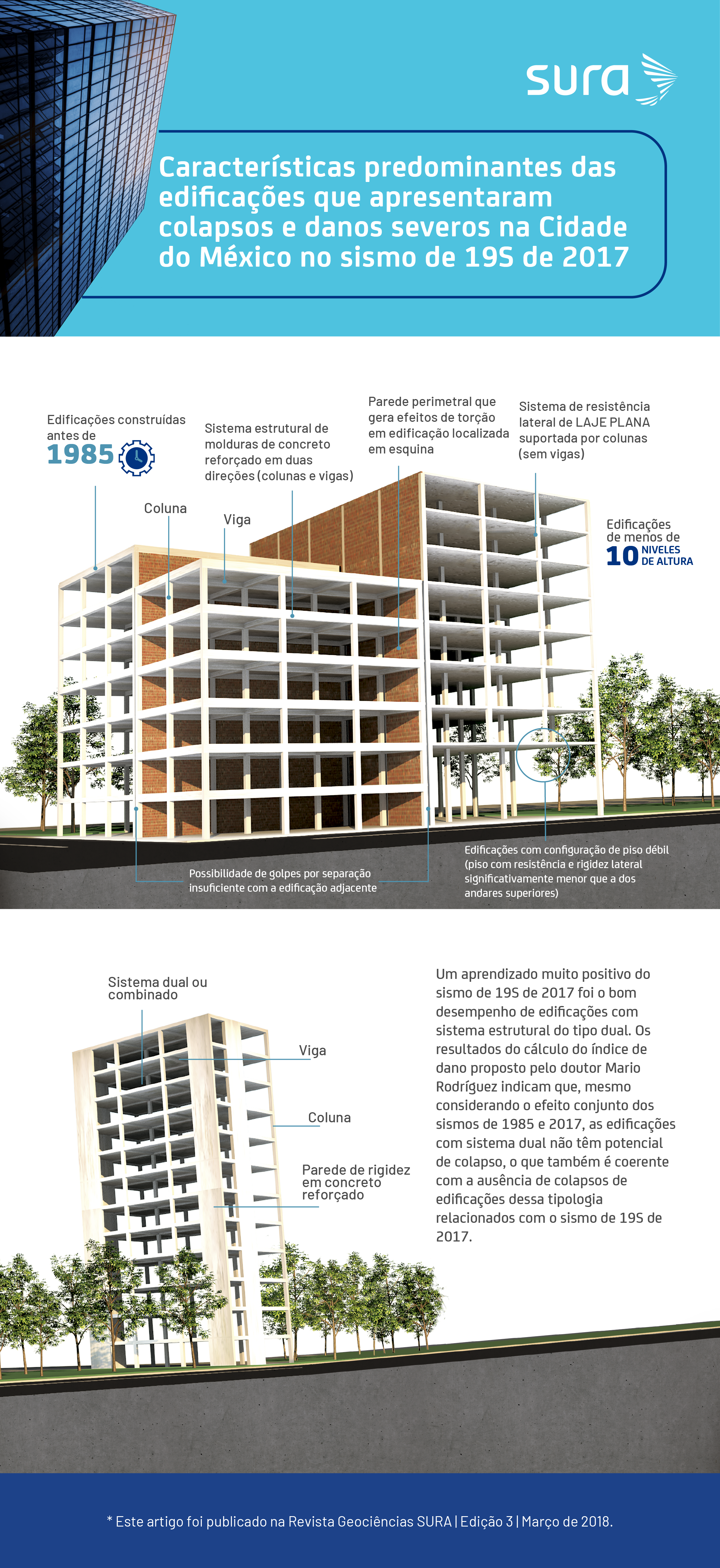
However, We cannot lose sight of the relevance of structural systems in the seismic behavior of buildings. The earthquakes of September 19, 1985 and 2017 showed important lessons learned about structures with severe damage and collapses concentrated in flat laying systems and reinforced concrete moldings (pre-enclosed with non-reinforced alvenaria).
All this information becomes essential in the repair decisions and reinforcement and construction projects of new buildings after the earthquakes of September 2017.
In a period of 12 days, during more than September 2017, Mexico was shaken by two strong earthquakes. First, with a magnitude of 8.1 Mw and a depth of 47 km, it occurred in the state of Chiapas, on September 7.
Preparation, generosity and knowledge
In response to the 7S earthquake of magnitude 8.1 Mw, the XXXVI Conselho Diretor do Colégio de Engenheiros Civis do México issued a call for volunteer engineers to travel to Oaxaca and Chiapas with the objective of assessing the damages and collaborating with the federal and local authorities.
The organization of Mexico in a group of brigades for the inspection of buildings in Mexico City is a great achievement that this Latin American country has achieved for the world. The brigade scheme shows not only the generosity of its members – a group of more than 600 volunteer engineers and civil engineering students – but also the usefulness of their efforts to guide the decisions of the State.
Within these brigades, the structural engineering committees play a decisive role, through their knowledge and experience to technically assess the level of building damage.
As the number of structural engineers is reduced in comparison to the total number of brigade members, this visual inspection plan of buildings implements a first rapid building assessment format that allows filtering the most critical cases to define the building plot that would require a second inspection visit with a more detailed form.
Seismic demarcation of the City of Mexico for earthquake design purposes – NTC 2004
Participation of the engineer Francisco García Álvarez, president of the Sociedade Mexicana de Engenharia Strutural (SMIE, in its Spanish acronym), as leader of 35 brigades, reflects the great commitment of the country's engineering to post-earthquake care. The participation of two groups of structural engineers was constituted with the leadership of the Colégio de Engenheiros Civis do México (CICM, in its Spanish acronym) with the commitment of SMIE and the universities, not which is highlighted in the case of UNAM.
It can always be improved, but The result is a powerful initiative that was possible thanks to the generous dedication of a group of people motivated by a common interest, which is the great challenge of strengthening, establishing models and criteria and achieving efficient and systematic support for structural engineers.
Secondly, with a magnitude of 7.1 Mw and a depth of 48 km, it was created on the border between Puebla and Morelos, on September 19. The date of the earthquake of September 19 is an enormous coincidence because it occurred precisely in the commemoration of two 32 years of the great earthquake of September 19, 1985.
Technology at the service of people
Information about the progress of the brigades in Mexico City is available to the general public from the earthquake occurrence on the site www.sismosmexico.org. Ainda, the Mexican Government launched a campaign on the site www.gob.mx/sismo/ to help identify structural damage in construction, or to define aid priorities.
Sasmex is a modern system, existing in few cities of the world and that has useful applications for systems distant from the city, as in the case of the 19S 1985 earthquake.
This system can also be enhanced for earthquake applications closer to the city, according to the network and its developed instruments. For the population of Mexico City, it becomes essential to improve the functioning of the SAS utilities each time to properly interpret the signals and follow the correct protocols.
Learned about the structural performance of buildings
The articles published by author Mario Rodríguez, researcher at the Autonomous University of Mexico (UNAM) and the John A. Blume Seismic Engineering Center, at Stanford University, show statistics from the 19S 2017 earthquake that allow identifying predominant characteristics of the buildings that collapsed and will present severe damages associated with that event.
Based on what we learned about the buildings that collapsed during the September 19, 2017 earthquake, The John A. Blume Seismic Engineering Center, Stanford University, highlights the importance of creating regulatory mechanisms for the seismic review and rehabilitation of buildings built before 1985. and located in the areas of the old lake of Mexico City.
The concentration of two collapses in buildings built before 1985 also shows a positive balance of the evolution of the Mexican seismic standard, which seeks to reflect the learning of the great earthquake of 1985 in its requirements.
Learners from the post-earthquake plan of SURA in Mexico
In the conviction to repair, reinforce and reconstruct to achieve buildings with better seismic performance for the future, in cases where possible, there is a commitment from SURA to seismic resilience in Latin America. The SURA action following the September 2017 earthquakes in Mexico confirms the relevance of this conviction.
The SURA post-earthquake assessment methodology was implemented in Mexico with several groups of structural engineers from Mexico, Chile and Colombia, in such a way that, from September 25 to December 21, 2017, SURA had permanent groups of about 23 specialists in structural engineering for the implementation of the inspection plan of more than 2.000 buildings in Mexico City and the states of Mexico, Morelos, Puebla, among others.
In the opinion of Gloria María Estrada Álvarez, manager of Geociências da Suramericana SA, “the great balance of the post-earthquake plan in Mexico was a very effective mechanism to support, from an engineering perspective, our insurance companies affected by these earthquakes.” No
country. We will be able to improve more and more, we have many logistical elements to improve, but the result was a group of more than 150 people, composed of teams from different areas of SURA México, by the Geociências team of Suramericana SA and by a group of professionals from structural engineering companies from Chile, Mexico and Colombia, prepared in the post-seismic methodology of SURA and all committed to a common cause: inspect and prepare building forms with some type of impact to diagnose and classify damage that guides the processes of repair, rehabilitation and reconstruction. In the stage of complementary studies for the group of buildings that require additional evaluations to define the most appropriate repair or rehabilitation techniques in each case, SURA relies on the support of a group of international structural engineering companies with vast experience in the field. -earthquake of a highly prestigious Mexican company in the structural engineering field. At SURA, we are convinced that private companies, especially the insurance sector, have a responsibility to contribute to society, creating mechanisms that prevent vulnerability from being repaired, rehabilitated or reconstructed.”
The collaborative schemes with SURA that could be implemented in Mexico are basically only the first initiatives with academia and with professional associations, such as the case of UNAM, SMIE and a group of structural engineering companies and structural engineers that support A fruitful future in the short and medium term to advance the development of knowledge and management of seismic risk in Mexico.
A plan to be worked on after the SURA earthquake is to achieve a better collaboration scheme with the efforts of the Government and other institutions of the country. For SURA, it is evident that, when a disaster of any kind occurs, it is a challenge for society as a whole, since public-private efforts should always be oriented towards the community.
Considerations on the regulations of earthquake-resistant construction in Mexico
The evolution of the seismic norm in Mexico reveals positive aspects of the seismic performance of buildings in the country, which we show the results of two trainees placed in practice since 1985. As expressed by doctor Mario Rodríguez, after the 1985 earthquake, The regulation by earthquake in the City of Mexico is related to the fact that this time did not exist, requiring more resistance and lateral rigidity in buildings, or that it is an additional factor to interpret the better behavior of buildings in the earthquake of September 19, 2017 in comparison with the which was observed in buildings in the earthquake of September 19, 1985.
The update of the seismic standard for Mexico City includes details of the estimated response only for the purposes of the seismic design of each site, for which designers access the Seismic Actions Design System (SASID), as explained by engineer Francisco García. Álvarez, current president of SMIE.
The provisions published in December 2017, which modify the Construction Regulations of the City of Mexico, include standards for the seismic rehabilitation of concrete buildings affected by the earthquake of September 19, 2017.
Taking into consideration the cases of buildings that suffered collapses or major damages in the earthquake of September 19, 2017 and that have not been presented, damages are not considered
earthquake of September 19, 1985, or doctor Mario Rodríguez suggests that, For a better interpretation of the vulnerability of structures, the effect of accumulated damage must be considered when the structures experience more than one strong earthquake during their useful life.
Dr. Rodríguez has been working for several years at UNAM in research into a damage index, as has been validated based on real data from the 19S 2017 earthquake, which shows a promising path to advance in complementary methodologies for the analysis of performance. expected seismic of buildings (Rodríguez, 2017).
The seismic behavior of non-structural elements and their interaction with the building structure constitutes a fundamental aspect for the seismic performance and functionality of buildings after these types of events. When evaluating two non-structural elements, it is necessary to consider not only the materials used in construction systems, but also the importance of integrating the architects into the equipment of the construction and rehabilitation projects of buildings.
Many specialists in structural engineering in Mexico – among those who stand out is Dr. Luis Esteva, professor Honorary UNAM – agrees that innovative structural solutions for seismic protection, such as isolation and seismic dissipation, can be very efficient in the seismic rehabilitation of essential structures and care for communities that have been affected by the earthquakes of September 2017, given to large importance of maintaining your operations after um earthquake.
The two earthquakes of 7S and 19S in Mexico should be considered in the updating of the standards and non-improvement of construction quality control mechanisms in different Latin American countries. Many countries in the region have similarities with Mexico in seismic conditions, structural typologies and construction practices. The great legacy of responsibility that earthquakes left us is to place our learners in practice with responsibility and conviction that seismic resilience is a challenge achievable for our societies.
Sources
- Francisco Garcia Alvarez. Civil engineer, master in engineering. President of the Mexican Society of Structural Engineering.
- Gloria Maria Estrada Alvarez. Civil Engineer, specialist in Environmental Engineering, specialist and master in Earthquake Engineering.
- Mario Rodriguez Rodriguez. Civil engineer, master and doctor in Structures, exclusively dedicated researcher of the UNAM Engineering Institute.