



Why can the implementation of seismic resistance technologies be a fundamental factor for competitiveness? Chile has already faced strong earthquakes, but demonstrated its leadership in this issue mainly during the earthquake of February 27, 2010. The traditional construction technique used by Chileans helped protect people's lives and the country's heritage.
* This article was published in Geociências SURA Magazine | Issue 1 | November 2016.
In the early hours of February 27, 2010, an earthquake with a magnitude of 8,8 Mw originated in the central area of the coast of Chile, causing damage to structural and non-structural elements in buildings in the cities of Concepción, Viña del Mar, Constitución , Talca and Santiago do Chile.
Although it has been considered the second largest earthquake in the history of Chile and the seventh in world history, most of the buildings have not suffered damage. This is a clear example of good seismic performance, and a sign that Earthquake-resistant engineering directly affects seismic risk mitigation and the competitiveness and sustainable development of a country.
A good tradition in construction: rigid structures
Chile is a country that is forced to face very strong earthquakes. After the Chillán earthquake in 1939 (magnitude of 7,8 Mw), we observed that the buildings foram constructed using the confined alvenary technique, that is, with clay beams, columns and tie beams of reinforced concrete, react better than they were built in alvenaria without confinement (without reinforced concrete beams and pillars), as Patricio Bonelli explains.
Later, when we started to build tall buildings, we started using reinforced concrete walls (reinforced concrete). This idea was transmitted to the next generations of engineers, who will learn about the need to design structures with walls, in order to guarantee greater lateral rigidity and, therefore, better seismic performance. Finally, In the 1970s, reinforced concrete walls assumed an important role in Chile.
This was fundamental because forty years later, in the 2010 earthquake, because, according to Bonelli's engineer, most of the buildings will function very well because, in addition to being quite rigid, they are built in hard soles with good characteristics, like the brita in Santiago . “These results are surprising, with little or no damage to the structures in a non-linear regime (low levels of deformation) and sometimes without cracks or damage,” he explains.
In a recent work carried out by engineer Patricio Bonelli together with engineer René Lagos and other professionals, an evaluation of a sample of more than 2.000 buildings in Chile was carried out, which shows relative deformations associated with the 2010 earthquake. The good performance of these buildings was the result of two strong foundations alone, at a distance from the slope where the earthquake originated and the high lateral rigidity of the two buildings.
One of the reasons that this natural phenomenon in Chilean years was to continue with its traditional structure of rigid wallsHowever, differently than two competing buildings or porticos, formed by beams and columns, these cause minor displacements and, consequently, minor damage.
Furthermore, for the engineer Bonelli, the separation of two reinforced concrete walls (reinforced concrete) is to determine the thickness and the amount of reinforcement necessary at the edges of the wall, in order to improve the seismic response of the building.
“If you walk through Concepción and Santiago you will never think that an earthquake like that in 2010 occurred.”
Patricio Bonelli. Researcher and professor at the Federico Santa María Technical University of Valparaíso, Chile.
What things do we learn from the earthquakes that occur in Chile?
Secondly, engineer Bonelli, the earthquakes in Chile, especially in 2010, list several details:
- We cannot trust our walls with such thickness, because generally the confinement is not effective and its behavior tends to be very fragile. The curvature (bending caused by compression) of the walls should be avoided. This depends on the characteristics of the structure and the expected deformation demand at the location of the building.
- The deformation demand is not only related to the type of earthquake and the distance from the place of interest, but rather to the amplification effects of two seismic movements linked to single masses and topographic conditions.
- It is only a decisive factor in the generation of earthquake damage; Therefore, depending on the characteristics alone, there are areas in which certain types of buildings should be restricted, which will involve a greater effort in relocation. According to engineer Bonelli, the current project practices in Chile are directed towards the construction of rigid structures that behave adequately and have the greatest ductility possible, that is, the capacity to resist permanent damage without collapse, but always to be used. la, or which means to count with structures that are slightly deformed.
Incorporate technologies
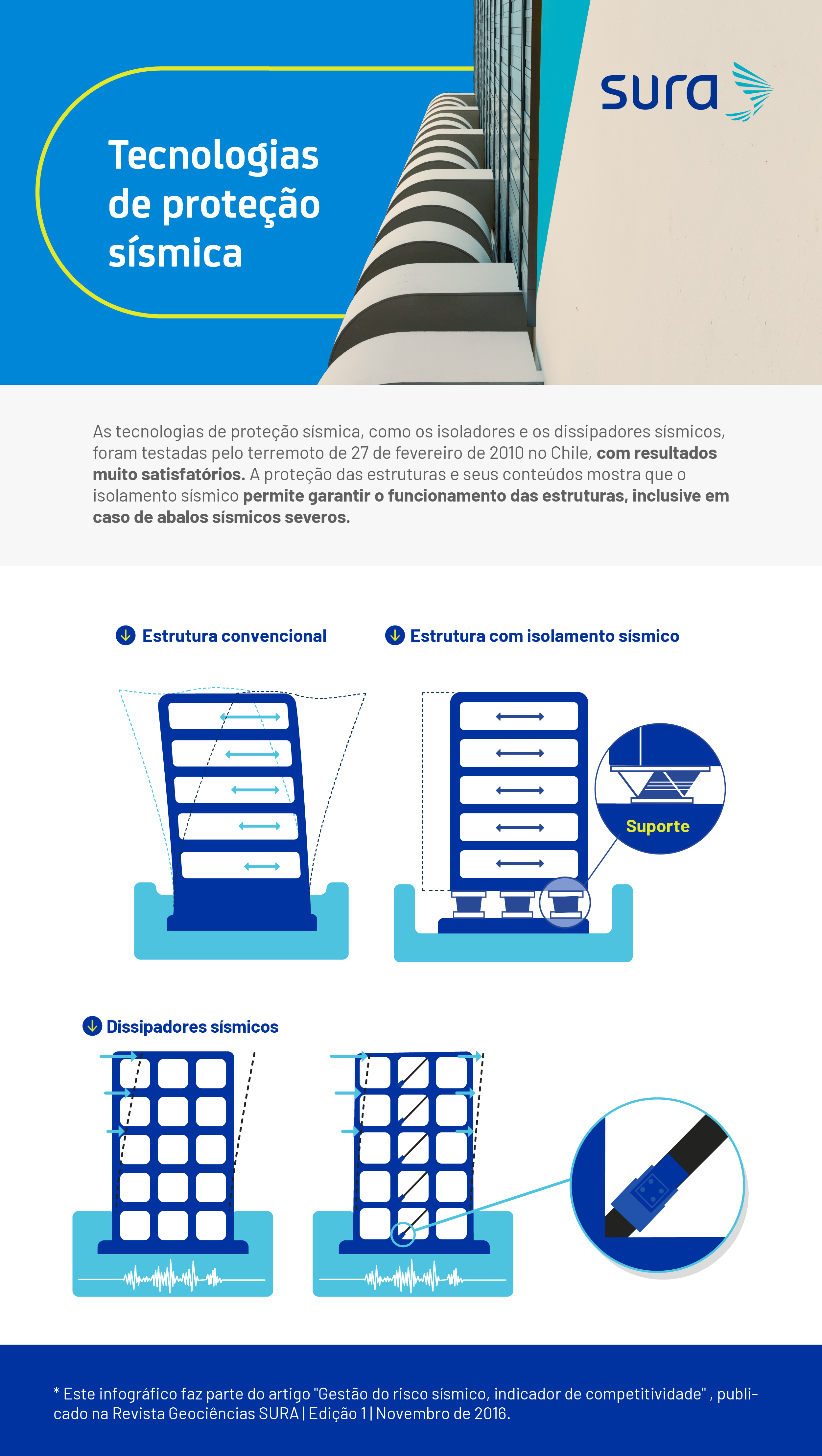
According to the 2010 earthquake, there were few buildings with seismic isolation in Santiago do Chile and Viña del Mar. All of them have been rebuilt in an excellent manner in the face of these movements. Therefore, in recent years the use of this type of system has been expanded, because, as the engineer Patricio Bonelli states, as the isolator “the earthquake has been eliminated.”
Second to engineer Gloria María Estrada, Manager of Geociências da Suramericana, An isolated system based on the face so that the relative displacements between the steps of the building are small and thus do not cause damage.
Another technology used is energy dissipation, which reduces deformation by approximately 30%. In the 2010 earthquake, several buildings that contain this system reacted very well, however, The best solution, second to the engineer Bonelli, is the seismic isolation, which should be regularized and used massively.
Even though the building does not suffer structural damage (which compromises its stability and resistance), it is important to consider that structural damage may arise that impedes its occupation and functioning immediately after an earthquake. Seismic isolation offers the greatest advantage of being a solution to reduce damage of both types.
Therefore, it is considered a success that Chile is not implementing this technology not only in low buildings, but also in higher ones, such as those of 20 and even those of 30 floors. When you start using it, the costs will increase approximately 5%, but it is currently decreasing or increasing two costs for the works and lower.
“It is necessary to continue promoting the use of seismic isolation technology, because, as the relative displacement between the paths of the building is limited, we know that it will not be sensitive to damage,” says engineer Bonelli and adds that it is the best solution for reduce both structural and non-structural damage.
Immediate occupation and operation
The major effects of the 2010 earthquake in Chile were the loss of profits and the damage caused to non-structural elements, which made it impossible to immediately occupy and use the structures after the earthquake. Therefore, seismic risk management with a preventive focus is necessary.
Insofar as we manage seismic risk, The companies will count as others competitiveness indicator, which refers to the mitigation of losses associated with lost profits. If you do not suffer damage to your installations, both in structural and non-structural elements, you will be able to continue functioning, since partial or definitive dates will not be necessary.
In addition, Chilean seismic standards specify that in earthquakes such as the Maule earthquake, damage is expected at certain points, and engineer Patricio Bonelli highlights that, in practice, people “do not receive any type of damage.” Therefore, it is important to be conscious to avoid damage, as a fundamental element of competitiveness and sustainability.
Seismic risk management also requires resilience capacity, that is, recovery capacity after an earthquake. This is a great example of Chilean engineering, as engineer Bonelli states: “If you walk through Concepción and Santiago you will never think that an earthquake like that of 2010 occurred.”
Sources
- Patricio Bonelli. Civil engineer from the University of Chile, specialist in structural calculation of reinforced concrete. Researcher and professor at the Federico Santa María Technical University of Valparaíso, Chile.
- Gloria Maria Estrada Alvarez. Civil engineer, specialist in environmental engineering, specialist and master in earthquake-resistant engineering.