

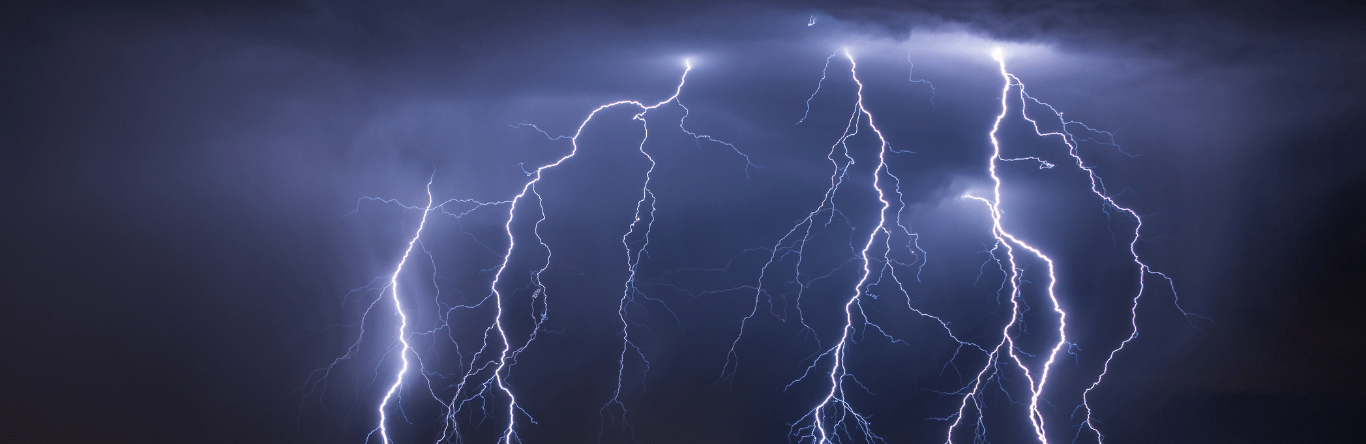
As atmospheric discharges are two of the most impressive phenomena in nature. It is for this reason that, since ancient times, our ancestors, marveled at this phenomenon, have associated its origin with an expression of the power of divinities. Thousands of years later, we have only managed to unravel the physical processes that gave rise to this natural phenomenon, or that have allowed us to design systems that mitigate its impacts.
* This article was published in Geociências SURA Magazine | Edition 5 | September 2019.
Throughout the history of humanity, different cultures have attributed electrical discharges to manifestations of anger or power of their respective deities. This is the case, for example, of two ancient Greeks, Vikings, Buddhists and some indigenous ancestral communities, who associated this type of phenomenon with divine punishments sent by Zeus, Thor, Buddha or certain mythical figures.
Only in the second half of the 18th century, thanks to the work of Benjamin Franklin, was it possible to give a physical explanation to this phenomenon, which has the potential to affect good materials and cause loss of human life.
What is the origin of electric shocks?
Electrical discharges generated in the Earth's atmosphere can be caused by volcanic eruptions, extremely intense forest fires and snow storms or, for that matter, poeira. However, most atmospheric electrical discharges occur in cumulus clouds, also known as storm clouds.
This type of cloud is due to many two natural atmospheric phenomena that represent an environment in good materials and in the life of people and animals. Furacões, tornadoes, torrential chuvas, hail storms and electric shocks are the origin of storm clouds, which are characterized by a great vertical development.
Numerous cumulus clouds present strong ascending and descending wind currents in its interior, caused by temperature differences between the Earth's surface and the upper atmosphere. These currents have the capacity to move, at high speed, the particles of ice, snow and water droplets contained within the structure of the cloud, also known as “hydrometeors”.
Hydrometeors move chaotically within the cloud, colliding one with another, or seem to be electrically charged, as explained by doctor Silverio Visacro, professor and chef of the Atmospheric Discharge Research Center of the Federal University of Minas Gerais (UFMG). , Brazil. During these collisions, larger particles are negatively charged and, thanks to their size and force of gravity, remain at the base of the cloud, while smaller particles are positively charged and remain in the highest layers of the day. a cloud.
This distribution of charges means that the lower part of the cloud is negatively charged and the upper part positively. On the other hand, the surface of the Earth has a slightly negative charge. However, when a storm cloud forms, the negative charge at the base of the cloud is large or enough to repel the negative charges that it is not alone.
Therefore, only any object that is above or close to the storm will be positively charged, generating an electric field that is the beginning for the discharge to be generated. Given the conditions described, the next step to generate an electrical discharge is to establish a connection channel between the opposing loads, because it is an electrical conductor. However, when there is a very large difference between opposing charges, this potential will exceed the resistance of the air, which will be charged electrically, through a process known as ionization.
During the ionization process, the negative charges, in order to establish a connecting channel with the positive charges, break the insulating capacity of the air and allow it to flow freely, forming branches and generating a main passageway, a process known as “stepped leader”.
When the main passageway is about 50 meters away from establishing a connection with positive charges, they are also attracted and overcome the air resistance, establishing the connection channel and giving rise to electrical discharge, which is also known as electrical current. return.
After the main electrical discharge or return current, it may be that a new one has an excess of negative charges that flow through the same channel initially established, generating a second, third or fourth consecutive discharge, depending on the excess of charges in the new one. Ramifications are not observed during this type of process.
Main ideas to understand this phenomenon
- Range: name commonly attributed to atmospheric electrical discharges.
- Lightning: refers to visible energy associated with atmospheric electrical discharge.
- Ceraunic index: refers to the number of days of trovoada, a specific region per year. It is used where there is no availability of direct measurements from the discharges that occur directly not only.
- Found: It is caused by atmospheric electrical discharge. It occurs as a consequence of the occurrence of the present electrical discharge channel.
What are the main types of atmospheric discharge?
Cloud-ionosphere
Studies carried out in the 1980s and 1990s will allow us to identify that there is a series of atmospheric discharges that occur at the top of the new cumulus clouds in the direction of the ionosphere. This layer of the Earth's atmosphere can range between 80 and 500 kilometers in altitude and is characterized by large ionization processes that allow the concentration of free electrons.
Intra-cloud
This is the most common type of electrical discharge in the atmosphere. We will run between two opposing loads in the same cloud. It is more frequent that it occurs within two physical limits of the cloud, it is also possible that it occurs outside the limit, or that it makes possible the observation of the branching of the radio, such as the cloud-atmosphere discharges.
Cloud-cloud
It occurs when there is an electrical discharge between two opposing electrical charges, present in two clouds that are at a certain distance.
Cloud-earth
It occurs when there are transfers of electrical charges between the atmosphere and the earth. Most of these discharges ocorre das nuvens para a terra (downward discharges), but it is also possible that ocorram da terra for as nuvens (upward discharges). Embora nuvem-terra downloads are not more common, they represent a greater benefit for people and better materials, in comparison with other types of downloads.
“The geographical distribution of nuvem-terra discharges is very linked to orography and local dynamics of storms. However, tropical regions are characterized by a higher frequency of downward discharges, while extratropical zones with lower temperatures have more upward discharges than in the tropics.
Doutor Silverio Visacro, specialist in atmospheric electrical discharges and professor-researcher at the Federal University of Minas Gerais, Brazil.
What is the global distribution of electrical shocks?
There are several measurement instruments to determine the location of an atmospheric electrical discharge, recent advances in remote sensors, such as satellites, amplification or spectrum to better determine the global distribution of this phenomenon.
The satellite sensors detect electrical activity in the upper part of the cloud from optical or temperature sensors that measure the internal discharges of the clouds, however, a disadvantage is that they cannot detect cloud discharges. There are more precise instruments to detect nuvem-terra discharges, such as electromechanical devices, as explained by doctor Silverio Visacro.
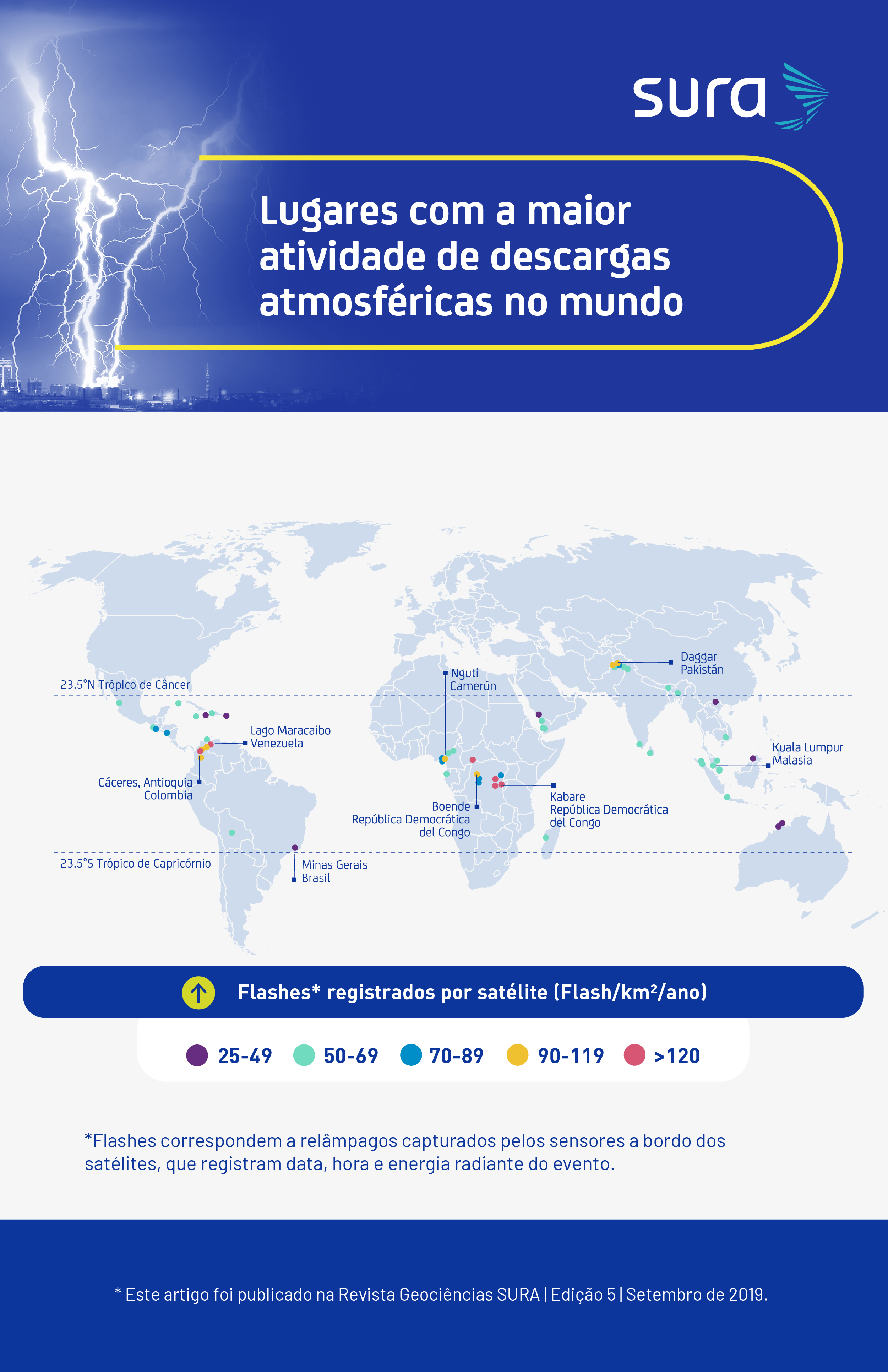
From two records from two satellite sensors, it is possible to conclude that electrical discharges occur anywhere on Earth. Therefore, in the tropical region there are areas with the highest density of discharges, between the Tropics of Cancer and Capricorn.
This region has a higher exposure to solar radiation compared to the rest of the globe, therefore, its surface temperature is higher. This marks a large difference in temperature with the high atmosphere, which favors the convective processes that give rise to electrical storms.
Although localized areas in the tropics present a greater quantity of atmospheric electrical discharges in relation to global distribution, there are other additional factors, such as regional topography, the shape of the coastline or coastal lines and the dynamics of local winds, which make it possible Within the areas located in the tropics, there are regions with higher discharge density than others.
An example of two local effects on the density of electrical discharges is presented at the confluence of the Catatumbo River with Lake Maracaibo., in Venezuela, known as one of two geographical points in which the greatest number of this type of phenomenon is recorded, with approximately 250 rays/km2, reason why it is widely known in Venezuela as “Catatumbo Lightning”.
What are the impacts of electric shocks?
Atmospheric electrical discharges can have significant impacts, both for the safety of people and for goods. It is difficult to establish a reliable number due to the lack of information and reports, It is estimated that this phenomenon causes, on average, the death of 2.000 people/year, according to a National Geographic report.
In the years with materials associated with this phenomenon, it is estimated that the United States alone's economic losses may exceed eight thousand dollars per year, according to data released by the National Institute for Protection against Raids (NLSI). There are many ways to classify the material damage that an electric shock can cause. Not so much, It is possible to group the major impacts into three main categories:
Damage caused by fire: Due to their gravity, perhaps they represent a greater threat, since, in addition to causing material loss, we can compromise life and safety of people. Fires associated with electrical discharges can occur after the impact of lightning in wooden installations or other types of inflammable materials and, in general, only start by burning lightning. This type of electrical discharge presents a continuous current, in which the electricity flows for a longer period than that of a normal electrical discharge, generating the heat necessary to start the fire.
Another source of fires associated with atmospheric electrical discharges arises when the lightning strikes a structure or nearby areas that contain flammable material. This type of event, in which there are explosions or release of hazardous substances in the environment due to natural phenomena, known as Natech (Natural Hazard Triggering Technological Disasters). According to the investigations carried out, about 61% of these events were triggered by atmospheric electrical discharges, being the most affected petrochemical and oil industries.
Damage caused by power surges: Lightning rarely affects electrical or electronic devices directly. This type of damage is generally caused by impacts on the power lines, increasing the voltage of the transmission lines. They can also be caused by induced overloads, causing a drop in voltage. In both cases, devices connected to a power source at the moment of impact can be damaged.
Damage to electronic devices can generate other types of losses that can represent even greater economic losses when there are industrial processes that depend on the continuous operation of these equipment, such as monitoring systems, ventilation, telecommunications, among others. For this reason, it is important to have adequate protection systems and auxiliary equipment to guarantee the continuity of operations.
Damage associated with shock waves: Atmospheric electrical discharges generate shock waves when aquecem or air. We perceive these waves as trovões. When too much happens outside of a structure, it can become devastating. They are only capable of causing damage to concrete, tiles, concrete blocks and gesso walls, as well as breaking glass and creating scratches and fences.
Protection systems
Atmospheric electrical discharges can impact structures, installations and cause damage to nearby areas and connected services. Dr. Silverio Visacro emphasizes that, in view of these phenomena that can affect the operation and continuity of two businesses, there are protection systems, external and internal, that allow mitigating the impact on structures, facilities and equipment:
External protection systems: We attempt to dissipate or channel radio energy safely, minimizing damage to people, equipment and structures.
Internal protection systems: They are only used to mitigate the risks that we may encounter as a result of the radio energy. These are devices that regulate overloads and divert energy that can enter the structure through two conductive elements that provide services, such as communications or metal tubes.
O para-raios is the best protection: Its function is to attract electrical shocks and channel the energy from them to or only through a set of elements, such as catchment ponteiras, calhas and grounding system. This prevents discharges from directly impacting the structure, or which could damage both the structure and its contents.
The fact that high isolated trees function as natural parasites “And a phenomenon called “lateral discharge”, in which lateral ramifications of the main beam of the beam affect nearby objects, is the reason why you should not seek shelter for trees during a storm”, explains doctor Silverio Visacro.
Lightning may eventually affect electrical service networks, inducing surges that may cause damage to electrical and electronic devices if the corresponding internal protection systems are not available.
Recommendations during an electrical storm
Atmospheric electrical discharges can represent a latent danger for people who are surprised by a storm while carrying out outdoor activities. Some activities that are generally associated with the impact of atmospheric discharges on individuals:
- Practice sports in open fields: soccer, golf, mountaineering, cycling, camping, among others;
- Do activities in the open sea: navigation in small boats, fishing, swimming, among others;
- Carry out work in open fields: with agricultural machines, roads, among others;
- Talking on the phone;
- Repair or use electrical appliances.
Before and during an electrical storm, there are a series of recommendations that must be followed in advance. to reduce the risk of damage that the electrical discharges produced can cause, such as:
- Add activities to your open life, such as playing sports, for example;
- Remove loose or dried debris from trees that are at risk of falling during a storm and causing any type of damage;
- If you are in the open, seek shelter inside houses, fields or cars;
- Avoid taking a bath during a storm, since the heat and some other things present in the bathtub may lead to electricity;
- Avoid or use unsecured telephones;
- Disconnect electrical and electronic devices, such as computers, for example;
- Avoid approaching natural parasites, such as tall, isolated trees in open places;
- Do not travel on slopes, high points, open fields and beaches;
- Avoid covered areas or small isolated structures in open places;
- Do not drive tractors, agricultural machines, motorcycles, golf carts and bicycles;
- If you are close to forests, seek shelter in areas where there are small bushes;
- In open areas, it is possible to go to the lowest places on the ground, like small valleys;
- If you find yourself in the open sea, turn to dry land and seek shelter immediately.
Sources
- Juan Pablo Restrepo. Civil engineer and specialist in Hydraulic Resources for the National University of Colombia.
- Silverio Visacro Son. Electrical Engineer, Master from the Federal University of Minas Gerais (UFMG), Belo Horizonte. Doctor for the University of Rio de Janeiro.