



Seismic isolation is a proven technology that allows a structure to “dance” safely with the earth instead of fighting against it. Isolating a structure from any seismic movement is the most effective way to protect, in addition to its contents and functionalities, above all, the lives of its occupants, and minimizes losses associated with the suspension of operations and liability-generating events.
* This article was published in Geociências SURA Magazine | Edition 2 | September 2017.
Imagine that your house is gently resting on a frozen lake without sticking to it, when a large earthquake occurs. Besides noticing some minor vibration, how would you know that an earthquake occurred? In the absence of a connection to Terra it would allow the ice to slide horizontally without affecting the house.
Without you, without going to your house, without drying the coffee beans on the table, we would experience the horizontal movements of the terrain. With this idealized scenario, Master Mason Walters, structural engineer of the company Forell/Elsesser, California, explains the concept of “seismic isolation”.
It is clear that the reality of seismic isolation is not ideal if we consider the legal limits of the property that each building or structure can occupy, or that it implies both restrictions on how much the isolated structure can move during the project's seismic event. a mechanism for the structure to recover its original position after the earthquake.
Engineer Ivan Skinner was the pioneer of seismic isolation. This eminent engineer said: “we want to give a gentle walk to the structure”. The idea of seismic isolation did not end in the 70s and everything that was necessary to start the project became reality in the following decade. The first construction project with seismic isolation was the William Clayton building, in Wellington, in New Zealand.
How does seismic isolation work?
Seismic isolation consists of replacing the direct and rigid connection of the structure as the support ground with a set of flexible supports in a horizontal sense, which allows the property to be maintained without greater disturbance, even if the support ground moves violently.
The supports responsible for separating the structure from the ground are called “isolators”, which are designed for the specific strength, flexibility and energy dissipation requirements of each project.
In this way, as explained by engineer Mario Lafontaine, from the Chilean company René Lago Engineers, In every work with a seismic isolation solution there is a so-called “isolation plane”, which is defined as the limit between what is above the isolators (protected structure) and what is below two isolators (which moves together like the terrain).
This isolating plane enables a relative horizontal movement between the structure and the ground – which changes the horizontal dynamic conditions of the structure in relation to the conditions under which it is built in a conventional manner – and allows:
- that the structure above the isolators is protected from large relative displacements between steps, which is the main cause of damage to conventional structures;
- significantly reduce horizontal force on the basis of overturning moment in an isolated structure, in relation to what would be experimented with being built in a conventional way, or what was translated into a lower horizontal force of a base project;
- Reduced acceleration in walking, which is the main cause of damage to contents and electromechanical elements that perform vital functions in certain buildings.
Isolated structures require some details in the connections of structural and non-structural elements, such as:
- The tubes and cables must have flexible connections between the protected structure that is below two insulators, in such a way that they accommodate with ease the displacements in the isolation plane during an earthquake;
- The entrances, connections between bridges, stairs and elevators must be loose to prevent them from colliding during a seismic event.
“Any structure that requires operational continuity is a candidate for using seismic isolation systems. For example, industrial structures are afraid of interrupting production due to damage following a very high earthquake, which motivates the use of technology.”
Engineer Mario Lafontaine, from René Lagos Engineers, in Chile
How do seismic isolators work?
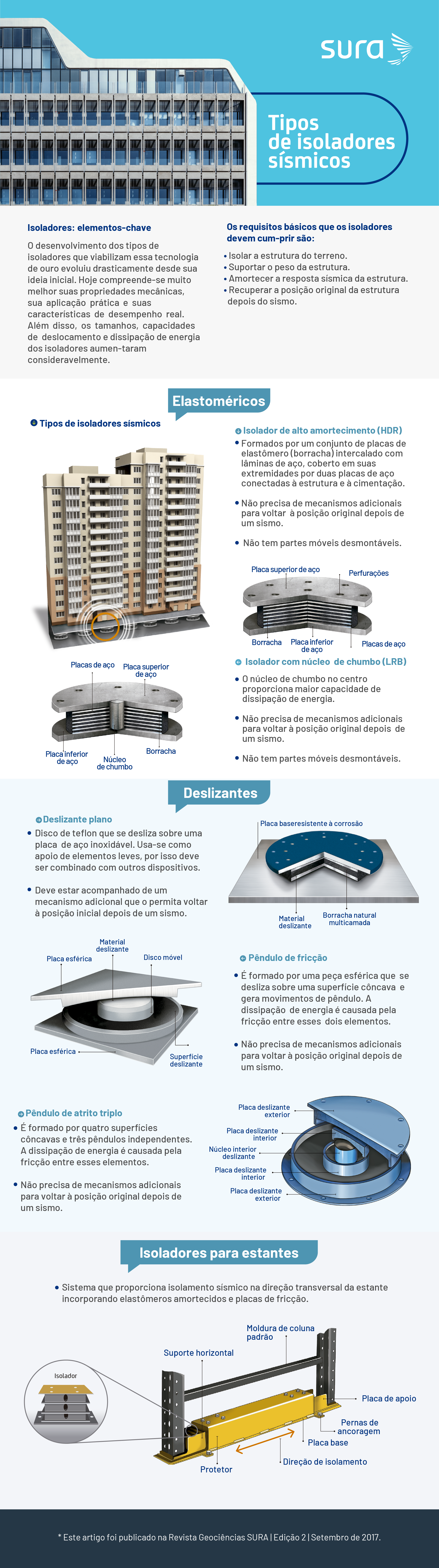
The development of two types of insulators that make this technology viable has evolved drastically from its initial idea. It best understands its mechanical properties, its practical application and its real performance characteristics. In addition, the sizes, displacement and energy dissipation capacities of the insulators will increase considerably.
The basic requirements that insulators must meet:
- insulate the ground structure;
- support the weight of the structure;
- damping seismic response of the structure;
- recover the original position of the structure after the earthquake.
The seismic isolation systems demonstrated their effectiveness during the earthquake of March 11, 2011, in Tonohu-oki, with a magnitude of 9,0 (Mw), considered the fifth largest earthquake recorded worldwide and with the longest duration recorded in Japanese history.
During this event, buildings constructed with seismic isolation have shown excellent performance, as in the case of a new commercial building built with reinforced concrete in Sendai in 1981 and rehabilitated in 2009 through the implementation of seismic isolators.
In relation to the applications of seismic isolation in buildings, engineer René Lagos explains: “When we talk about rigid solos and flexíveis solos, from rigid buildings or flexible buildings, all of them are relative terms, ou seja, Seismic isolation attempts to concentrate all the deformation of the isolators and increase the period of vibration of the structure in relation to the material that is not isolated., in such a way that it is not found in the extension where it is located at maximum seismic response alone.”
Sources
- Jose Ignacio Restrepo. Doutor in Seismic Engineering at the University of Canterbury, in New Zealand. Professor at the University of California, in San Diego, and professor at the Escola de Redução do Risco Sísmico (Rose School), in Pavia, in Italy.
- Mario Lafontaine. Civil Engineer at the University of Chile, hired since 2008 by the company René Lagos Engineers.
- Rene Lagos. Civil engineer of the University of Chile, partner and general manager of René Lagos Engineers.