

SURA developed a post-earthquake assessment methodology that is applied only by specialists in structural engineering for the diagnosis, classification of damage and definition of intervention solutions for buildings affected by earthquakes.
* This article was published in Geociências SURA Magazine | Edition 3 | March 2018.
Source
Earthquake of magnitude 6.2 Mw, at a depth of 10 km, in the city of Armênia (Colombia), on January 25, 1999, led to the directives of SURA, particularly its president, Gonzalo Alberto Pérez, in need of developing a methodology Company's own for post-earthquake building appraisal.
Ainda that the post-earthquake attention of SURA in the earthquake-affected areas of Armenia has counted with the participation of a group of structural engineers, There is no methodology that allows homologation and unified criteria for the evaluation of the buildings involved. This earthquake was what inspired the post-earthquake assessment methodology of SURA.
The methodology was focused on unifying assessment procedures and criteria, aimed at diagnosing and classifying objective damages, to support repair, rehabilitation or reconstruction decisions of clients' buildings, in accordance with the earthquake-resistant construction regulations applied to them. state vanços gives art in structural engineering in the world.
“A Suramericana was visionary in developing this methodology. "He is not only thinking about paying for damages, but also about helping to build more resilient and less vulnerable cities, which are also more prepared to face another earthquake."
Juana Llano, Vice President of Insurance of SURAMERICANA SA
Development and implementation
The development of SURA's seismic assessment methodology since the beginning, in the year 2005, was led by engineer Gloria María Estrada, current manager of Geosciences of SURA at the regional level, with the participation of three external assessors, scientists and stagiários, of structural engineering, the engineers Juan Diego Jaramillo, Roberto Rochel and Álvaro Pérez. This team developed the first version of the methodology that was concluded in 2008.
A few weeks after the earthquake of magnitude 8.8 Mw occurred, in Chile, February 27, 2010, This group of professionals carried out a reconfirmation visit to the main affected areas to, in this way, test the methodology in buildings of different types and with different levels of damage.
For the development of this methodology, we have studied different criteria and proposals existing in the world, among which we can highlight the Federal Emergency Management Agency of the United States (FEMA), the National Earthquake Risk Research Program United States (NEHRP, in English) and some specific publications of the Colombian Association of Seismic Engineering (AIS, in Spanish).
The main contribution of the SURA methodology, in relation to existing approaches, was obtaining a diagnosis and classification of damages based on quantitative data, or that allows an objective view, based on engineering criteria.
Engineers Elizabeth Cardona, Victoria González and Juan David Rendón were integrated into this work team, between 2012 and 2015, and are now part of the Geociências team of SURA. Once it is a dynamic methodology, which seeks to be at the forefront of the advances in structural and seismic engineering, it was subjected to review and feedback processes from external specialists, such as in the case of two engineers Francisco Pérez, from the company Andes Engineering, and Alejandro Pérez, from the Projects and Designs company.
To implement this methodology, SURA trains external teams of specialists in structural engineering. In 2008, in Colombia, SURA had a group of 60 trained structural engineers. Currently, the company has expanded this group and has specialists in Colombia, not Chile and not Mexico, which offers better response capacity.
The most important proof of the methodology observed in the year 2017, in the assessment plan of SURA, after the earthquake of 19S 2017, in Mexico, where a group of more than 70 engineers specializing in structures participated.
From this experience, learning will remain very valuable, more or more relevant and the conviction of its importance to channel efforts for the seismic resilience of our region, in search of repair, rehabilitation and reconstruction of buildings in accordance with the advances in engineering.
Tomás Isaza, current Insurance Director of SURA México, has promoted and supported the development of SURA's methodology for post-earthquake building evaluation since 2005 and, after seeing its application in Mexico, is convinced of its effectiveness in meeting the needs of both clients affected by earthquakes.
What is SURA's methodology for post-earthquake building assessment?
It consists of accompanying the client with specialists in structural engineering in two fundamental stages:
- diagnosis and classification of damage – based on inspection visits carried out exclusively by structural engineers, a manual for damage survey is followed. The results are analyzed by a centralized team of specialists, which generates a damage classification report for each building;
- definition of methods of repair, rehabilitation or reconstruction, according to the damage.
How does the SURA procedure work to classify damages?
- Identify areas affected by earthquake.
- Send structural engineers to affected areas to carry out the survey of damage to secured buildings.
- Process the field data to classify the damage of each building in three categories: collapse risk; minor avarias; give us special
- Prepare a report with the classification of damages and indicate the recommendations or complementary studies necessary to define two intervention methods.
The stages and categories for the classification of damages:
Stage 1. Diagnosis and classification of damage.
- Manual for the preparation of the field form, to achieve unified criteria;
- Form for the collection of information in the field, carried out by structural engineers, to characterize the building and post-earthquake damage in the affected areas;
- Analysis of pre-filled forms in the field, executed by a centralized team of specialists.
- Program for the generation of diagnostic reports and damage classification, based on the processing of field forms.
Category 1. Collapse risk. Buildings whose damage causes collapse or collapse cliff, which requires demolition and construction of a new building, based on the applicable seismic design standards.
Category 2. Minor avarices. Buildings with minor damages are repaired through standard procedures.
Category 3. Give us specials. We will require complementary studies to define the most appropriate solution for post-earthquake intervention.
Stage 2. Definition of two repair methods, rehabilitation or reconstruction, second level of damage.
- Complementary studies carried out by companies specialized in structural engineering, with extensive knowledge and experience, to define the most appropriate intervention in the building.
Connection with the urban planning megatrend
SURA's methodology for post-seismic assessment allows offering adequate treatment to affected buildings and, at the same time, promotes the development of knowledge, which also serves as feedback for seismic risk management in Latin America.
In this way, studies and developments of a preventive nature are encouraged based on the knowledge acquired on how to achieve better seismic performance of buildings, or that are directly connected to the urban planning megatrend.
As part of this megatrend, all opportunities to reduce earthquake damage are potentialized to build more resilient cities, because, For people, companies and general society, it will always be more important to post-earthquake attention than to pre-seismic management. A SURA, like this and other initiatives, wants to offer experience, knowledge and conviction to the region.
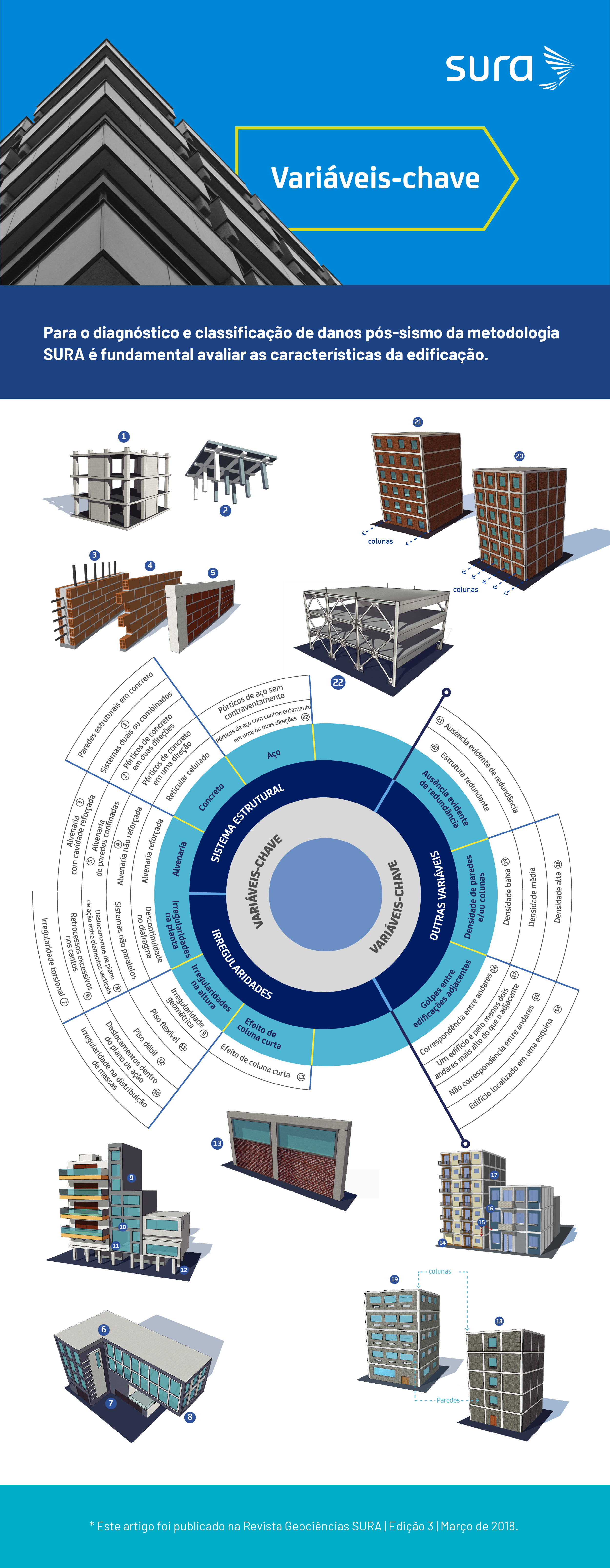
Sources
- Alvaro Perez Arango. Civil engineer of the National University of Colombia. Master in Strutural Dynamics and Seismic Engineering from the Technical Institute of Karlsruhe, Germany.
- Gloria Maria Estrada Alvarez. Civil Engineer, specialist in Environmental Engineering, specialist and master in Earthquake Engineering. Manager of Geosciences of Suramericana.
- Juan Diego Jaramillo Fernandez. Civil Engineer, Master in Earthquake Engineering and Master in Engineering.
- Roberto Rochel Awad. Civil Engineer, Master in Structures; Professor Emeritus of the Eafit University, Visiting Professor of the University of the North, the National University of Medellín, the University of Antioquia and the Industrial University of Santander.