

Technological, industrial and scientific development can be affected by space weather, particularly in sectors such as satellite operators, electrical infrastructure, airlines, oil drilling companies and precision agriculture. These investigations seek to understand more clearly the activity of the Sun and its effects, in order to mitigate the risks related to Earth.
* This article was published in Geociências SURA Magazine | Issue 1 | November 2016.
During the last century, a technological, industrial and social evolution occurred without precedent in history. The communication and transportation systems, the spatial conquest and the use of electrical energy not only improve the quality of life, but also form fundamental and interdependent structures for human activity, the security of two countries and economic vitality.
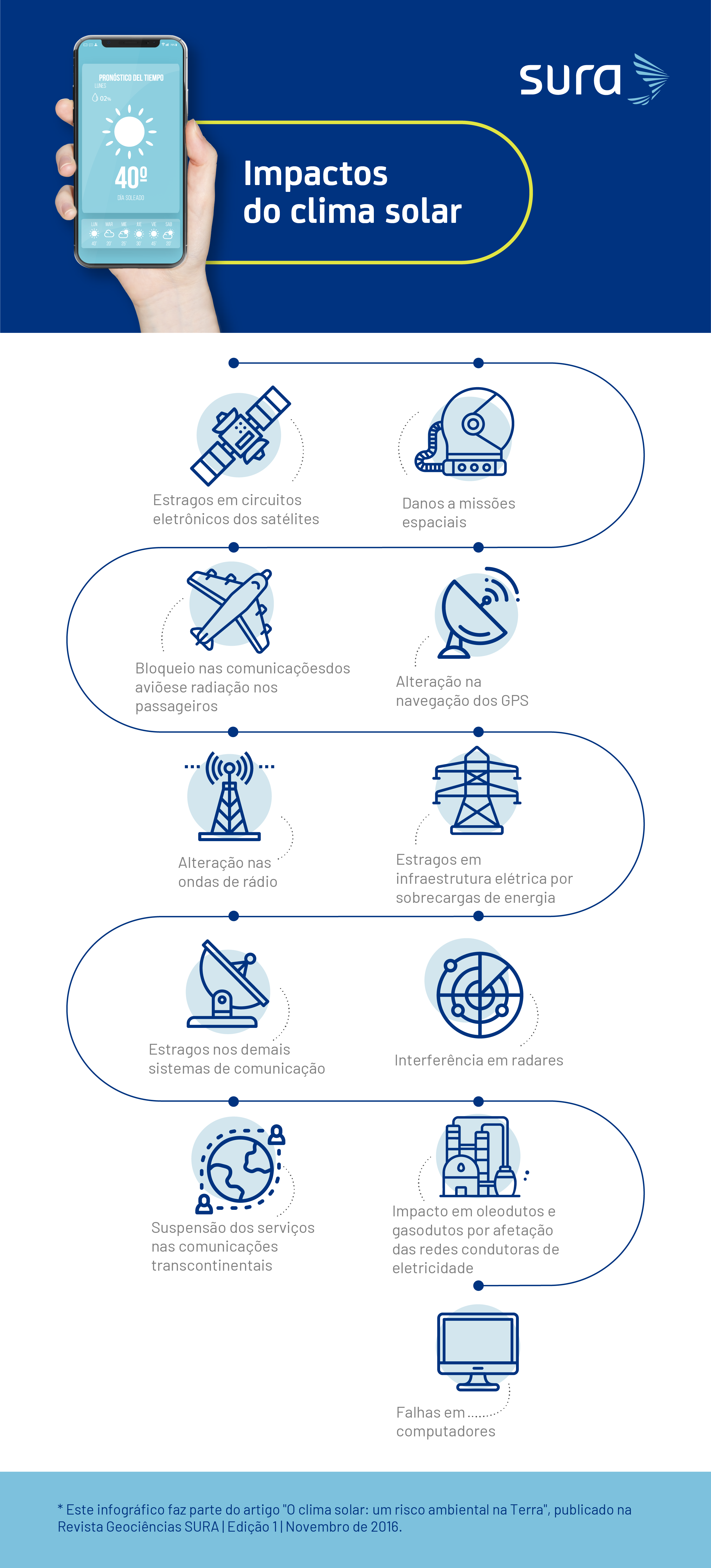
The need to understand and foresee solar activities goes beyond scientific interest and has a direct impact on business and government forecasts, perhaps This activity can be used to affect electrical networks, wireless communication, telecommunications, global positioning satellites or GPS, spatial misses and maritime, air and land transport networks.
Activity on the surface of the Sun
On the morning of September 1, 1859, astronomer Richard Carrington observed the eruption of sunspots for the first time. Hours later, I was informed of the massive failure of telegraphic communications and the colorful northern lights in Havaí, Central and South America.
One hundred and thirty years later, in 1989, a solar storm deixou without electricity for twelve hours five thousand people in Quebec. These are not the only solar phenomena that have occurred in history, only those that have the greatest impact due to their transcendence and impact on the planet.
According to a report carried out by the Lloyd's of London insurance market in 2013, an extreme solar storm, at the level of the Carrington storm, could cause major disruptions in the electricity networks, affecting a population between 20 and 40 million people. people in the United States, and generate a recovery expense that can vary between 600 billion and 2,6 trillion dollars.
The coronal mass ejection (CME) is the ejection of plasma clouds from the outer layer of the Sun or solar corona. They occur most frequently during the period of maximum activity of the solar cycle, which varies between 10 and 12 years.
The generation of the coronal mass axes is related to the rotation of the Sun's magnetic field lines. When the rotation of the solar equator causes the extension of the field lines, they also interact with local magnetic fields, called active regions, creating sunspots. , so it eventually causes a solar storm that emits highly energetic particles, which move in a random direction and occasionally we can reach Earth.
Likewise, professor and researcher at the National University of Colombia, Dr. Santiago Vargas Domínguez, explains that “understanding the behavior of sunspots – regions of the Sun with high magnetic activity – is important because only the wave points emitted by solar magnetism ” and, likewise, it is very related to solar eruptions.
If sufficient resources are invested in protective technologies, the effects of solar storms can be attenuated, but their cost can be very high. This is a dilemma that industries constantly face.”
Dr. Louis J. Lanzerotti, physics researcher at the Nova Jersei Technological Institute.
How do solar storms affect Terra?
Terra has a natural shield generated by its magnetic field or magnetosphere, which protects the electrically charged particles that come from outside. Therefore, a large part of the particles released in a solar storm are deflected away from the magnetosphere and others are directed towards the poles. As particles that reach the poles have the ability to interact with the Earth's atmosphere, as explained by Dr. Rualdo Soto-Chavez.
For the physics professor and researcher at the Nova Scotia Institute of Technology, Dr. Louis J. Lanzerotti, who spent more than four decades studying two space plasmas, “In the last 150 years, the technological system of humanity has become more complex and, therefore, we are increasingly vulnerable to the effects of space weather.”
In the case of interfiber coronal mass axes in the Earth's magnetic field, it is possible that the electrical energy transmission networks, the space gaps and the communication systems are affected. Furthermore, rays of solar radiation will disturb the communication systems, radars and GPS present in telephones, airplanes, boats and automobiles.
For the National Oceanic and Atmospheric Administration of the United States (NOAA), “industries potentially affected by space weather must evaluate the possible impacts of these events on their operations, so that they identify and implement possible mitigation measures that guarantee to the reliability and sustainability of your businesses.
Sectors that should use space weather information include satellite operators, electrical infrastructure, airlines, oil drilling companies, precision agriculture and government entities.”
Risk mitigation
Over the past few years, countries like the United States have made several efforts to mitigate, respond to, and recover from two potentially devastating effects of space weather.
The National Space Weather Strategy, presented simultaneously with the National Space Weather Action Plan in the United States in 2015, promotes greater national and international coordination and cooperation between public and private sectors – government, universities, emergency organizations, communications media and insurance industries, among others – in order to improve observation networks, carry out research, develop assessment models and increase efforts to protect and mitigate two risks related to the activity of the Sun.
According to Dr. Louis J. Lanceretti, who is also a member of the National Academy of Engineering of the United States and the International Academy of Astronautics, “really, in addition to being a technical problem, it is a cost-profit problem. We always have to face the decision of how much we want to spend to mitigate the risk versus the possibility of experiencing the problem.”
Communications companies, such as AT&T, upgrade parts of the power system to mitigate the effects of solar storms on voltages. Other measures are also known, such as disconnecting the transformers to prevent them from causing damage derived from these phenomena.
Dr. Louis J. Lanzerotti developed an instrument, RBSPICE, for NASA's “Van Allen Probes” mission, in order to understand the space radiation environment related to solar activity. The spacecraft and its instruments are designed to operate continuously for six to six years in a solar radiation environment. This is another example of mitigating the effects of solar storms, explains Dr. Rualdo Soto-Chavez.
The challenges of the future are not solely focused on understanding and estimating with greater clarity the solar phenomena and their possible impacts, but also on improving the management capacity of the industries directly affected by the behavior of space weather. These challenges range from a representative evaluation of the useful life of two satellites, taking into account solar activity, as well as mitigating the economic losses that can also be caused by hyperconnected societies.
Plans, how the United States governs, is only the beginning of a political effort to improve state preparedness in the face of two unavoidable spatial phenomena. Latin American countries and their public and private organizations should not be indifferent to these initiatives, in order to protect and conserve the dynamics of the global economy or understand solar activity as a natural cliff in the same way as earthquakes, volcanic activity or as enchentes.
Sources
- Louis J. Lanzerotti. Professor and researcher of physics at the Nova Jérsei Technological Institute.
- Rualdo Soto-Chavez. Professor and researcher at the Nova Jérsei Technological Institute.
- Santiago Vargas Dominguez. Dr. in Astrophysics from the University of the Canary Islands. Professor and researcher at the Astronomical Observatory of the National University of Colombia.