



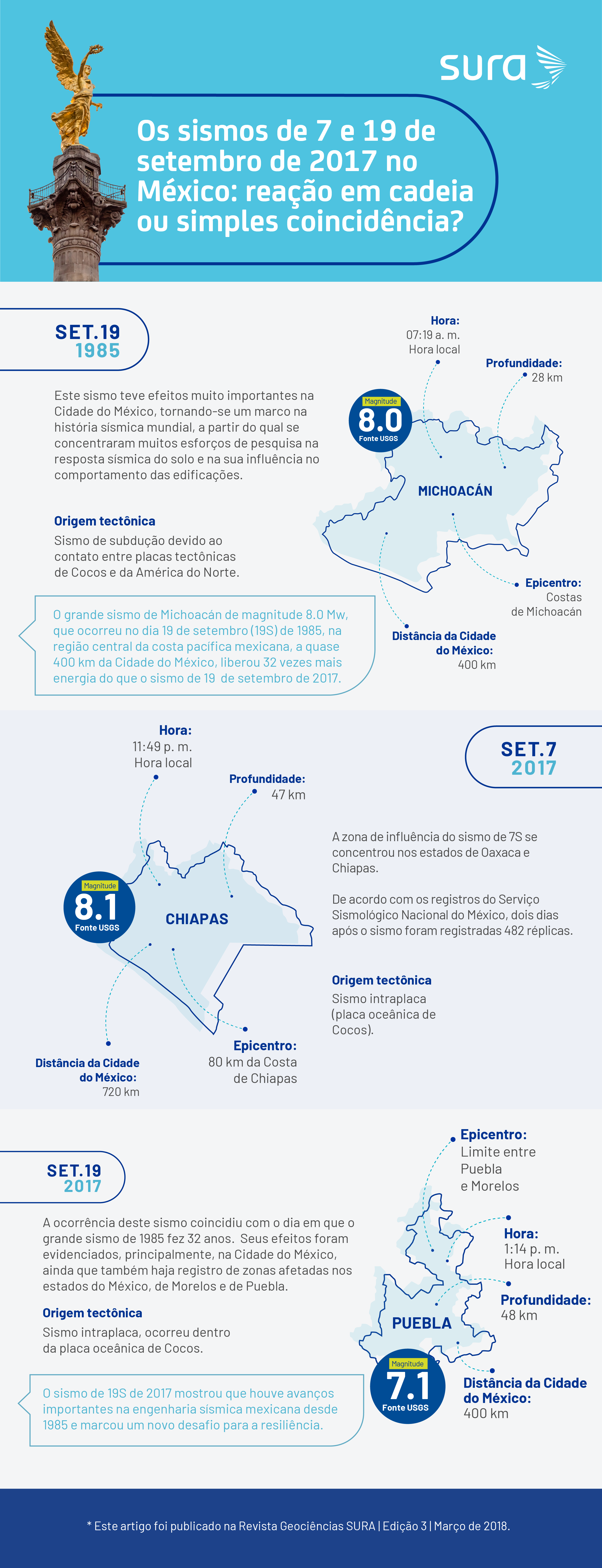
In Mexico we recently learned of latent seismic activity in most two countries in Latin America, following several earthquakes during the month of September 2017. More shocking is that one of these events was recorded just on the day of the large earthquake in September 19, 1985 fez 32 years old.
* This article was published in Geociências SURA Magazine | Edition 3 | March 2018.
No more than September 2017, in a period of 12 days, Mexico was shaken by two large earthquakes. The sequence began on 7S, with an earthquake of magnitude 8.1 Mw, off the Pacific coast, next year in the state of Chiapas. A few days later, on September 19, a 7.1 Mw earthquake shook Puebla and caused the collapse of 44 buildings in Mexico City.
As proposed by Dr. Ross Stein, professor of geophysics at Stanford University, scientist emeritus of the United States Geological Service (USGS) and CEO of Temblor Inc.: “A disturbing question arises after the occurrence of two earthquakes: are these events related to each other?”
Close to the space and time of these two events and the nature of their tectonic origins can make us know that, in fact, there is a reaction in the chain. To answer this interesting question, Dr. Ross Stein and the Temblor Inc. team studied the two earthquakes, in order to estimate the possible relationship between them.
To assess the potential impact that the Chiapas earthquake could have on the Puebla earthquake, based on a effort transfer analysis. The results of this analysis will allow the team of Temblor Inc. to conclude that the earthquake of magnitude 8.1 Mw registered on 7S, in Chiapas, made no efforts on the fact that it originated in the earthquake registered in Puebla 12 days later.
Exactly as author Ross Stein expresses in his publication about this analysis: “in calculating the efforts generated by the Mw = 8.1 earthquake in Chiapas on the basis of the Mw = 7.1 earthquake in Puebla, we verify that the efforts that this effort were made very small, even if they are smaller than the ones that are generated by the fingers of my hand.”
Could recorded seismicity show any relationship between the earthquakes of September 7 and September 19, 2017?
AequipedaTemblorInc.analisouocatalogo National Seismological Service of the National Autonomous University of Mexico (UNAM) and found that the aftershocks of the Chiapas earthquake present a pattern consistent with the distribution of two estimated increments of stress (Coulomb analysis).
Another very compelling discovery is that doctor Ross Stein proposes that, after reviewing the distribution of the two points where the aftershocks of the 7S earthquake originated in Chiapas (Mw = 8.1), no aftershock was found in the vicinity of the region where the earthquake occurred. of 19S, in Puebla (Mw = 7.1).
It was concluded, from this analysis, that The efforts transmitted by the 7S earthquake, in Chiapas, on the fault that originated in the 19S earthquake, in Puebla, are insignificant And, thus, there is no relationship between these two earthquakes.
What is the probability that these two events will be independent?
According to the analyzes carried out by the Temblor Inc. team, it is possible to infer that the Chiapas earthquake has no significant impact on the occurrence of the Puebla earthquake, but, What is the probability that these two events are independent, are we considered to be the fact that the Puebla earthquake occurred with a temporal difference of barely 11 days in relation to the Chiapas earthquake and that its epicenters were 600 km away?
According to the estimates of doctor Ross Stein and his team, this probability corresponds to 1 in 30.000: “you could say that a probability of 1 in 30.000 is too remote to think that the earthquakes in Chiapas and Puebla are related. Therefore, before considering that 1 in 30.000 is a very small number to consider the two earthquakes as a coincidence, it is best to ask: what is the probability that the Puebla earthquake (Mw = 7.1) will occur just two hours after the simulated 32 years after the 1985 earthquake in Mexico City? It definitely has to be a coincidence, right? This probability corresponds to 1 in 900.000. “Quase uma em um milhão!”
So, as author Ross Stein said, “coincidences can happen in the life of any person. After several seismological analyses, this is the best explanation that we have for what is happening.”
“Coincidences can happen in the life of any person. After several seismological analyses, this is the best explanation that we have for what is happening.”
Dr. Ross Stein.
Tectonic and historical environment of earthquakes in Mexico
Mexico is located in an area of the American continent where it occurs at the interaction of five tectonic plates (Pacific, Rivera, Cocos, North American and Caribbean plates), so that this region presents an important seismic area. . As the National Seismological Service of Mexico states, Although there is no current method or technology to predict earthquakes, the tectonic context of Mexico includes regions where large earthquakes will occur, which may occur again in the future. This conviction is that this Latin American country has to be sought, in the development of knowledge, a path to seismic resilience.
Sources
- David Jacobson. Graduate in Geological Sciences from Whitman College, in Walla, Washington, and Master in Geology from the University of Canterbury, in Christchurch, Nova Zelândia.
- Ross S. Stein. CEO of Temblor Inc. and professor of Geophysics at Stanford University.