



Most of the scientific community (more than 97%) affirms that the climate is changing at a pace without precedent in response to the activities carried out by home. Despite the enormous impact on different dimensions scientific, economic, social, political, moral and ethical, the concepts associated with climate changes are not always understood. Addressing them is essential for designing adaptation and mitigation strategies.
* This article was published in Geociências SURA Magazine | Edition 4 | December 2018.
The first thing we must understand to explain the meaning and importance of climate change is the definition of three concepts that are part of our daily life: atmospheric temperature, climate and climate variability. Thus, it is important that these concepts be defined in light of a broader approach that classifies them: the climate system.
The global climate system depends mainly on the energy of the sun and is formed by the interrelationship of all the subsystems that make up our planet: the hydrosphere, atmosphere, cryosphere, lithosphere and biosphere. Any disturbance in one of these subsystems can affect the total equilibrium of the system, causing an alteration of the atmospheric state on a certain time scale.
If we think about it, furacões and El Niño-Southern Oscillation (ENSO) — first, an atmospheric phenomenon formed and intensified by the energy available in the water in two oceans and, second, a phenomenon that has important climatic consequences in many regions of the world and whose origin is presented as a consequence of aquecimento or cold water surface of the tropical Pacific Ocean — we would have two clear examples of the inter-relationship of the hydrosphere and the atmosphere within the climate system.
However, we can only begin to talk about atmospheric time, climate and climatic variability when we understand that atmospheric disturbances caused by the interrelationship of different climatic subsystems can occur on various temporal scales (hours, days, months, years, decades or weeks). .
Or what is the atmospheric tempo?
In its simplest definition, Atmospheric time is understood as the current state of the atmosphere at a geographical point and at a specific moment., represented by variables, such as precipitation, temperature, nebulosity, relative humidity, etc.
Consider, for example, a particularly sunny day that is interrupted by a few hours of rain or a summer week in which we are surrounded by several days of rain and fog. Is it correct to attribute these unexpected variations to climate change? Definitely not.
The climate system is highly sensitive to perturbations in the system as a whole, and that is why Edward Lorenz, considered the country of Chaos Theory, describes the atmospheric temperature as a chaotic system, since any minimal perturbation can trigger very different results. This is why it seems so difficult to predict the atmospheric time precisely.
The next important concept to be defined is or climate, understood as the predominant atmospheric time in a given region over a long period of time (time horizons that are not less than 30 years). The climate is influenced by regional physical variables, such as geographical location, average altitude above sea level, geographical features, proximity to the sea and type of vegetation. The latter shows us that between the climate and life there are interactions between two people, that is, that there is reciprocity between these processes.
To understand the relationship between atmospheric time and climate, there is a fairly clear analogy in literature. Think of atmospheric time as the moods that a person experiences throughout life: joy, sadness, melancholy, euphoria, excitement, saudade, etc.
All these emotions can occur at specific moments, even not the same day. However, an individual's personality is not determined by his or her momentary mood, but rather by his or her habitual behavior, thus, The climate is similar to the personality and the atmospheric tempo to the different emotions experienced.
“We can conceive of climate as a result, in the long term, of the collective behavior of all the components of the Earth's climate system (atmosphere, hydrosphere, cryosphere and biosphere). All of them are in constant interaction, which results in natural climatic variability of atmospheric time, over a long period of time, on different space-time scales.”
Dr. Germán Poveda, specialist in hydroclimatology and climate changes and professor-researcher at the National University of Colombia, Medellín headquarters.
Or what is climate variability?
The atmospheric time is defined as the state of the atmosphere on time scales of hours, days and some weeks. The climate corresponds to the average state of the atmospheric temperature in a given geographical region, for a period greater than 30 years. Thus, how can we define the behavior of atmospheric time on intermediate scales of, for example, 20 years?
The variation of atmospheric conditions in periods of one or several months, years, five-year periods or longer periods (up to two decades) is explained by climatic variability. The climate varies naturally and these variations occur cyclically, due to factors such as rotation and translation of the Earth, sunspots (regions of the sun with high magnetic activity) or volcanic activity.
Some examples of climate variability are: diurnal temperature cycle, climatic seasons in extratropical regions, winter and summer seasons during the annual cycle in tropical regions, weather seasons, Madden Julian Oscillations and ENSO.
Or what is climate change?
Once the climate concept is defined, we could say that Climate change is nothing more than a change in the normal conditions of the atmospheric temperature, in periods of over 30 years. However, its exact definition is much more complex.
The climate has been changing naturally for thousands of years. These changes occur due to phenomena on geological time scales, such as: meteorite debris, volcanic megaeruptions, changes in the luminous intensity of the sun, changes in the inclination of the Earth's rotational eixo, in the eccentricity of the Earth's orbit, in orogeny (formation processes of mountains), the long-term carbon cycle, among others. These natural changes are seen in the history of the Earth during the glacial and interglacial periods.
It is true that the climate presents a natural variation throughout the history of the Earth, The relevance of the climate change that we are experiencing is, as Dr. Germán Poveda explains, in the speed at which these changes are occurring, as a consequence of human intervention.
Climate change can be understood as a reaction in the weather. The origin of this is the increase in the emission of stove-effect gases (SGE), which are also found naturally in the Earth's atmosphere, resulting from the burning of fossil fuels (oil, car, gas, gasoline, etc.) and desmatamento ( carbon dioxide, methane and nitrous oxide). As a consequence of the higher concentration of GEE, there has been an increase in the temperature of the atmosphere and the global climate.
Why do we know what the climate is changing?
The technological development of the last two years has allowed us to build and train measurement and monitoring equipment that allows us to better understand the behavior of the climatic parameters and physical variations present in terrestrial subsystems.
Thanks to the sensors, as many of the satellites orbiting Earth are equipped with, for example, we can determine the behavior of the temporal space of precipitation, humidity or temperature and we can measure the concentration of carbon dioxide in the atmosphere. Likewise, the optical images obtained by satellites allow us to create sequences so that we can make temporary comparisons of a given geographic region or phenomenon of interest.
This global diagnosis that technology has offered us in recent decades has been contrasted with the results of paleoclimatic studies, which have led more than 97% of the scientific community to agree, unequivocally, that the climate is changing and achieving unprecedented numbers in response to human activities. .
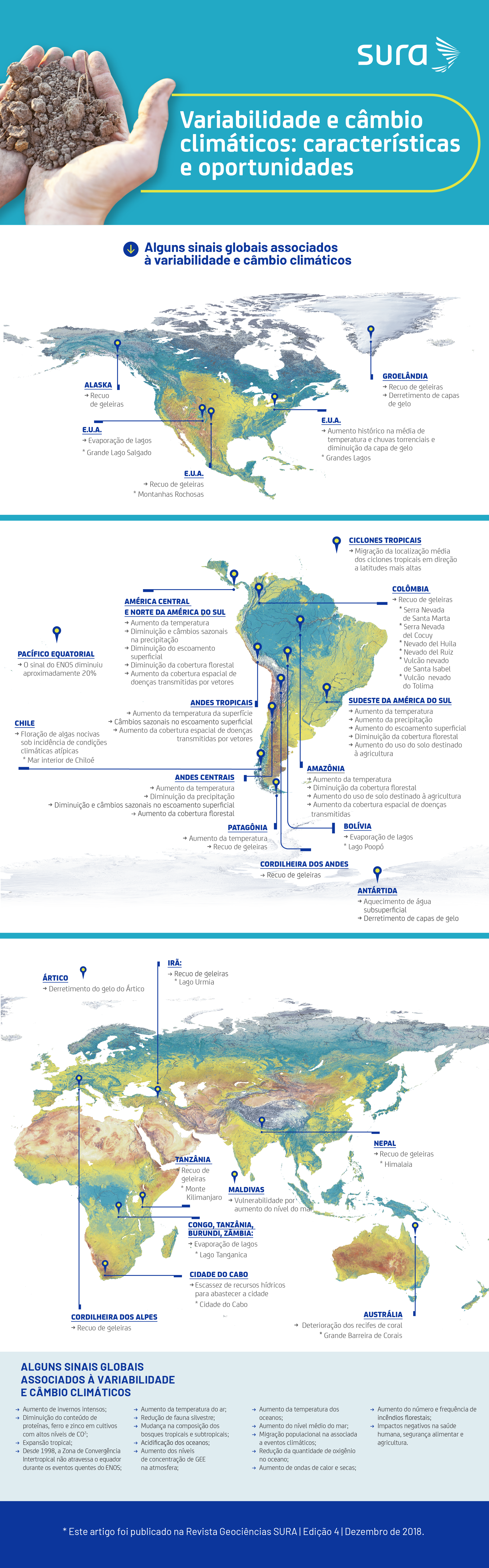
The manifestations of these changes are evident throughout the world in phenomena such as the receding of sea ice, the collapse of the oceans, the increase in the global average temperature, the increase in sea level, or the increase in the severity and frequency of extreme hydrometeorological events.
Opportunities and risks associated with climate change
The risks associated with climate change can be grouped into two categories: physical risks and transition risks.
The physical risks are those derived from the materialization of events of hydrometeorological origin, while the transition risks are the results of the implementation of public policies and regulatory changes aimed at reducing GEE emissions.
The latter have great potential to transform industrial technology and markets, and it is this transformation that creates opportunities for new emerging markets and the development of new technologies that guarantee the sustainability of the environment.
Or what is the world doing to fight against climate change?
This problem focuses the attention of the scientific community, as well as all types of governmental and non-governmental entities, which permanently join forces to establish actions that allow us to understand, finance and manage all the actions that allow us to mitigate or adapt to the consequences. do climate change.
Climate change does not have a single consequence and does not affect only a geographic region or productive sector. This is a transversal problem, with a very broad spectrum that impacts various social, economic and environmental sectors on a large scale.
Thus, the solutions cannot be concentrated on a single front, as highlighted by Dr. Germán Poveda, professor at the Faculty of Mines of the National University of Colombia, when referring to the strategies to face variability and climate change:
“One of the greatest difficulties we face is that for each sector, even for each person, climate change can have a totally different connotation: the consequences of energy generation are not necessarily the same as in food production or protection against “floods.”
As climate change becomes more and more understood, several strategies are emerging, thanks to the scientific community and the years of other actors involved, so that the consequences of a constantly changing climate, both for governments and for private companies, may be confronted. These ideas are mainly focused on mitigation and adaptation.
Climate change mitigation strategies are focused on defining measures to reduce GHG emissions that alters the atmospheric composition and accelerates global warming, as well as guaranteeing the conservation of two ecosystems that absorb and weaponize these gases.
Consequently, the transition risks associated with climate change are derived from mitigation measures, as these seek to encourage technological changes that allow the substantial reduction of GEE emissions and guarantee the conservation of forests used by some industries, leading them to redefine their strategies. and we will change the traditional production mechanisms.
On the other hand, the strategies that mitigate the physical risks resulting from extreme climatic events, such as more intense and persistent chuvas, longer dry periods or rising sea levels, are grouped together not known as adaptation measures to climate change. These measures can be structural, such as the construction of protection against extreme climate events, or non-structural, such as education and awareness programs or the implementation of urban planning standards. that limits the construction of residential and industrial complexes in areas with a high probability of extreme events.
Given this scenario, it is necessary that governments and productive sectors characterize their vulnerability to transitory and physical shocks that may negatively impact them. In this way, it is possible that the necessary measures to guarantee sustainability and resilience to the new challenges associated with climate change are also taken.
Finally, it is important to highlight that most of the measures proposed by global entities that lead the fight against climate change are classified into two categories (mitigation and adaptation), Many other strategies with different actors involved can be implemented to increase awareness about a sustainable world, such as the control of population growth, criminalization of deforestation, excessive consumption of natural resources and pollution of two life support systems (water, air, soils, forests and fishing), economy of water and energy and change of the matrix of polluting energy sources On the other hand, they should be clean and renewed, as suggested by Professor Germán Poveda.
Sources
- German Poveda Jaramillo. Civil Engineer and Mestre in the Use of Hydraulic Resources of the National University of Colombia, Mestre in Engineering of the University of California and Doutor in Engineering of Water Resources of the National University of Colombia and the University of Colorado.
- Juan Pablo Restrepo. Civil Engineer with specialization in Hydraulic Resources of the National University of Colombia.
- Luisa Fernanda Vallejo. Civil Engineering of the Antioquia Engineering School and Master in Hydraulic Resources of the National University of Colombia.