


On February 24, Russian military forces began occupying Ukraine. Day after day, the country is subjected to artillery attacks, bombing of various military bases and cities, among other military actions.
As time goes by, the conflict continues and the economic and financial consequences are increasing, affecting all regions of the world, including Latin America.
Here's how the world's economies are affected in various ways:
Sanctions
Many countries around the world have agreed to impose economic sanctions on Russia following its aggression against Ukraine. Driven primarily by the United States and the European Union, actions are being taken on different fronts with the aim of reducing Russia's ability to continue the ongoing military campaign. The main measures are:
-
- Several Russian banks have been removed from SWIFT (the dominant payment system for interbank transactions).
- Freezing the assets of the Central Bank of Russia, making it difficult for the country to liquidate the assets it currently holds.
- Freezing of assets of individuals or companies in their territories.
- Restrictions on exports of technology that could support Russia's ability to refine oil.
- Sanctions against Alexander Lukashenko, President of Belarus.
- Vladimir Putin signs decree banning taking more than $10.000 or its equivalent in other currencies out of the country.
International Trade: Economic sanctions will have an impact primarily on international trade, since by restricting exports and imports to and from Russia, countries with which it maintains an important bilateral relationship, they may begin to be affected, not only through international price quotations, but also from the lower supply and demand for goods and services that this may imply.
Trade relations between countries in the region and Russia
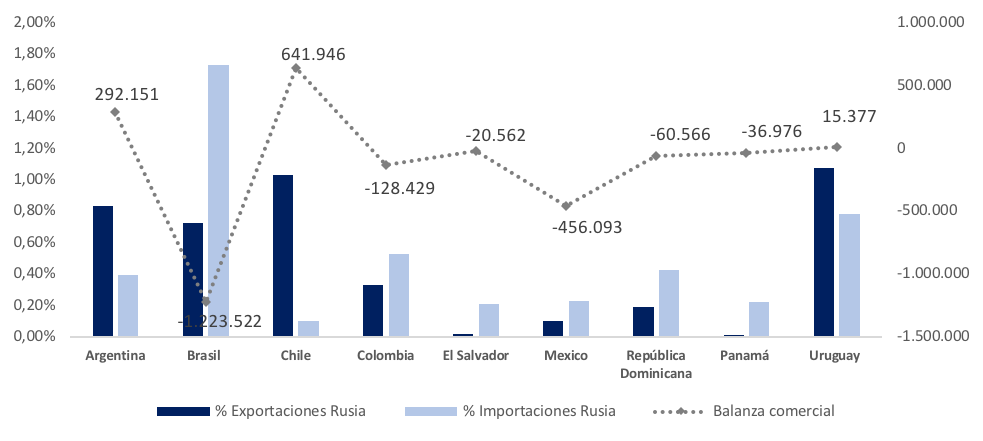
Argentina, Chile and Uruguay have a net surplus in trade relations with Russia, while Brazil, Colombia, El Salvador, Mexico, the Dominican Republic and Panama have a deficit. In general, exports and imports represent less than 2% of the total value of exports and imports.
Trade relations between countries in the region and Russia -Imports from Russia-
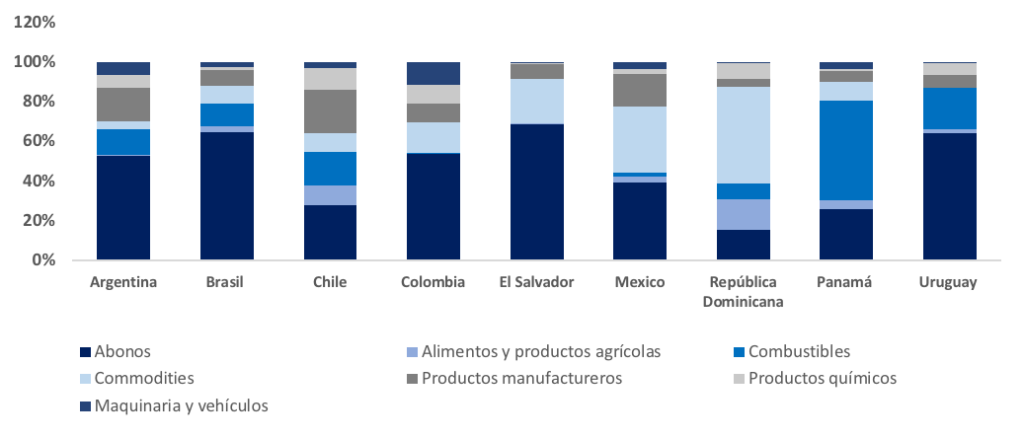
- Fertilizers are the main import product for countries in the region, where for countries such as Argentina, Brazil, Colombia, El Salvador and Uruguay they represent more than 50% of the total.
- In the case of Panama, imports of fuels and mineral oils stand out, representing 50% of total imports from Russia.
- Among the imports from the Dominican Republic and Mexico, commodities and raw materials stand out, which are mainly represented by copper, nickel, aluminum, wood and steel.
Trade relations between countries in the region and Russia – Exports to Russia
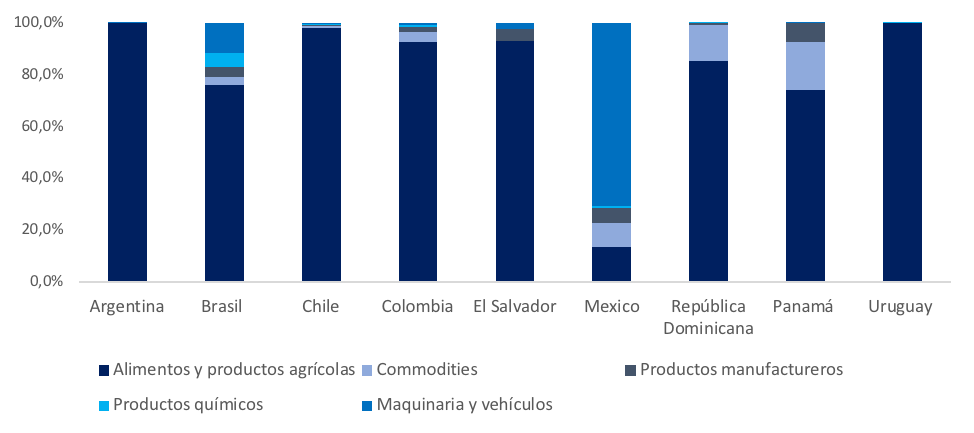
- Except in the case of Mexico, where the machinery and vehicles sector predominates, exports to Russia are mainly agricultural products for countries in the region.
Markets
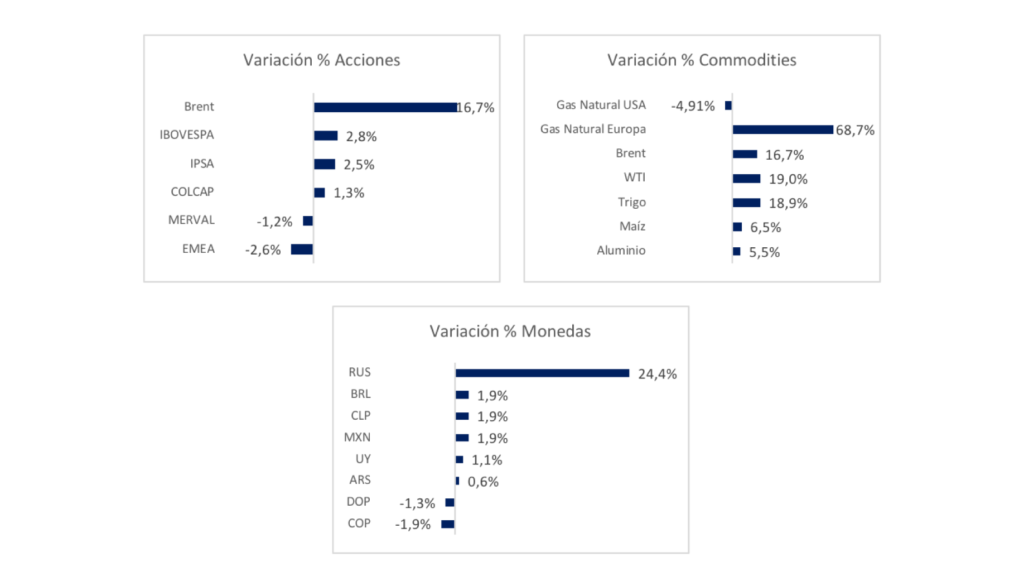
With the various sanctions imposed by Western countries and the measures taken by the Russian government in response, the main impacts are being seen in the international price quotes of commodities, the stock indices of Asia and the exchange rate of Russia and some countries in the region.
- Currencies such as the Colombian peso and the Dominican peso have shown slight appreciation in recent days, while the Russian ruble has depreciated by approximately 30%, reflecting the strong capital outflow that has been evident since Russia's formal invasion of Ukraine.
BUSINESS REACTIONS
- Multinational companies such as Adidas, Apple, Disney+, among others, have suspended the shipment of products and delivery of some services in Russia.
- Major oil companies halt major projects in Russia: Exxon, Shell.
- Volkswagen stops vehicle production in the country.
POLITICAL AND SOCIAL
- Position of countries worldwide.
In addition to purely economic sanctions, the political stance of countries regarding the conflict has triggered the adoption of measures by private and public organizations that cover operational, business, sports and social aspects. Some of the most notable decisions are:
- UN General Assembly approves non-binding resolution condemning Russian aggression against Ukraine. The resolution was approved by 141 of the 193 UN member nations. Four Latin American countries abstained from voting: Bolivia, Cuba, El Salvador and Nicaragua.
- Russian President Vladimir Putin announces that he has alerted the country's nuclear forces in response to aggressive comments from NATO member countries.
- Delegations from Ukraine and Russia met on February 28 to begin negotiations. The second day will take place on March 3.
- European Commission announces it will finance the purchase and delivery of weapons to Ukraine.
- German Chancellor Olaf Scholz announces an extraordinary 100.000 billion euro budget to modernise the German armed forces and the delivery of lethal defensive weapons to Ukraine
- The European Union, Switzerland and Canada have closed their airspace to all Russian aircraft, whether military, commercial or private. Russia has responded in kind.
- Russian government-controlled media outlets are banned in the European Union. State-owned media outlets such as Russia Today and Sputnik, along with their subsidiaries, will no longer be allowed to operate as sources of information.
- China has called for respect for its “legitimate interests” and reiterated that it is “firmly” opposed to any type of “unilateral sanctions” against Russia, a country with which it will maintain economic exchanges.
- Refugee crisis.
- According to the UN, 12 million people in Ukraine will need assistance, while more than four million Ukrainian refugees could need protection in neighbouring countries in the coming months.
- As of March 1, the UN reports that more than 900.000 people have left Ukraine.
- Ukraine reports more than 2.000 civilian deaths since fighting began on February 24.
- Brazil announces the creation of a humanitarian passport for Ukrainian refugees. Thousands of Ukrainian citizens live in the country, including some 600.000 in the state of Paraná alone.