



After a 2020 where the fiscal deficit grew up in Latin America, the situation begins to reverse. The public spending required by the policies implemented to reduce the impacts of the pandemic ceases and the countries of the region recover. However, factors such as the inflation and Russian invasion of Ukraine are putting pressure on economies again and governments are carefully considering their options for the coming years.
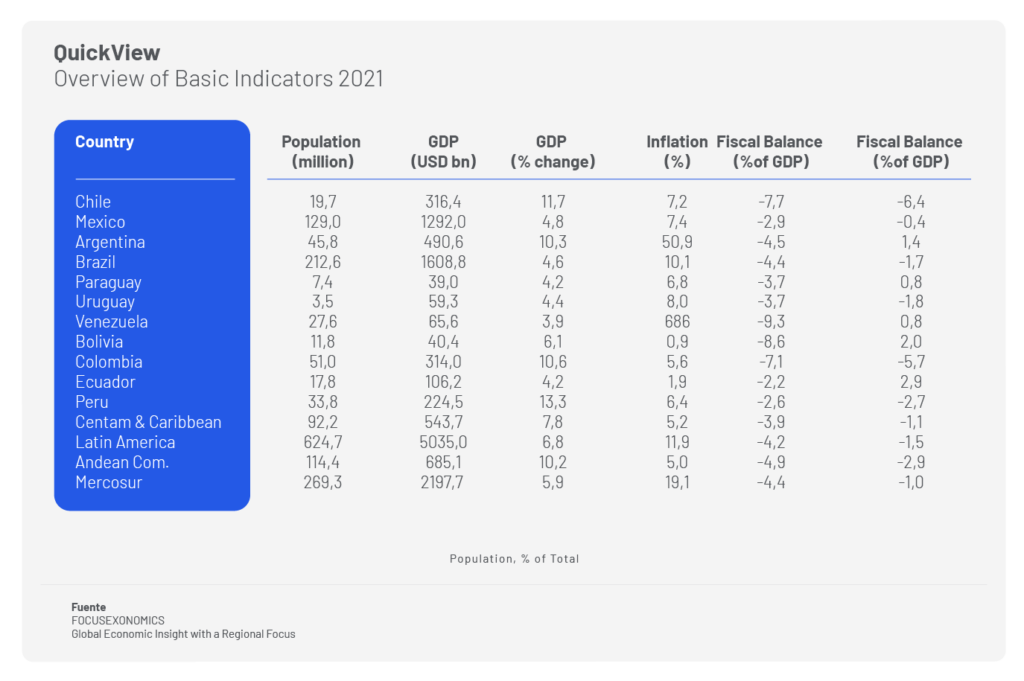
“The fiscal balance of Latin America for the end of 2021 was around -4.5%, showing a significant recovery compared to the previous year, in which the fall reached approximately -8.5%,” he explains. Juanita Gomez Loaiza, Managing Director, Trend and Risk Modeling at SURA. And he adds: “The economic recovery that occurred in the region after the lifting of travel restrictions mobility imposed by COVID 19, had a significant impact on the recovery of countries' public finances."
In that line, the International Monetary Fund The agency expects Latin American countries to close 2022 with an average deficit of 4.7% compared to their Gross Domestic Product (GDP). “Large variations are expected, ranging from the 7.6% forecast for Brazil to 1.5% for Chile, including 3.2% for Mexico; 3.8% for Argentina; 2,4% for Peru; 4.6% for Colombia; 2.7% for the Dominican Republic and 2.5% for Uruguay,” the agency said in a report entitled “Fiscal Surveillance” that it released in April of this year.
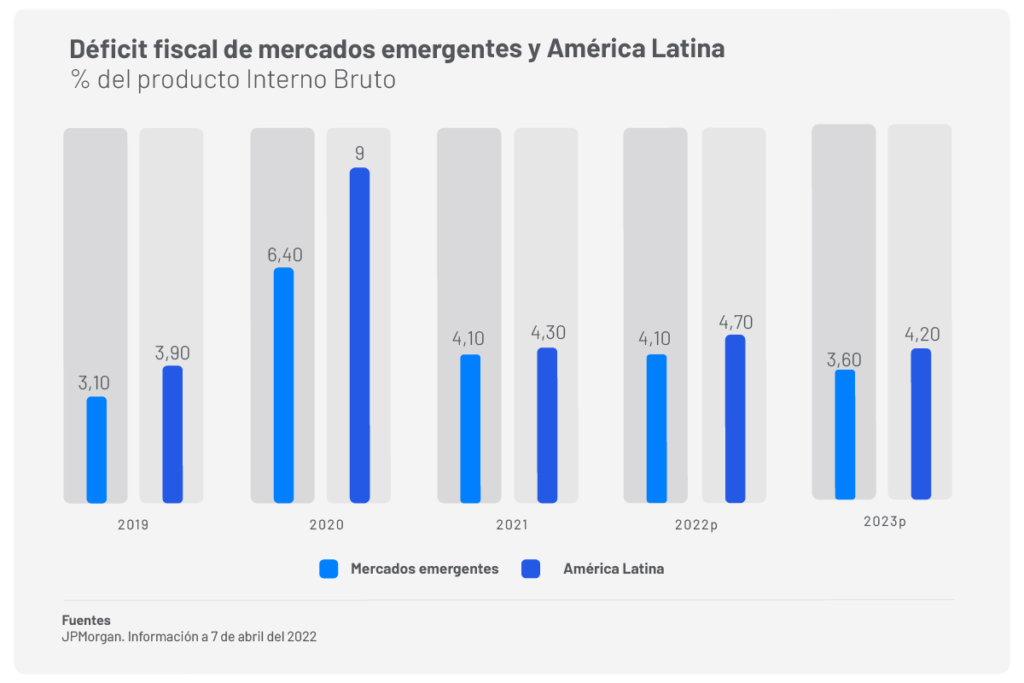
On the other hand, Fitch Ratings, the international risk rating agency, highlighted the reduction in deficits in countries in the region. “Tax collection grew well above real GDP and inflation (except in Panama and Bolivia) was the key factor for the solid fiscal results,” the firm said.
“However, this behavior was not homogeneous in the region and the challenges that governments face as their debt levels have significantly increased remain,” he points out. Gomez Loaiza.
The fiscal deficit in Latin American countries
According to Interamerican Development Bank (IDB), “in 2021, fiscal stimulus in Latin America and the Caribbean was reduced, but not eliminated.” “The average, measured by the increase in the primary fiscal deficit, was 2.1 percentage points of GDP in 2021 compared to 3.9 percentage points of GDP in 2020,” the organization notes.
The case of Brazil is one of the most notable. The Fitch Ratings study indicates that “the consolidated public sector recorded a primary surplus of more than USD 12 billion in 2021. On the other hand, the Central Bank of that country highlighted that it is “the first positive annual result in the last eight years.”
A different case is that of Ecuador, where a deficit of USD 3.7 billion was recorded in 2021. Although compared to that of 2020, which exceeded USD 7 billion, a considerable decrease is observed. Something similar occurs in Argentina, where the primary deficit in 2021 was 3% of GDP while the previous year it had been 6.5% of Gross Domestic Product.
The most complex cases in the Fitch report are Chile, Colombia and El Salvador as the “largest fiscal deficits” in the region. In the first of these countries, the deficit reaches US$23 billion, 7.6% of its GDP, while in the second the deficit is also 7.6% of the Gross Domestic Product, and in the third, 5.6%.
“Despite the economic recovery that was seen in 2021 worldwide, challenges remain in Latin America,” he comments. Gomez Loaiza. “The recovery, mainly explained by an increase in demand that could not be fully met due to the disruption in supply chains, leaves a global inflationary risk that was evident since the last quarter of 2021 and that has deepened with Russia's invasion of Ukraine in February 2022,” adds the SURA expert.
Latin America and the future of its fiscal deficit
Although the international context is complex, the IMF expects a continued decline in Latin America's fiscal deficit. The financial institution expects the average deficit in the region to fall to 4.2% of overall GDP in 2023 and to 3.4% in 2024.
“Projections for most Latin American countries point to much smaller deficits than in 2020 due to the end of the exceptional fiscal measures imposed due to the pandemic and the return of economic growth and, therefore, tax revenues,” said Paolo Mauro, deputy director of the IMF's Financial Affairs Department.
However, the IDB points out that this depends on the economic variables of each nation. “Countries that export raw materials will benefit from the increase in prices due to Russia’s invasion of Ukraine,” they point out. “Especially in 2023, and they will be able to use the associated revenues to slightly reduce their primary fiscal deficits by 2024 compared to the pre-war scenario,” they continue.
In contrast, in tourism-dependent countries, the progressive fiscal adjustment of the primary deficit is slowing down and the fiscal balance remains below the pre-war scenario. “The larger fiscal deficit projected in the 2022-24 period, together with greater inflationary pressures and the increase in the cost of financing, could lead to an increase in the debt/GDP ratio for the average country of up to 74% by 2024. For tourism-dependent countries and commodity exporters, the debt/GDP ratio could reach 87% and 68%, respectively,” the organization notes.
For this reason, experts say that each nation must make strategic decisions to reduce its fiscal deficit without damaging its particular economy. “Countries should begin to orient their medium-term policies towards scenarios with greater uncertainty,” he reflects. Gomez Loaiza. “This involves thinking about the optimal debt structure, terms, rates, types of bonds to be issued and, additionally, developing strategies that allow for the guarantee of the sources of income that will be necessary,” he continued.
In conclusion, the IDB comments that “the form of consolidation can be as important as deficit reduction.” “Policies to redirect spending that protect productive public investments, for example in infrastructure, and investments in health and education, can reduce the negative impacts of fiscal consolidation on output and reduce income inequality,” they point out.
In this regard, they state that “in more general terms, credible fiscal institutions are vital to guarantee medium-term fiscal planning and generate high confidence in fiscal sustainability. In these efforts, it is crucial to reduce labor informality, responsible for the high tax evasion that plagues the region and, in turn, limits the effectiveness of fiscal policies and undermines reforms,” they conclude.
Faced with a regional panorama that requires a complex balance, SURA supports users with products that adapt to the current context. Whether to continue growing, strengthen a project or find comprehensive solutions, there are insurance policies that provide the possibility of achieving these objectives. In addition, the professionals who work for the company offer advice to guarantee the peace of mind of each individual, family or company.