


It is estimated that, worldwide, the increase in medical costs during this year will maintain the same upward curve (8.1%) recorded in 2021. The data comes from the latest report made by Willis Towers Watson, a leading global company in advice, brokerage and solutions in the insurance industry, on the "Global Medical Cost Trends 2022".
The panorama and the variations presented were very different between regions and countries, being Latin America the most affected region, registering double-digit increases, driven by currency devaluation, variations in demand for health products, treatments and services, increased costs of freight and raw materials, non-compliance and delays in the delivery of medicines, among other aspects related to supply chain failures.
In 2021, Gross medical inflation in Latin America was 13.2%In some countries, the situation was more alarming. Mexico, for example, recorded a year-on-year increase of 19%. This figure is in contrast to 4.4% in Colombia or 5% in El Salvador.
The impact of costs in the region
Experts at Make Sure You Live They analyzed the prices related to the costs perceived by the user or final consumer. CPI health It explains the increase in out-of-pocket spending in households. Therefore, it reflects the increase in supplies and medicines dosed and packaged for retail sale, increases in co-payments or medical consultations, among other aspects that depend directly on the structure of the system in each country and its particular allocation of expenses.
“Inflation and medical costs vary depending on the macroeconomic conditions of countries, the structure of their health systems, competition, contracting and price regulation mechanisms, the participation of private actors, innovation in health, among other aspects,” explain specialists at Seguros SURA.
On the other hand, high volatility and high change in prices It is a consequence of the breakdown in the global supply chain, as well as the war between Russia and Ukraine.
Ukraine and Russia are not relevant players in the export of pharmaceutical products, nor do they have a significant trade relationship with Latin America and the Caribbean. “However,” say experts from asegura de Vivir, “the vulnerability and dependence of the region on extra-regional imports is evident, since it only manages to supply 17% of pharmaceutical product imports.”
"The European Union and the United States are the main trading partners for supplies to the health sector, which means that Latin America would be at the mercy of the impacts of the war between Russia and Ukraine on the production of medicines and supplies in these regions," SURA explains.
Cost dynamics by country
A report prepared by Ipsos, an organization dedicated to market research, compared drug prices in 7 Latin American countries: Argentina, Brazil, Chile, Colombia, Ecuador, Mexico and Peru.
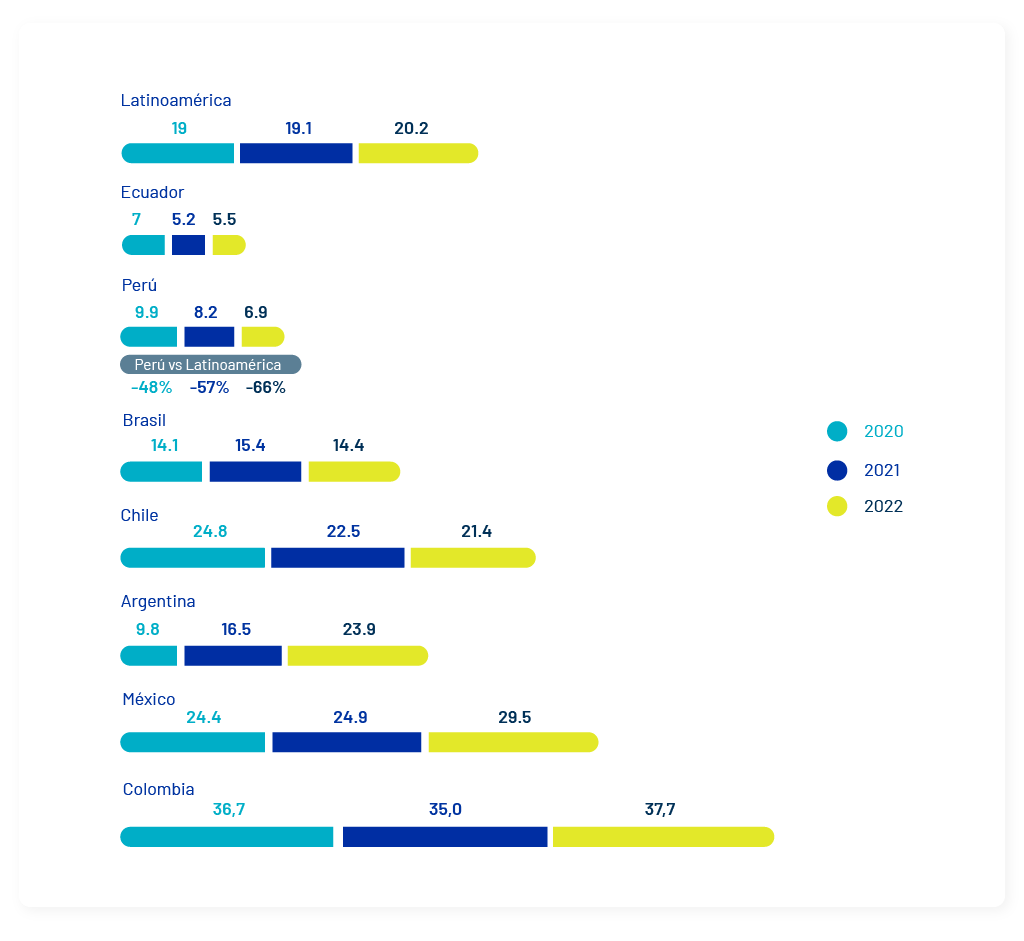
The graph shows that the only country - along with Peru - where there was a clear decline in the price of medicines was Chile, where the value of medicines fell year after year (of the period analyzed). The opposite happened in the Argentina, where the average went from 9.8 to 23.9 when comparing 2020 to 2022.
In many cases, part of the year-over-year decline recorded from 2020 to 2021 was lost the following year. Such is the case of Ecuador y Brazil. In parallel, in Colombia y Mexico, 2022 values exceed those of 2020.
Contrary to what happens with medications, Real wages are falling in the regionThis situation makes access even more difficult for various social sectors. Bloomberg Line It compared the minimum wages in force in Latin American countries for the months of January and August 2022, and calculated the real wage in each country against the accumulated inflation in the year up to August, that is, the present value of each minimum wage with the discount rate, which in this case is the CPI.
Argentina The United States is one of the most affected countries, with one of the highest inflation rates along with Venezuela and a fall of between 30% and 50% of real wages. However, most Latin American countries have a less marked fall, which is between 5% and 9%. In fact, some countries still retain almost all of the purchasing power of their nominal minimum wage, with inflation under control this year. This is the case of Panama.
Leaving aside Argentina and Venezuela, Chile It is the country with the highest inflation. Chile's wages have fallen by 9.13%. Closely followed by Costa Rica y Colombia, with falls that were around
8.77% and 8.37% respectively. Another preponderant case is that of Uruguay, where the real minimum wage was USD 433 in August after adjusting for inflation, while the nominal minimum wage was USD 467 at the exchange rate on September 21.
These are the real minimum wages in Latin America until August in other countries:
- Brazil: nominal minimum wage of USD 234 with a real value of USD 224 after an accumulated inflation of 4.39%.
- El Salvador: nominal minimum wage of USD 243 with a real value of USD 230 after an accumulated inflation of 5.46%.
- Mexico: nominal minimum wage of USD 262 with a real value of USD 248 after an accumulated inflation of 5.54%
- Dominican Republic: nominal minimum wage of USD 178 with a real value of USD 168 after an accumulated inflation of 5.7%.
From SURA Insurance We focus on the needs of people and companies. In this sense, we seek transformation through a new meaning of what we do and how we do it. We seek to deliver sustainable well-being and competitiveness to people and companies through human talent and management of trends and risks.
Our purpose is to fulfill our strategic objective: to achieve loyalty, attraction and development of people through sustainable profitability above the cost of capital. We are motivated to generate capabilities that allow maintaining and improving people's ability to manage their health, empowering them to care for themselves, thus contributing to the social and economic development of Latin American territories.