

Hail is a natural phenomenon of meteorological origin that represents a threat to different productive sectors, with the agricultural sector undoubtedly being the most vulnerable due to its potential to affect crops and plantations. This is why for several decades efforts have been concentrated on understanding its physics and establishing actions to mitigate its impact.
* This article was published in Geociencias SURA Journal | Issue 4 | December 2018.
How is hail formed?
There are several natural phenomena of meteorological origin that have a great potential to affect human lives and material assets: hurricanes, tornadoes, atmospheric discharges, gusts of wind, torrential rains and hail.
All these phenomena have their origin in thunderstorms, which are systems with spatial scales that can vary from a few to a few hundred kilometers, and time scales that fluctuate from a few minutes to several hours.
Weather systems characterized by these spatiotemporal conditions are known in meteorology as mesoscale systems, and are formed by masses of cumulonimbus clouds, commonly called storm clouds.
Cumulonimbus clouds are the highest type of clouds that can be seen in the atmosphere. They are dense and powerful convective clouds that are different from other types of clouds because their formation dynamics make them present structures of great vertical development, and can reach heights of up to 22 km above the Earth's surface, especially in the tropics.
They form when there is a high temperature gradient between the land or ocean surface and the upper layers of the atmosphere, which results in a rise of warm, humid air mass that increases the height of the column of these clouds in a process known as convection.
The formation of cumulonimbus is frequent in regions with high topographic relief., since orographic effects favor the convective processes that give rise to this type of system, and once formed they can travel, depending on the speed and direction of the winds, towards plain regions, even reaching coastal areas, as explained by Ph.D. Pablo Alberto Mercuri, Director of the Natural Resources Research Center of the National Institute of Agricultural Technology of Argentina (INTA).
It is important to note that although the phenomenon is directly associated with cumulonimbus, the formation of this type of cloud does not necessarily imply that there are hail formation processes. Stanley A. Changnon, for example, estimated that only 60% of thunderstorms can give rise to the phenomenon.
Additionally, Even when a cumulonimbus cloud presents the conditions that guarantee the formation of hail, it is possible that the hail will never reach the Earth's surface., because it can come into contact with parcels of warm air that are concentrated near the ground and change its solid state to liquid, causing it to precipitate in the form of rain. It is for this reason that thunderstorms rarely produce hail in warm climate regions.
On the other hand, regarding the proportion between solid and liquid precipitation that a cumulonimbus can generate, Gokhale, 1975, estimated in his studies that the volume of hail that reaches the Earth's surface is less than 10% of the volume of rain produced by a thunderstorm, and that it falls at an approximate speed of 150 km/h.
Hail falling to the ground reaches speeds of up to 150 km/h.
Hail as an agricultural risk
Hail can have negative impacts on property such as houses, cars, boats, aircraft, and can occasionally be dangerous for livestock and even, in exceptional cases, for human lives. However, it is possible to say that the most vulnerable sector to this type of natural phenomenon is the agricultural sector.
The impact that hail has on the agricultural sector is verified in the case of Argentina, where the majority of agricultural insurance billing corresponds to hail protection (95%). and to a lesser extent, to multi-risk insurance, in the latter case linked to the development of comprehensive risk policies, as expressed by María Fernanda Muñoz, Deputy Manager of Agricultural Risks at Seguros SURA Argentina.
In general, the damage that hail can cause to goods and properties depends mainly on the characteristics of the event such as the size of the hail, angle of precipitation, wind speed, amount of hail precipitated per unit area, and the characteristics of the impacted area. However, in the specific case of the agricultural sector, damage to crops is associated with two additional factors: the type and stage of the crop.
There are types of crops that may be more sensitive to hail than others. For example, tea and tobacco may suffer from small hail events, while other crops such as corn are a little more resistant and are only affected by hail with sizes greater than 19 mm (Bal SK, 2014).
The other determining factor in the damage that a crop can suffer due to hail is the stage at which the hail strikes. A storm may cause minimal damage at the beginning of a campaign for a specific crop, while the same storm can cause significant damage if it strikes in the middle stage.
The intensity of hail in a certain geographic region can be defined as the combination of four main factors that account for the severity of the phenomenon:
Event Frequency: corresponds to the number of times that hail events are recorded in a specific geographic region.
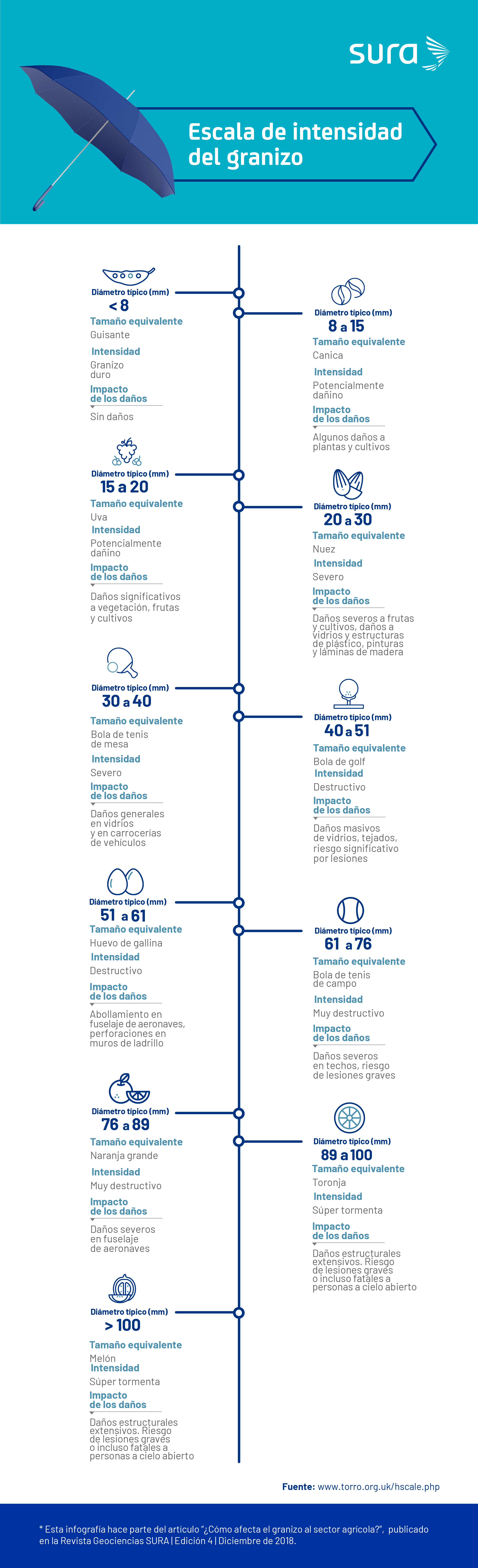
Average hail size: The size of hail is directly related to the damage it can cause. The larger the hydrometeors, the greater the damage they can cause.
Number of precipitated hydrometeors: Studies show that in general, the more frequent hail storms are at a given point, the larger the size of the hydrometeors and the number of elements precipitated per unit area.
Wind speed during hail events: The angle of fall of hailstones depends on the particle size and the wind speed. The greater the angle of fall from the vertical, the more damage the storms can cause, as they can reach surfaces that would otherwise not be affected.
What are the protection measures against hail?
Due to the high impact that hail has on the agricultural sector and the difficulty of anticipating the occurrence of the phenomenon in order to take actions to mitigate its effect, Several techniques have been developed to reduce the damage that hail can inflict on crops.
Some of these techniques are linked to the artificial modification of atmospheric conditions that give rise to hail, while others are focused on structural measures on land to protect crops:
Cloud Seeding: It is based on the modification of cloud microphysics that leads to the formation and precipitation of hail. It consists of introducing a substance into the already formed storm (by means of aircraft, ground generators or anti-hail rockets), so that additional ice crystals form around these particles that compete for the excess water in the cloud.
This produces smaller ice particles, which if precipitated, are more likely to melt upon contact with warmer air, turning into rain. artificial ice cores They are usually silver iodide, although potassium iodide or solid carbon dioxide (dry ice) can also be used.
Cloud seeding can also be done early in a convective system, with the goal of forcing rain to fall prematurely so that the potential for ice formation is not reached.
In Argentina, this mitigation system has been used in the province of Mendoza for several years, and is part of a comprehensive plan to combat hail due to the agricultural vocation in this region and the high threat of formation and precipitation of large hail that mainly affects vineyards, significantly damaging the quality of the grapes.
Anti-hail nets: They are protective meshes with high mechanical resistance and generally made of high-density polyethylene. These meshes withstand the impact and weight of falling hail, but can sometimes modify the microclimate of the crop, a factor to be taken into account in the feasibility at the time of installation.
Tree planting: Planting trees next to crops is used to intercept hail and help reduce wind speed and the speed of impact of the hydrometeor on the surface.
What are the systems for measuring and detecting hail?
Satellites
Satellites are used to obtain information on the meteorological conditions in which severe storms with the potential to produce hail develop. These sensors allow the measurement of atmospheric variables that are precursors to the phenomenon.
Weather radar
Radar measures distances using electromagnetic waves. It is based on measuring the time it takes for the wave emitted by the radar itself to return, once it is reflected by the particle. Most radars do not detect hail directly. Its presence must be inferred by means of techniques or criteria that use the data obtained by the radar and, in other cases, these measurements are combined with data from surveys or numerical models.
Disdrometers
They are used to measure all types of precipitation, recording the size, amount, diameter and speed of fall of the hydrometeor. From this information it is possible to calculate the reflectivity factor and the precipitation rate.
Hail gauges
Rigid foam plate on which the impacts of falling hailstones are marked. From this plate it is possible to obtain information such as the diameter, the density of the hailstone (quantity that has fallen), the intensity of the impact (kinetic energy) and the total volume of ice that has fallen in the area.
Fonts
- Juan Pablo Restrepo. Civil engineer and specialist in Hydraulic Resources from the National University of Colombia.
- Luisa Fernanda Vallejo. Civil engineer from the School of Engineering of Antioquia and M.Sc. in Hydraulic Resources from the National University.
- Maria Fernanda Munoz. Agricultural Engineer from the National University of La Plata, and specialist in Agribusiness from the University of San Andrés.
- Pablo Alberto Mercuri. Engineer in Agricultural Production from the Catholic University of Argentina, M.Sc. in Agricultural Applications of Remote Sensing, and Ph.D. in Agricultural and Biological Engineering from Purdue University.