


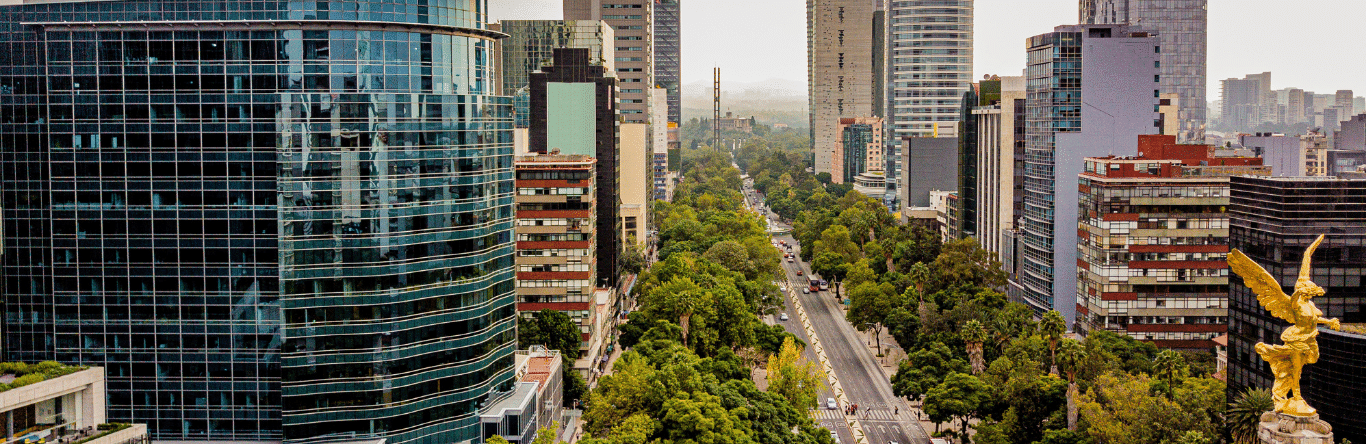
Mexico is a territory with a vast seismic history, with records dating back to 1500, and in which high-intensity earthquakes such as those of 7S and 19S in 2017 stand out. Considering that the reduction of seismic vulnerability is key to the sustainable development of a country, Mexico has concentrated efforts on the development of knowledge, the evolution of construction regulations and the preparation of suitable professionals for their application, which are essential elements to increase its resilience capacity.
* This article was published in Geociencias SURA Journal | Issue 3 | March 2018.
The lessons learned from earthquakes in Mexico throughout history have encouraged the development of research that has generated changes in the Earthquake Resistance Standards. Requirements have been incorporated in all stages of the projects, such as detailed studies of the characteristics of the soil and its local effects on buildings, greater knowledge regarding methods of analysis and structural design, use of earthquake-resistant materials and greater controls during the construction process stage.
The evolution of the Earthquake Resistance Standards in Mexico results in: a positive balance of the past earthquake of 19S of 2017, where only a small percentage of the buildings built in Mexico City collapsed or suffered significant damage, demonstrating that the changes generated in them have been key to achieving a reduction in seismic vulnerability.
SURA is currently supporting the development of structural assessment studies and repair/rehabilitation projects for approximately 40 buildings in Mexico City, the States of Mexico, Puebla and Morelos.
Management of buildings affected by earthquakes
The magnitude and severity of damage that a structure may suffer from an earthquake depends on various factors, such as the characteristics of the supporting soil, the quality of the structural design, the structural typology, the construction materials and the presence of irregularities.
The presence of damage to a building implies carrying out a detailed review of it, in order to determine whether it can be repaired, rehabilitated or if, due to the severe level of damage, it is advisable to demolish it and build it again.
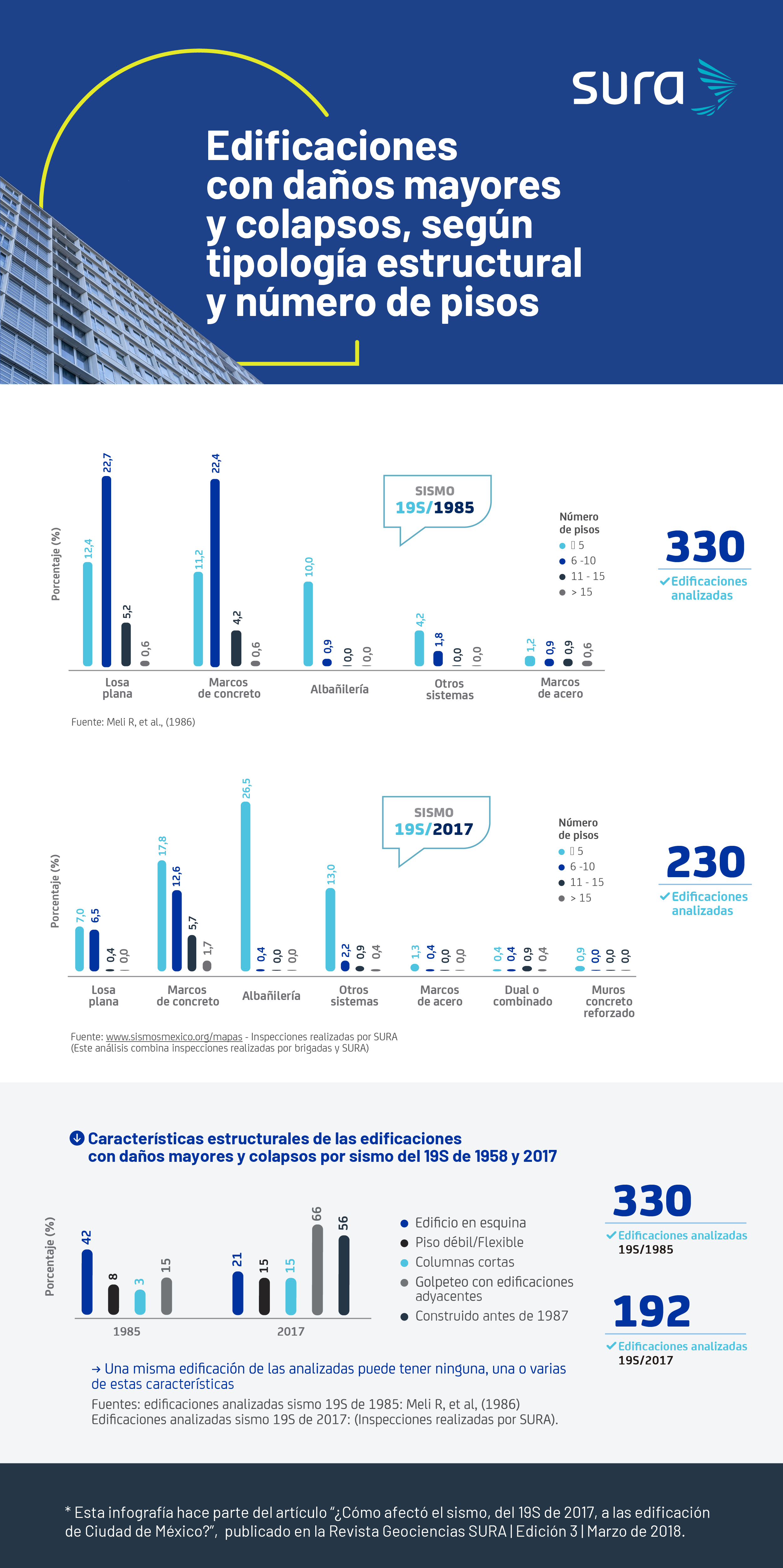
During the 19S earthquake, the structural systems that performed best were:
- Low-rise structures with continuity of walls from the foundation to the roof.
- Structures with parking spaces outside the building, eliminating the possibility of a weak floor in the structure.
- Dual or combined systems. Rigid structures whose displacements are smaller than those of concrete frames.
- Steel structures that, due to their modern design and height, have a very different vibration pattern to that of the ground.
- Buildings built after 1985.
- Reinforced concrete wall structures.
The most commonly used rehabilitation techniques for strengthening medium-rise buildings that were damaged by the 1985 earthquake were the casing of reinforced concrete columns and beams. For taller buildings, the predominant technique was the addition of reinforced concrete walls and metal braces.
Today, The great development of new technologies used in different parts of the world, which seek to improve the seismic performance of buildings, is highlighted.
A positive balance
The 19 September 2017 earthquake shows that the damage to buildings depends largely on the structural system and the area where the building is located. If a detailed analysis is carried out that takes into consideration which structures behaved appropriately in Mexico City, both in the 1985 earthquake and the 19 September 2017 earthquake, it could easily be concluded that Combined dual systems were some of the typologies that had the best seismic performance.
According to the opinion of M.Sc. Francisco García Álvarez, the 19S earthquake of 2017 had different characteristics than the earthquake that occurred in 1985, where the great distance between the epicenter and Mexico City (400 km), for the latter, caused the high frequency contents of the earthquake to disappear, leaving only the low frequencies that excited structures between 8 and 15 levels.
However, for the 2017 earthquake, with an epicenter closer to the city (approximately 120 km), the high frequencies were filtered out and therefore affected lower-rise buildings, with the disadvantage that these were the most predominant.
For a megacity like Mexico City, the number of buildings affected by the 19 September 2017 earthquake is low. The path towards seismic resilience marks a challenge that seeks to substantially reduce the vulnerability of the built environment, which implies interconnections with the mechanisms of communication to society.
In conclusion, The global effort to achieve greater resilience has focused on the use of new technologies both for the design of new buildings and for the implementation of rehabilitation alternatives, such as energy dissipation systems and seismic isolation, which imply an increase in initial investment costs but a significant reduction in structural damage and losses associated with business interruption. This translates into a lower total cost distributed over the expected useful life of the building.
Fonts
- Elizabeth Cardona Rendon. Civil Engineer and specialist in Earthquake Resistant Engineering from EAFIT University.
- Francisco Garcia Alvarez. Civil Engineer, M.Sc. in Engineering. President of the Mexican Society of Structural Engineering.
- Francisco Garcia Jarque. Civil Engineer, M.Sc. in Engineering.
- Gloria Maria Estrada Alvarez. Civil Engineer, specialist in Environmental Engineering, specialist and M.Sc. in Earthquake-Resistant Engineering.
- Juan David Rendon Bedoya. Civil Engineer and specialist in Structures from the National University of Colombia.
- Mario Rodriguez Rodriguez. Civil Engineer, M.Sc. and Ph.D. in Structures, full-time researcher at the UNAM Engineering Institute.
- Victoria Luz Gonzalez Perez. Civil Engineer from the University of Medellín, specialist and M.Sc. in Earthquake Resistant Engineering from EAFIT University.