

Technological, industrial and scientific development can be affected by space weather, particularly in sectors such as satellite operators, electrical infrastructure, airlines, oil drilling companies and precision agriculture. Research is seeking to better understand the Sun's activity and its effects in order to mitigate the associated risks on Earth.
* This article was published in Geociencias SURA Journal | Issue 1 | November 2016.
The last century has seen unprecedented technological, industrial and social development. Communication and transportation systems, space exploration and the use of electric power have not only improved the quality of life, but have become essential and interdependent structures for human activity, national security and economic vitality.
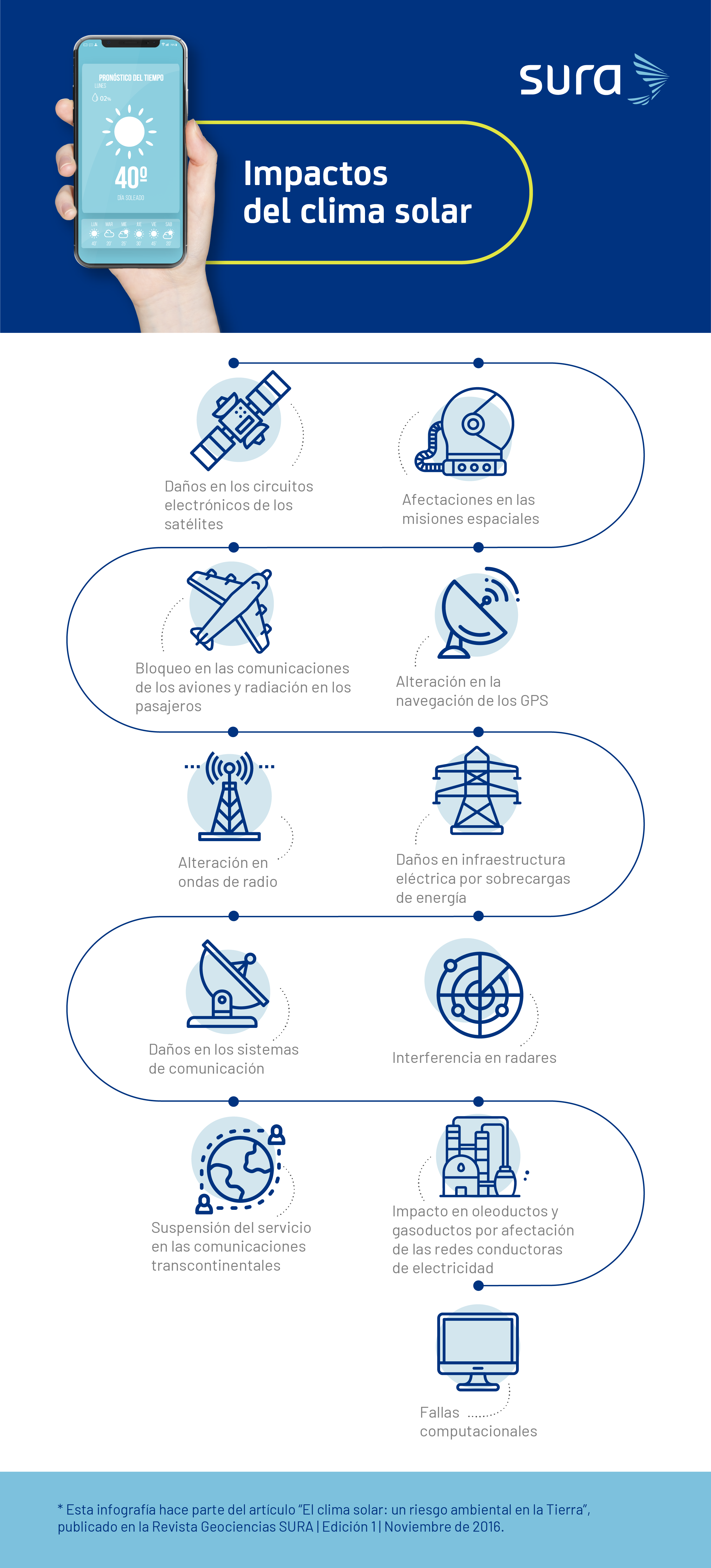
The need to understand and predict solar activity goes beyond scientific interest and directly impacts business and government forecasts, because This activity may affect electrical networks, wireless communications, telecommunications, global positioning satellites or GPS, space missions and maritime, air and land transportation networks..
Activity on the surface of the sun
On the morning of September 1859, XNUMX, astronomer Richard Carrington first observed the eruption of sunspots. Hours later, massive telegraph communications failures and colorful auroras were reported across southern Hawaii and Central and South America.
One hundred and thirty years later, in 1989, a solar storm left five million people in Quebec without electricity for twelve hours. Although they are not the only solar phenomena that have occurred in history, they are the ones that have had the greatest impact due to their significance and incidence on the planet..
According to a report by insurance market Lloyd's of London in 2013, an extreme solar storm on the scale of Storm Carrington could cause major disruptions to power grids, affecting a population of 20 to 40 million in the United States and generating recovery costs ranging from $600 billion to $2,6 trillion.
Coronal mass ejections (CMEs) are plasma clouds that are expelled from the Sun's outermost layer, or solar corona. They are most likely to occur during the peak solar cycle, which lasts between 10 and 12 years.
The generation of coronal mass ejections is related to the rotation and magnetic field lines of the Sun. When the rotation at the solar equator causes the stretching of the field lines, these interact with local magnetic fields, called active regions, creating sunspots, which eventually generate a solar storm that emits highly energetic particles, which move in a random direction and can occasionally reach the Earth.
In this regard, professor and researcher at the National University of Colombia, Ph.D Santiago Vargas Domínguez, explains that “understanding the behavior of sunspots—regions on the Sun of high magnetic activity—is important because they are the points where solar magnetism is emitted” and, therefore, they are closely related to solar flares.
“If sufficient resources are invested in protection technologies, the effects of solar storms can be mitigated, but the cost can be very high. This is a dilemma that industries constantly face.”
Ph.D. Louis J. Lanzerotti, physics researcher from the New Jersey Institute of Technology.
How do solar storms affect Earth?
The Earth has a natural shield generated by its magnetic field or magnetosphere, which protects it from electrically charged particles coming from outside. For this reason, a large part of the particles released in a solar storm are detected by the magnetosphere and others are directed towards the poles. Particles that reach the poles have the ability to interact with the Earth's atmosphere, as explained by Ph.D. Rualdo Soto-Chavez.
For New Jersey Institute of Technology physics professor and researcher Ph.D. Louis J. Lanzerotti, who has devoted more than four decades to the study of space plasmas, “Over the past 150 years, humanity's technological system has become more complex and, therefore, we are increasingly vulnerable to the effects of space weather.".
If coronal mass ejections interfere with the Earth's magnetic field, they may affect power transmission networks, space missions and communication systems. Additionally, bursts of solar radiation will disrupt communication systems, radars and GPS present in telephones, airplanes, ships and automobiles.
According to the National Oceanic and Atmospheric Administration (NOAA), “industries potentially affected by space weather should assess the potential impacts of these events on their operations in order to identify and implement possible mitigation measures that ensure the reliability and sustainability of their businesses.”
Sectors that should use space weather information include satellite operators, power infrastructure, airlines, oil drilling companies, precision agriculture and government agencies.".
Risk mitigation
In recent years, countries such as the United States have made various efforts to mitigate, respond to and recover from the potentially devastating effects of space weather.
The National Space Weather Strategy, launched simultaneously with the U.S. National Space Weather Action Plan in 2015, promotes greater national and international coordination and cooperation among public and private sectors—government, academia, emergency agencies, media, and insurance industries—to improve observation networks, conduct research, develop estimation models and increase efforts to protect and mitigate the risks associated with solar activity.
According to Ph.D. researcher Louis J. Lanzerotti, who is also a member of the U.S. National Academy of Engineering and the International Academy of Astronautics, “It’s really more of a cost-benefit problem than a technical problem. You always have to deal with the decision of how much you want to spend on risk mitigation versus the possibility of having the problem.”
Communications companies such as AT&T have redesigned parts of their power systems to mitigate the effects of solar storms on voltages. Other measures include shutting down transformers to prevent damage from these phenomena.
Ph.D. Louis J. Lanzerotti developed an instrument, RBSPICE, for NASA's Van Allen Probes mission to understand the radiation environment in space associated with solar activity. The spacecraft and its instruments were designed to operate continuously for six to eight years in the solar radiation environment. This is another example of mitigating the effects of solar storms, explains Ph.D. Rualdo Soto-Chávez.
The challenges of the future not only focus on understanding and estimating solar phenomena and their potential impacts more clearly, but also on improving the management capacity of industries directly affected by the behavior of space weather.These challenges range from estimating the representative lifespan of satellites, taking into account solar activity, to mitigating the economic losses that this can cause in hyperconnected societies.
Plans such as those of the United States government are just the beginning of a political effort to improve state preparation for inevitable space phenomena. Latin American countries and their public and private organizations should not be alien to such initiatives, to protect and preserve the dynamics of the global economy as long as solar activity is understood as a natural risk just like earthquakes, volcanic activity or floods.
Fonts
Louis J. Lanzerotti. Ph.D., professor and researcher of physics at the New Jersey Institute of Technology.
Rualdo Soto-Chavez. Ph.D., professor and researcher at the New Jersey Institute of Technology.
Santiago Vargas Dominguez. Ph.D. in Astrophysics from the University of the Canary Islands. Professor and researcher at the Astronomical Observatory of the National University of Colombia.