


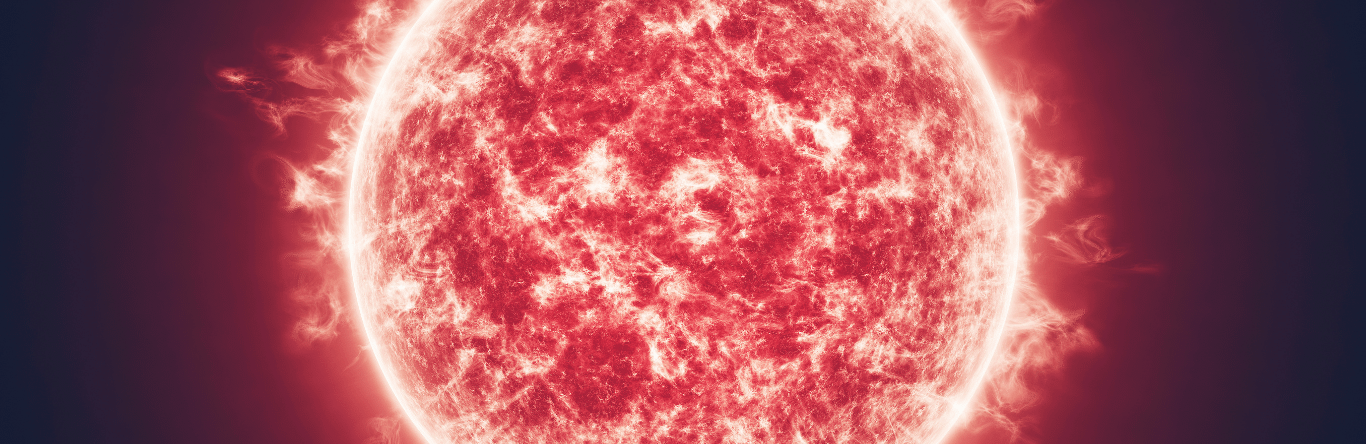
Galaxies are extensive space systems, held together by the force of gravity and composed mainly of gas, planets, countless stars and cosmic dust consisting of solid particles of ice and rock.
* This article was published in Geociencias SURA Journal | Issue 5 | September 2019.
The Sun is just one of more than 200 billion stars that make up our Milky Way galaxy. From this point of view, the Sun is nothing extraordinary in the Universe. However, for Earth and the planets that orbit it, it is a powerful center, holding the Solar System together, generating light, heat and life energy, and responsible for space weather.
The activity associated with solar dynamics, combined with the technological advances of humanity, has sparked the interest of the scientific community to understand in detail the physics of the Sun and the repercussions it can have on daily life on Earth, taking into account our high dependence on technological systems and their potential impact on some phenomena that occur on this great star.
Dynamics of the Sun
We can describe space weather as the system that regulates the conditions of the environment that exists between the Sun and the Earth. Space weather refers to energetic phenomena occurring on the Sun that affect systems and technologies in Earth's orbit and on its surface.
Before describing its impacts on Earth, it is necessary to provide a general context of the Sun and its dynamics, in order to better understand the phenomena that give rise to possible impacts on our planet.
Structure of the solar cycle
There are many types of stars. Among them is the Sun, a medium-sized yellow dwarf star that formed billions of years ago. The fact that the Sun appears yellow is an optical effect caused by the Earth's atmosphere, since the gases it is composed of cause only warm tones to be perceived on the Earth's surface, but in reality the star shines in a radiant white tone.
The Sun is composed of plasma, the fourth state of matter. Plasma is generated by injecting extreme amounts of heat and energy into the gaseous state of matter, resulting in an electrically charged gas. The Sun is capable of generating its own energy by fusing the nuclei of hydrogen atoms..
Because the particles that make up the Sun have positive and negative charges, magnetic fields are generated in it which, with the movement of plasma on its structure and in the presence of extreme temperatures, cause large explosions that are the driving force behind space weather.
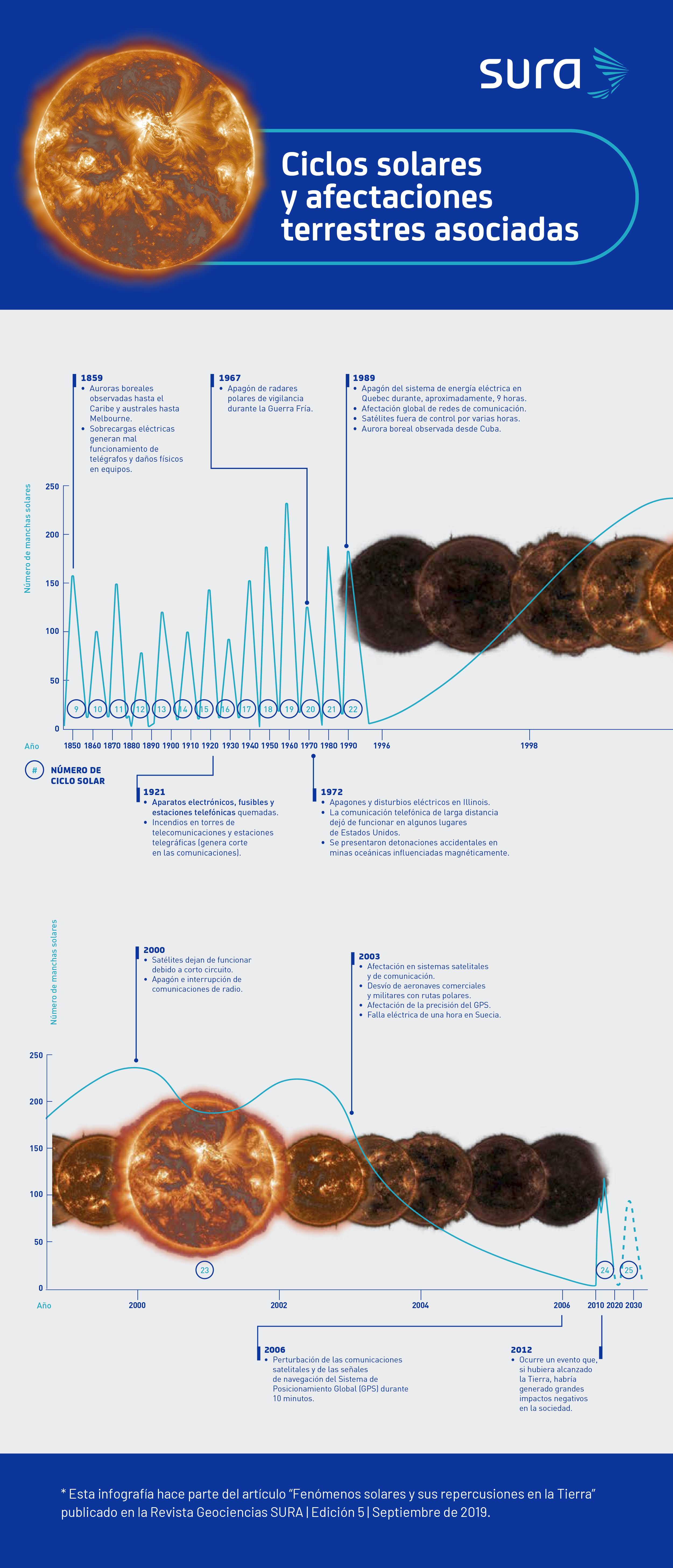
Based on the understanding that has been developed around the Sun, the scientific community has established that solar activity presents a cycle that lasts approximately eleven years, which is driven by its magnetic field.
The Sun's atmosphere is subject to large explosions as a result of its composition and the interaction of magnetic fields generated by electrically charged particles.Each flare converts magnetic energy into other forms of energy and causes the Sun to reach a calmer state. At this point, the Sun experiences what is known as a solar minimum and marks the beginning of a new cycle. In this state, flares are less frequent, so the Earth is less likely to be affected by solar activity.
Once a new solar cycle begins, the Sun's magnetic field increases its activity until it reaches its maximum level. At this point, the Sun presents its greatest energetic activity, which increases the appearance of sunspots. These are seen as dark regions on the surface of the star, because the amount of energy experienced by the area prevents the heat from the Sun's interior from emanating to the surface, generating lower temperatures than those of its surroundings.
A greater number of sunspots makes the solar climate more intense. This means that the Sun emits more energy and, therefore, the phenomena that affect our planet become more probable and common.
Energy phenomena associated with solar dynamics
The processes associated with the physics and dynamics of the Sun generate energy phenomena that have repercussions on the space environment between the Sun and the Earth. Some of these are:
Solar flares
Eruptions of electromagnetic radiation that occur on the surface of the Sun and can last from minutes to a few hours. They occur when the magnetic field lines become intertwined in such a way that a break is generated that releases all the energy stored in them. Considering that electromagnetic energy travels at the speed of light, The effect of solar flares on our planet is perceived a few minutes after the event is observed on the Sun.
Coronal Mass Ejections or CMEs
Enormous emissions of plasma (matter) and magnetic field originating in magnetically disturbed regions of the Sun's atmosphere and ejected into space over the course of several hours. They are most often preceded by solar flares.
These emissions represent the largest and most violent explosions in the Solar System. CMEs can travel at speeds ranging from 250 km/s to 3.000 km/s, the fastest ones can take between 15 and 18 hours to reach Earth, while the slowest ones can take several days. As they move away from the Sun, the ejections increase in size and can channel particles towards our planet that alter its magnetic field and create disturbances in it.
Solar Energetic Particles or SEP
Highly charged plasma particles transported in the solar wind. The energy released accelerates these particles to locations where explosions occur on the Sun, such as mass ejections and solar flares.
The particles can be accelerated to significant fractions of the speed of light and the event can last from a few hours to several days. These particles represent sudden increases in the intensity of radiation on Earth.
Solar wind
The Sun constantly emits plasma into space due to its composition and surface activity. This flow of particles is known as solar wind and has great potential to affect the Earth depending on the region of the Sun where it is produced, its speed, density and the magnetic field it carries. The solar wind originating at the poles and high latitudes of the Sun is high-speed (it can reach 800 km/s), while the one originating at the solar equator (the one that reaches the Earth) is low-speed (around 400 km/s).
“How much energy does a solar flare release? One can compare the world’s annual energy consumption, which is about 1020 Joules, with a single solar flare, which releases 1025 Joules.”
Antti Pulkkinen, deputy director of NASA's Heliophysics Department.
Impact of solar dynamics on Earth
The consequences of solar dynamics on Earth can manifest themselves in three interrelated ways: northern and southern lights, ionospheric storms and geomagnetic storms. Each can have a greater level of impact on our planet, depending on the speed at which these phenomena arrive and the magnitude of the impact.
Northern lights and southern lights
Depending on the severity and, in some cases, the location of the Sun where the energetic phenomena occur, there are different types of effects on Earth. The best known are the northern lights (in the northern hemisphere) and the southern lights (in the southern hemisphere).
The polar lights are one of the effects generated by solar activity. They occur due to the collision of charged particles with the upper atmosphere.
The charged particles follow the Earth's magnetic field towards the polar regions where, upon colliding with oxygen and nitrogen atoms and molecules, they transfer the energy contained in them to the Earth's atmosphere, causing the oxygen and nitrogen atoms and molecules to enter higher energy states, releasing it in the form of light.
Ionospheric storms
The ionosphere is the layer of the atmosphere that is electrically charged, because of this, it is the layer that has the greatest impact on the propagation of electromagnetic waves, which translates into communication, either between different parts of the Earth (by means of radio waves) or between outer space and our planet (satellite communication).
The ionosphere is particularly sensitive to variations in energy coming from the Sun. It can change its density and affect the way electromagnetic waves travel through it.
Solar activity can cause high-frequency (HF) radio waves traveling through this layer to be degraded or completely absorbed.. This causes disruption of long-range radio communications. These high-frequency waves are used by international radio stations, weather stations, ocean-to-ground communication in navigation and air-to-ground communication in aviation, citizen, government and military radio, some radar systems and the global maritime distress and safety system.
Disturbance of the Earth's magnetic field
geomagnetic storms
Another impact of space weather on Earth is the interaction between large explosions on the Sun and the behavior of the Earth's magnetic field. Variations in our planet's magnetic field can be measured from the Earth's surface, and these fluctuations are called geomagnetic storms.
When there is an input of mass, energy and momentum into the Earth's magnetic field due to perturbations on the Sun, the field is altered globally by the pressure exerted on it by the solar wind. All this interaction creates massive electric currents with amplitudes of millions of amperes, which flow through the magnetic field and can vary on time scales of seconds.
A geomagnetic storm can last for several days, after which the magnetic field gradually recovers. These changes in the Earth's magnetic environment can have an impact on:
- Satellite communications: television, communications and navigation signals.
- Global Positioning Satellite Systems (GPS): GPS coordinates deviate by several meters.
- High frequency radio waves: degrade.
- Additionally, violent changes in the magnetic field induce electric currents into conductive systems such as gas and oil pipelines, railways or high-voltage power transmission systems. These currents, also called geomagnetically induced currents (GIC), cause early corrosion of conductive systems such as pipelines; on power transmission lines they can create voltage fluctuations that collapse the system or cause transformers to overheat.
How is the world preparing to face these phenomena?
Efforts to manage and legislate these types of events are increasing. In the United States, for example, these efforts have focused on research and development groups, economic sectors, research and forecasting centers and government entities, each with a specific role.
Moreover, the power transmission industry It focuses on thinking about how energy systems (generation, transmission and distribution) are built in a resilient way, trying to reduce the impact of events where the network is disrupted, with decision-making that allows them to anticipate, adapt and recover quickly.
The prediction centers They focus on forecasting large explosions, implementing new models, improving the uncertainty of predictions and modelling the response of the Earth's magnetosphere, the ionosphere and the distribution of currents on Earth to energetic phenomena occurring on the Sun.
The governmental agencies For emergency management, they focus on planning for immediate response and early recovery from events of this type, directing resources to activities aimed at preparation, response, recovery and mitigation of associated effects.
Space weather has aroused growing international, scientific, industrial and public interest, as all sectors depend on electrical energy (communications, water, health, finance, to name a few). In addition, As technology advances and permeates everyday life, people become more vulnerable and adopt new dynamics in which space weather can affect their daily lives.
The challenges for the future are closely linked to better interaction between different disciplines and to connecting global efforts to generate joint development and a deeper understanding of the variety of processes that link solar activity and daily activities on Earth.
Fonts
- Antti Pulkkinen. Ph. D. and M. Sc. in Physics from the University of Helsinki.
- Luisa Fernanda Vallejo. Civil engineer from the School of Engineering of Antioquia and M.Sc. in Hydraulic Resources from the National University of Colombia.