

The Global Earthquake Model (GEM) is a global initiative that seeks to bridge the gap between knowledge and communities exposed to seismic hazards around the world. Its approach is based on scientifically reliable research, public data, tools to consider alternative scenarios and models, and synergies between academia and the public and private sectors.
* This article was published in Geociencias SURA Journal | Issue 1 | November 2016.
Assessing seismic risk in the world and communicating it openly is the main objective of the GEM Foundation. To achieve this, it researches and transfers information and knowledge that translate into the possibility of mitigating economic losses and, most importantly, preserving lives.
Global Earthquake Model (GEM), headquartered in the Italian town of Pavia, is a non-profit public-private partnership that provides organizations and individuals with open resources to assess seismic risk Anywhere in the world.
“We believe that partnerships between state, academic and private organisations worldwide are essential to managing natural disasters and preserving lives,” explains Ph.D. John Schneider, Secretary General of GEM.
The research carried out seeks to generate tools, collect information and build synergies to share knowledge and work with transparency. With all this, GEM aims to become a bridge of communication between scientific rigor and communities exposed to seismic threats in the world.
How did GEM come about?
The platform began operations in 2009 and has since then led global research and publicly disseminated its results, faithful to the principles established since its inception: open, credible, collaborative and transparent.
Its creation responded to an initiative of the World Science Forum of the Organization for Economic Cooperation and Development (OECD), in 2006. Since its conception it has sought to become The most comprehensive source of knowledge on seismic risk and a world reference for its knowledge and application.
“We work not only to develop tools or collect information, but to build synergies where everyone involved is convinced of the importance of sharing, being open and working together,” says Schneider, Ph.D. in geophysics.
During the first years of work, many financial resources were provided by public and private organizations in the form of sponsors. However, GEM directors realized that organizations show more interest in sponsoring specific projects in their areas of influence, so they expanded their work scheme and linked institutions committed to work at regional and country levels.
GEM has sponsors and public and private partners all over the world. SURA has been a sponsor since 2014 and has actively supported its projects and activities in Latin America.
Learning and teaching
Since 2009, there have been many lessons learned. Each investigation provides valuable data, and “with each earthquake we have the opportunity to collect more information that can be used to validate our models and advance prevention,” explains Ph.D. Schneider.
Earthquakes such as those in Chile and Haiti in 2010, Japan in 2011 and Nepal in 2015 have served to validate results. Ph.D. Schneider comments that “Our job is not to assess whether governments are prepared or not to respond. Our job is to help them understand the risk and to assess it themselves. whether or not the plans they have to mitigate them—such as building codes, urban planning, or building rehabilitation plans—are adequate.”
For this reason, its reports, research and tools such as OpenQuake They are shared with anyone who wishes to access them around the world, thus providing knowledge for estimating seismic hazards and risks.
GEM does not directly study other phenomena such as tsunamis or floods; however, it has managed alliances with organizations specialized in the study of these. One example is the Italian foundation International Center for Environmental Monitoring (CIMA), with which it works together on modeling, prevention and management of hydrological risk.
He has also worked with universities and scientific institutions in various countries, such as the geophysical institutes of Australia, Germany, the United States and Colombia. These institutions have implemented information or use GEM tools as the core of their plans for the development and dissemination of seismic knowledge.
SARA, investigations in South America
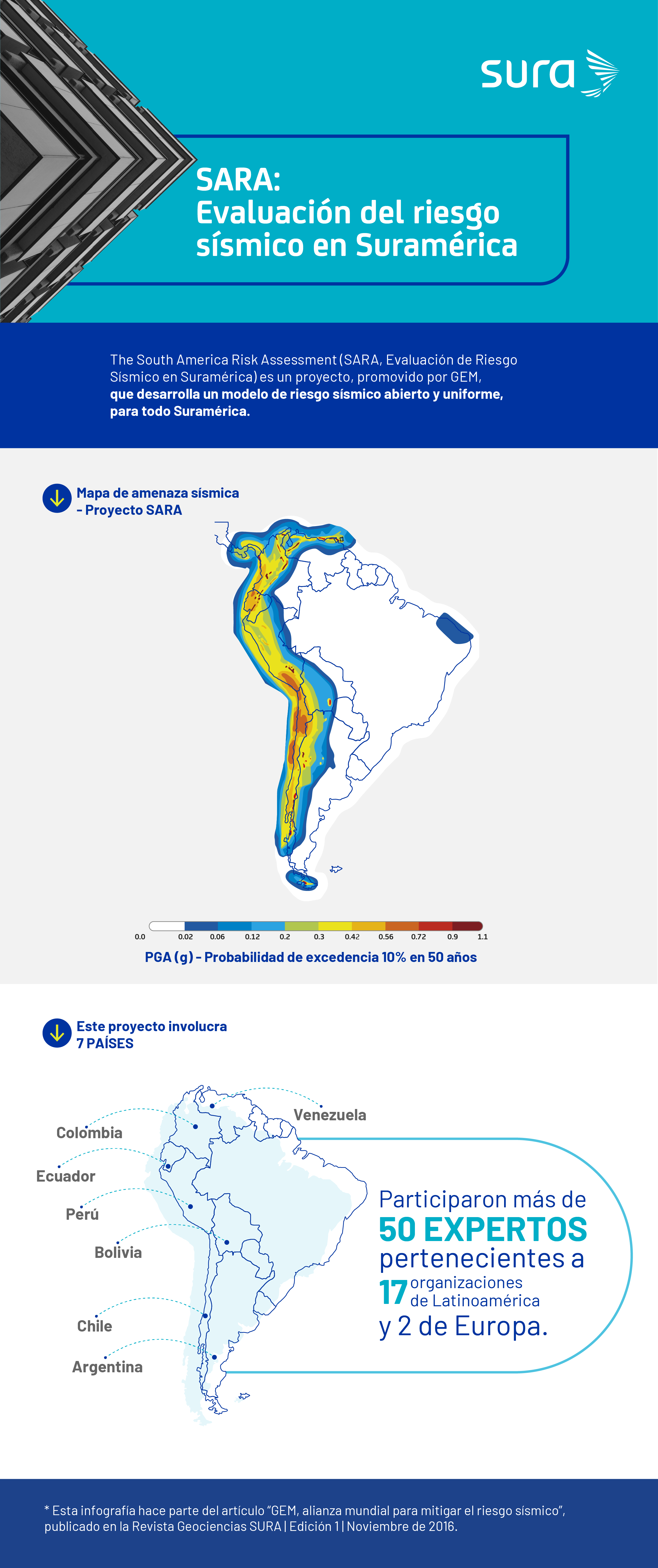
The South America Risk Assessment (SARA) is a project developed by GEM that benefits this part of the continent. The project began in January 2013 and seeks to develop a model for estimating seismic hazard and risk in the region through the use of standardized data and methodologies based on the principles of transparency, knowledge sharing, and scientific rigor.
SARA seeks to mitigate impacts and its work shines even more when one remembers that between 1970 and 2012, 77 people died and 15 million people were affected by the earthquakes that occurred in South America. In addition, economic losses were estimated at 37 billion dollars. For this reason, experts from the region planned research to offer products that would improve risk management and strengthen interest in learning more about this phenomenon.
For GEM Secretary General, Ph.D. John Schneider, “This has been a very successful project. It currently has the most complete information on seismic risk in the region.”This was confirmed after the earthquake in Ecuador, which occurred on April 16, 2016, where the investigations carried out were a valuable input for the Government of that country in estimating potential damage to buildings, the cost of replacement, the distribution of victims and the general impact.
In addition, GEM has conducted specific training in South America on the uses and applications of its products and tools, has provided support to universities that offer courses on seismic risk assessment and management, and has worked in conjunction with disaster prevention centers in several countries in the region.
What is the future of GEM?
GEM currently has several projects it plans to implement. One of the most important is to continue feeding its global project of information on seismic sources. In the seismic hazard component, it plans to collect additional information on the local response of different types of soil, especially in urban areas where soil variability is high.
You will work on recovery models to understand how social, physical, and economic factors contribute to how communities respond to or recover from an earthquake.. GEM will create prototypes similar to OpenQuake which can be used for other types of natural risks.
Research, knowledge transfer and preservation of life and property are objectives that make GEM's work generate benefits and strengthen seismic risk mitigation worldwide.
Fonts
- John Schneider. Geophysicist from the University of California, San Diego, United States, Ph.D. in Geophysics from the University of Wisconsin.