

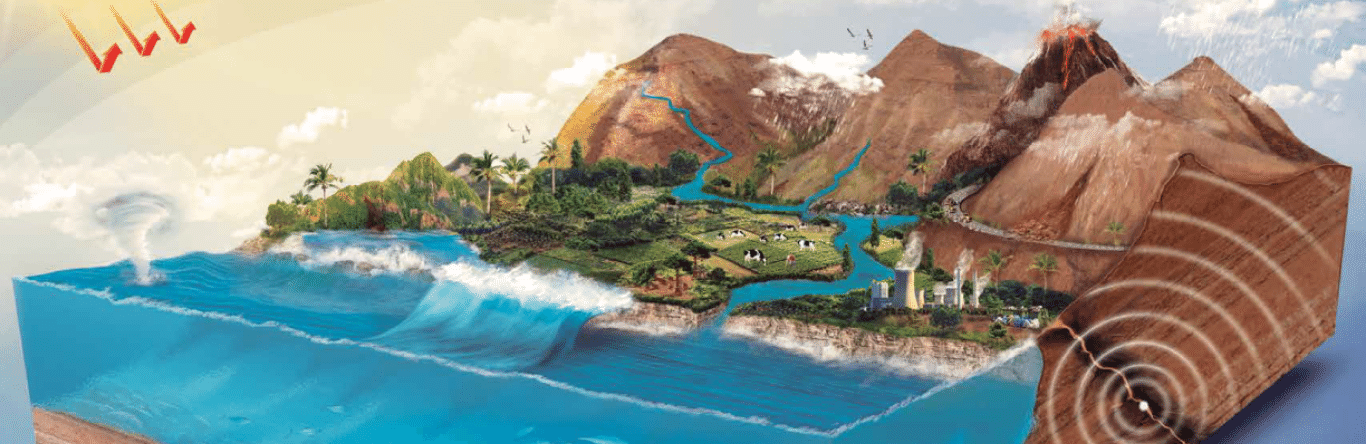
SURA's Trend and Risk Management (TRM) model recognizes nature as a source of interrelations with productive activities, human talent and the financial results of companies. By managing nature's trends and risks, organizations can better understand the associated phenomena and variables, measure their impacts, reduce uncertainty, anticipate and create value.
* This article was published in Geociencias SURA Journal | Issue 2 | September 2017.
SURA, in its Risk and Trend Management model, recognises that nature, through the combination of its capabilities (sources of resources) and restrictions (natural phenomena), offers skills that enhance and in turn delimit human development and activities.
Society and technological developments have generated positive and negative changes in the environment, which is due to the fact that the capabilities of the natural environment have not always been understood and treated appropriately. Therefore, Knowledge of natural resources and phenomena is essential in the strategic direction of business, by considering the natural environment that encompasses the Earth with all its interactions and variables at the level of the continents, oceans, atmosphere and outer space.
The interactions between the forces of the environment, society and technology have generated transformations of a global and gradual nature, but with very marked impacts that are reflected in the megatrends of urbanization, variability and climate change, scarcity of natural resources, demographic changes, hyperconnectivity, globalization, power and global government.
These megatrends reflect nature's responses to forms of exploitation and indiscriminate use of resources., greenhouse gas emissions and environmental degradation, which in turn generate needs for sustainable development of cities, considering population distribution, soil suitability, quantification and management of variables and natural phenomena.
SURA has developed trend maps that allow us to understand the environment, the forces and the major global movements that have an impact on consumer behavior and the way we reinvent businesses.
Managing nature trends and risks
By managing nature's trends and risks, organizations can better understand the phenomena and associated variables, measure their impacts, reduce uncertainty, anticipate and create value.
The forces of the environment include natural and variable phenomena of geophysical origin (earthquakes, landslides, tsunamis), hydrometeorological (floods, torrential rains, hail, hurricanes, tornadoes, droughts) and cosmic (solar storms, meteorite falls), as well as flora, fauna and, of course, human beings.
It is clear that the forces of nature and the environment play a fundamental role in consumer and business trends, which is why studying their interrelations is essential.
Consumer trends revolve around knowledge of the environment, and this is where nature becomes a key factor. Consumers are more informed and their decisions to purchase products and services are increasingly determined by arguments related to the values of organizations in terms of adopted technologies and processes, environmental awareness, ethics, compliance with regulations, human talent, social commitment and risk management, which are reflected in the impacts associated with the goods or services they consume.
Visualizing these consumer trends in companies, understanding them and anticipating them through the necessary changes in business management, is a fundamental exercise for long-term sustainability.
This is why SURA has developed trend maps that allow us to understand the environment, the forces and the major global movements that have an impact on consumer behavior and the way we reinvent businesses.
Assessment of natural phenomena and risks
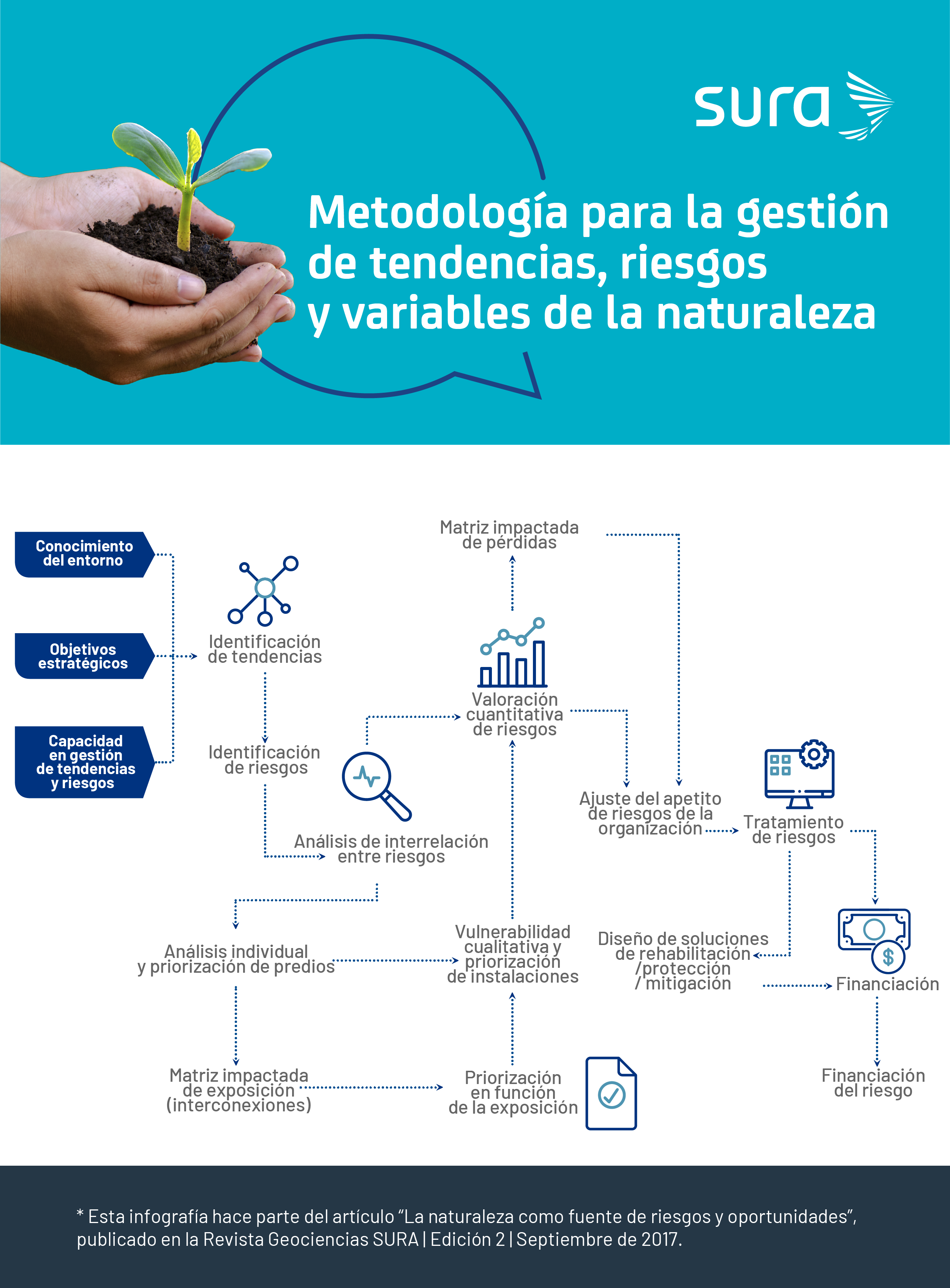
Nature Trend and Risk Management seeks to highlight the factors that have the greatest influence on an organization's strategy and operations, thus allowing it to prioritize those where the most relevant elements for the business converge.
The analysis of the forces of nature is approached from the phenomena and variables of this, classified as: geophysical, hydrometeorological and cosmic, which are closely related to each other.
The analysis is carried out through a phased process:
- Regional study and prioritization of properties, facilities or land, highlighting those that have greater exposure to natural phenomena, variability and climate change.
- Quantifying opportunities and risks on higher priority properties, considering interactions with nature and their relevance to the business.
- Cost benefit analysis as a basis for decision-making on adaptation, mitigation and risk transfer measures where the greatest impacts on business results are estimated, in terms of the safety of people, human talent, communities, income, profits, assets, relationships with suppliers, loss of customers, among others.
- Implementation of measures oriented towards sustainability and competitiveness, which are reflected in business continuity, income stabilization, market opportunities, strengthening of long-term relationships with suppliers, brand positioning, better risk indicators from international rating agencies and a growing positive reputation among consumers.
Nature's interrelations with business trends and risks
When nature's opportunities and risks are assessed in isolation, the vision is too short to achieve their proper management. SURA's approach to assessing the interrelations between nature and business trends and risks opens up the spectrum in such a way that it makes visible new opportunities to achieve greater efficiency in processes, sustainable use of natural resources, adoption of technologies with lower environmental impact, identification of critical points in supply chains, analysis of new ways of managing business, optimization of investments and creation of value for customers, society and the environment.
SURA seeks to raise awareness by making visible the trends and risks to which organizations are exposed., from a holistic and interconnected approach with nature.
Fonts
- Elizabeth Cardona Rendon. Civil engineer and specialist in Earthquake-Resistant Engineering from EAFIT University.
- Gloria Maria Estrada AlvarezCivil engineer, specialist in Environmental Engineering, specialist and M.Sc. in Earthquake-Resistant Engineering.
- Juana Francisca Llano Cadavid. Lawyer, specialist in Financial and Business Law, Civil Liability Law and Insurance from the Pontifical Bolivarian University, Reinsurance specialist from the Pontifical University of Salamanca.