


People and companies immersed in a changing environment require information and methodologies to understand the interrelations between the environment, society and technology. A good radar allows them to make decisions aimed at sustainable development.
* This article was published in Geociencias SURA Journal | Issue 4 | December 2018.
SURA develops applied knowledge based on structured observation of the local, regional and global environment, through a systemic, analytical and interdisciplinary approach. By interconnecting these phenomena, variables and facts, which are apparently isolated, patterns of behavior and correlations with causality are identified, which are useful for generating well-being and creating value for its clients.
What does the methodology consist of?
The identification of emerging or existing signals in the environment, through which it is possible to identify their transformations in a holistic and detailed manner, is done through observatories, following this structure:
Selecting a topic.
Signal collection: evidence, behaviors, phenomena or variables that suggest changes through:
- Investigation: information on new scientific knowledge in different disciplines, aimed at practical applications to solve needs.
- Everyday life: to delve deeper, connect, analyze, monitor data and track variables and phenomena in everyday life to visualize in a holistic and detailed way the transformations in people, companies, and the environment in general.
Signal analysis and grouping: for trend identification.
Development of trend radar.
Observatory of megatrends and signals
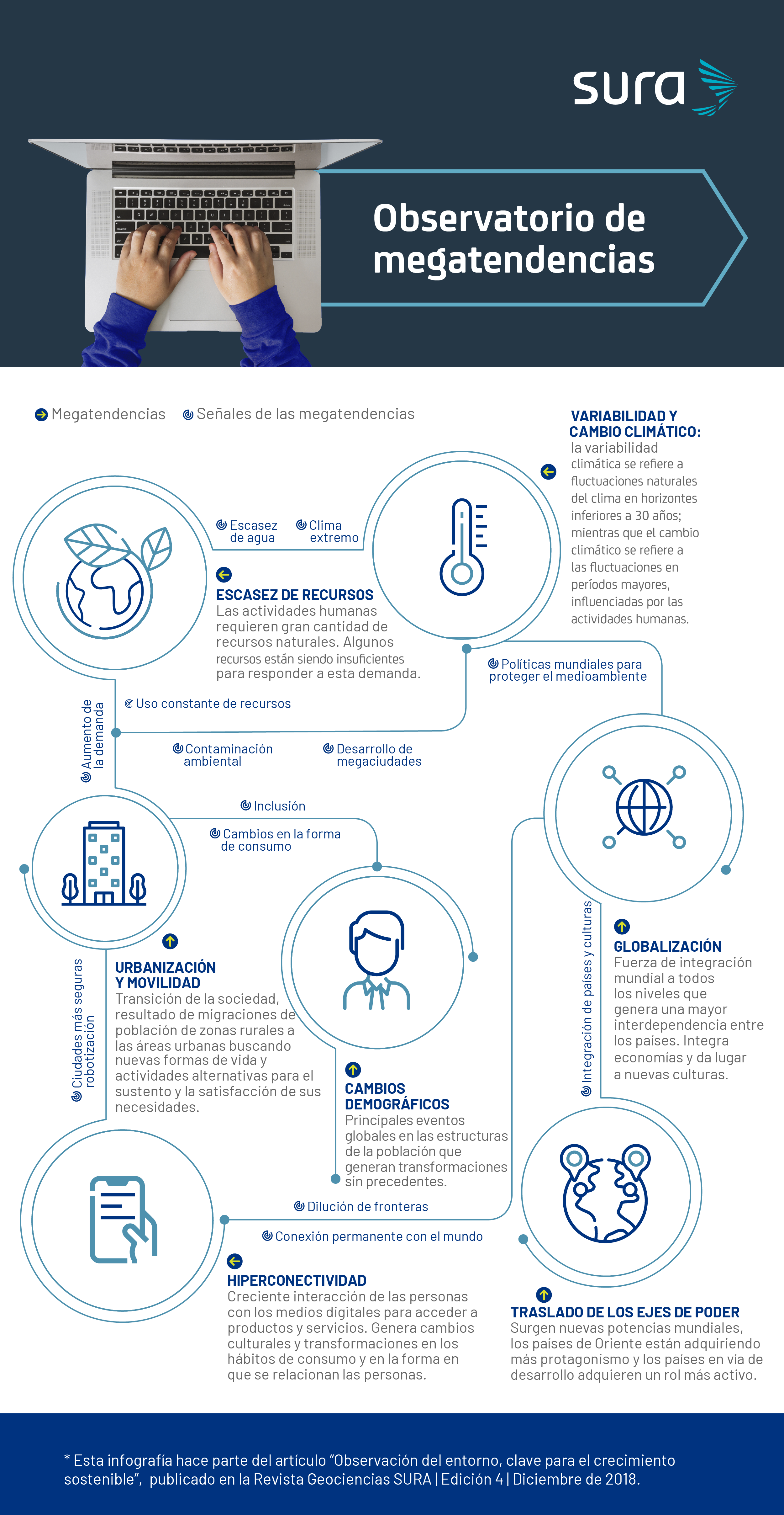
Megatrends are global forces of gradual transformation and dramatic impact on societies, organizations and the environment. Therefore, SURA, a Through observatories based on research and everyday life, it develops useful knowledge to understand in depth and understand the different manifestations of megatrends, allowing people and companies to anticipate changes in the environment.
Megatrends:
- Lack of sources.
- Variability and climate change.
- Demographic changes.
- Hyperconnectivity.
- Transfer of the axes of power.
- Urbanization and mobility.
- globalization.
Forces:
- Environment.
- Society.
- Technology.
Signs of climate change:
- Rising sea levels.
- Increase in average surface temperature.
- Coral reef bleaching.
- Weakening of ice sheets.
- Prohibition of polluting processes/products.
- Glacier retreat.
Signs of resource shortages:
- Water resource pollution.
- Population growth.
- Protection of natural resources.
Signs of urbanization and mobility:
- Green architecture.
- Electric cars from renewable energy.
- Smart cities (Master City).
- Construction with 4.0 materials. Construction from recycled materials.
- Eco-efficient buildings.
- Mass use of bicycles as the main form of transport.
- Autonomous transport.
- Optimization of transport infrastructure.
- Eco-efficient public transport.
Analysis of variables related to business income
Trends have implicit opportunities and risks. Structured observation of the environment allows us to anticipate the effects of trends, manage them and create value., turning them into an opportunity to generate well-being and competitiveness in the short term, and guarantee the sustainability of production processes, social development and environmental protection in the long term.
As part of the structured observation of the environment, it is very important to monitor essential factors, such as the use of clean energy sources, the availability of natural resources, production and marketing processes aimed at protecting the environment and urban development, which promote human well-being and health, and which provide decision-making elements for the management of relevant trends, based on the temporal variation of these factors.
Fonts
- Claudia Victoria Gutierrez Mejia. Mechanical Engineer from the Universidad Pontificia Bolivariana. Specialist in International Business and Risk Management and Insurance from the Universidad EAFIT. Specialist in Environmental Business from the School of Engineering of Antioquia.
- Elizabeth Cardona Rendon. Civil engineer and specialist in Earthquake-Resistant Engineering from EAFIT University.
- Paula Ochoa Botero. International Negotiator and Marketing Specialist from EAFIT University and Master in Administration from the Tecnológico de Monterrey.