

3 activities for emotional understanding with children
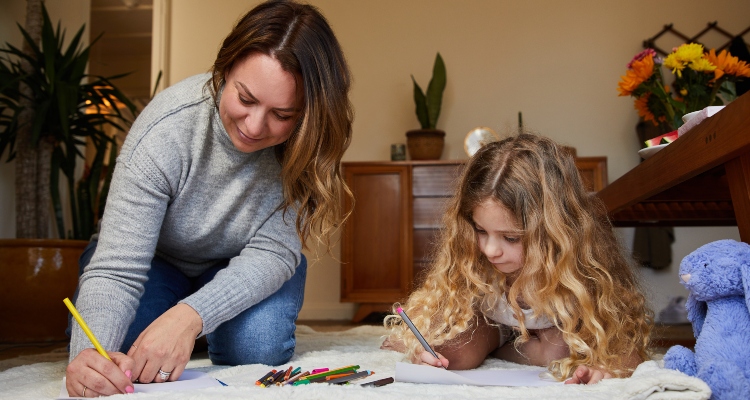
In times when children are subjected to high stress loads, working on activities to develop emotional understanding will always be a good option. Below we share three activities to do at home.
When we talk about emotional understanding, we refer to the process of understanding the wide range of emotional signals that we humans have, labeling them and grouping them.
Working on this topic with adults and children helps develop the ability to interpret the meaning of simple and complex emotions, and above all, learn to manage them in relation to the community.
How to work on emotions then?
- To work on emotional regulation:
Name of the activity: Responding to an accusation
Time: 25 minutes
To begin, read aloud the beginning of this story:
“Pepe is walking happily through the park when he suddenly sees Rafa coming towards him. Rafa has a very strange look on his face. Pepe wonders what is happening to him. They approach each other and greet each other, but Rafa immediately starts shouting. He says that Pepe has made him look bad in the eyes of the other kids in the neighbourhood, that he is a bad friend, that he is to blame for everything that happens to him. Then Pepe…”
Once the story has been read:
- Ask your child to act as he would if he were in the role of Pepe.
- Next, divide on a board the actions your child would take, those that allow for reconciliation and seek a peaceful path and those that promote greater conflict.
- Start the conversation with him to reach the conclusion of why the former are better than the latter.
- To work on assertiveness:
Name of the activity: write a story
Time: 45 minutes
This exercise aims to help children differentiate between ways of responding to an accusation and also to learn to control their emotions, both of which are necessary conditions for learning to resolve conflicts.
- Propose a conflict situation to your child or children.
- Ask your child to make up a story that has the following elements:
- Teenagers talking or texting on cell phones
-An accusation
-Solution that leaves the path open to dialogue
- Now ask him to tell his story out loud and discuss the advantages and disadvantages of the solution to the conflict, so that the emotional implications of the solution are understood. Evaluate the conclusions together.
- To work on active listening:
Name of the activity: 1 to 0 conversation
Time: 15 minutes
According to a study by Albert Mehrabian, in a face-to-face conversation the verbal component only represents 35%.
That's right, more than 65% is non-verbal communication, that is, the communication of our emotions, body posture, eye contact or gestures.
With this activity we seek to develop active listening and improve interpersonal communication.
- For this activity, seat all members of your family group. To do this, you need to place a row of chairs in a circle. Place another chair in front of each chair, so that participants sit facing each other.
- The idea is for each participant to remain seated for two minutes and then move to the next chair.
- During those two minutes of sitting, one of the two participants sitting in front speaks first, while the other listens actively, that is, paying attention to non-verbal language (emotions, gestures, etc.).
- After one minute, the roles are switched and the other person speaks while his or her partner actively listens.
- In the end, the mission is to talk about what was said and analyze the expressions, what each of the participants conveyed when speaking, with words and gestures.


