



The organism Global Web Index produces a periodic report in which it informs how many hours a person spends on social media per day, depending on the region. In Latin America, an average user interacts with these platforms for around 3 hours and 34 minutes per day, while the global figure is 2 hours and 28 minutes.
While this intense connection in these virtual spaces generates social links, communication between individuals and even work relationships, It also increases exposure to threats related to cybercrime. In fact, according to Fortinet, a company dedicated to cybersecurity, the Latin American and Caribbean region suffered 137 billion cyberattack attempts from January to June 2022. This represents an increase in 50% compared to the same period last year, which was 91 billion.
“On social media we tend to reveal many aspects of our lives. Who we interact with, our most valuable belongings, information about our children, pets and work,” she explains. Tatiana Vélez, cybersecurity specialist at Suramericana SAAnd he adds: “In general, it becomes a source of information to find out who you are, what you like, what places you frequent and to build a whole profile of your life, even much deeper than you can imagine. You would be surprised to know what Facebook, Google or Instagram know about you.”

For this reason, it becomes crucial for users know how to identify cyberattacks in these digital spaces and what are the ways to prevent them. In this way, all personal and private information uploaded to these platforms will be more secure and, at the same time, the risk of suffering attacks that can lead to anything from the loss of money to identity theft will decrease.
What are the most common cyber attacks on social networks?
Vélez highlights that there are currently several formats of virtual attacks which are usually implemented by criminals on social networks. “Cybercriminals use information from public sources to impersonate a person and then carry out attacks,” says the expert from Suramericana SA
In this regard, Vélez highlights three common modalities: Phishing, (sending malicious emails), smishing (malicious text messages) or social engineering“All of this is done with the aim of getting a person to carry out a financial transaction, to hand over confidential information – such as usernames, passwords and information of value to the market – or in general something that represents a benefit for cybercriminals. Let us remember that there is a motivation for everything and, mainly, cybercriminals are looking for money or reputation,” the cybersecurity specialist stresses.
On the other hand, reports indicate that The main platforms used for these criminal activities are Facebook, Instagram, Twitter and TikTok.. “Overall, social media remains the most imitated category, followed by technology,” highlights the second half of 2022 phishing report from Check Point Research.
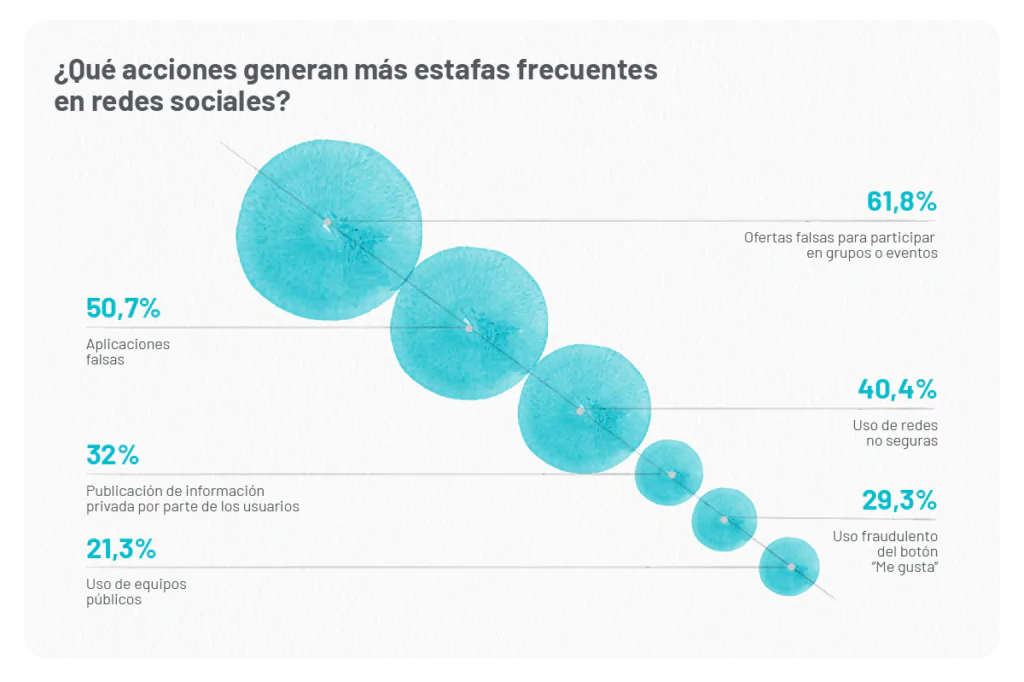
However, none of the networks mentioned compare with LinkedIn LinkedIn is by far the most widely used social network for committing these crimes. “After entering the ranking for the first time in Q1 with 52%, LinkedIn continues its reign as the most imitated brand with 45%, a worrying trend that highlights the risks faced by users of this platform,” says Check Point Research.
Finally, another concern in this field is the exposure to crimes such as grooming, the virtual harassment that minors suffer in spaces like Instagram and TikTok. “Approximately 40% of young people between 12 and 17 years old have been harassed online. 30% have had it happen more than once,” they say in BTR Consulting, a company dedicated to cybersecurity. And they add: “Only 1 in 10 victims Teens tell their parents or a trusted adult about their abuse and 83% of young people believe that social media companies should do more to tackle cyberbullying on their platforms.”
How to prevent cyber attacks on social media
For Vélez, the first aspect to take into account when preventing cyberattacks on social networks is attention. “We tend to log into our email or WhatsApp and immediately open images, files or links that are shared with us without first checking who sent them and for what purpose,” he explains.
“Recently, we have been seeing scams where your friends or contacts are impersonated and they ask you to borrow money. This is done from their emails or official contact numbers that have already been compromised. It is very important that, before doing any activity that involves money or giving out sensitive data, you first verify who the person on the other end is,” he continues.
Along these lines, experts from ESET, a developer of cybersecurity solutions, encourages users to implement in all services and applications the two step authentication, also known as two-factor authentication or 2FA. “This additional layer of security allows users to not rely solely on their password to secure their accounts, to use long and unique passwords for each online service or account, to install an antivirus solution on their phone and computer, and to verify privacy settings on social media and accounts such as Google,” they add.
In relation to digital crimes against minors, experts recommend that parents and responsible adults be close to minors, and accompany them with advice and examples for responsible participation on the Internet. “It is important that they know how to report accounts, file legal complaints when applicable, and leave places that harm them in time. In addition, adults have to be alert to look for signs that something is wrong, stay informed about children's online activities and cultivate a relationship of trust with them,” stresses Silvina Tantone, educational mentor of the NGO. Cybersecure Argentina.
Finally, Vélez highlights that “the main defence mechanism against cybercrime or fraud is the person themselves.” “The hygiene you have when browsing the Internet, when leaving information on your social networks, makes the difference. You are the main barrier against cybercrime”, concludes the expert from Suramericana SA
From SURA Insurance We support this vision with different actions. On the one hand, by promulgating educational content on the subject, such as the reports of Connectivity trends. And, on the other hand, by providing our clients with useful information so that, in the event of any eventuality, they can find a quick and reliable response.