


There is a perception that internationalization is something that is only within the reach of large companies. However, the more time passes, the more this myth is shattered. This is how Andrés Rave, Director of Solutions for South American Insurance Companies SURA, who emphasizes that to make this possible “it is necessary to prepare, draw on the experience of others, surround yourself with the right human talent and be competitive.”
According to the Global Latam Barometer of Internationalization of Latin American Companies, included in the report 'Global Latam, Foreign Investment series 2021', prepared by the Ibero-American General Secretariat, the main obstacle to the internationalization of Latin American companies is the regulation in the destination country. The research carried out by the organization includes the vision of 361 large and medium-sized companies from eighteen Latin American countries.
In addition to regulation, Another impediment to expanding a company's operations outside the country is the "tax system", the Secretariat says, "due to its collection capacity and penalties on business growth."
In this way, the first two obstacles that the Latin American companies They are not related to aspects of the organization itself, but to external agents. “Then, in this process, there are common problems associated with the lack of knowledge of the target market, not only in terms of its consumption dynamics and potential clients, but also in terms of tariff benefits, corporate, tax, labor and currency regimes,” Rave adds.
X-ray: how companies invest abroad
According to the report, before the pandemic, Latin American investments increased, reaching a total of 44.091 million dollars in 2019. This trend was significantly halted by the economic crisis caused by the outbreak of the coronavirus in 2020. In this way, In 2020, foreign investment issued by Latin America showed a 73% drop in value, totaling 17.185 million dollars, minimum levels compared to those recorded in the last decade
To encourage internationalisation, business leaders are asking governments to promote the elimination of administrative obstacles, adapt the tax system, help identify business opportunities abroad, promote the country's brand and intervene to increase access to financing.
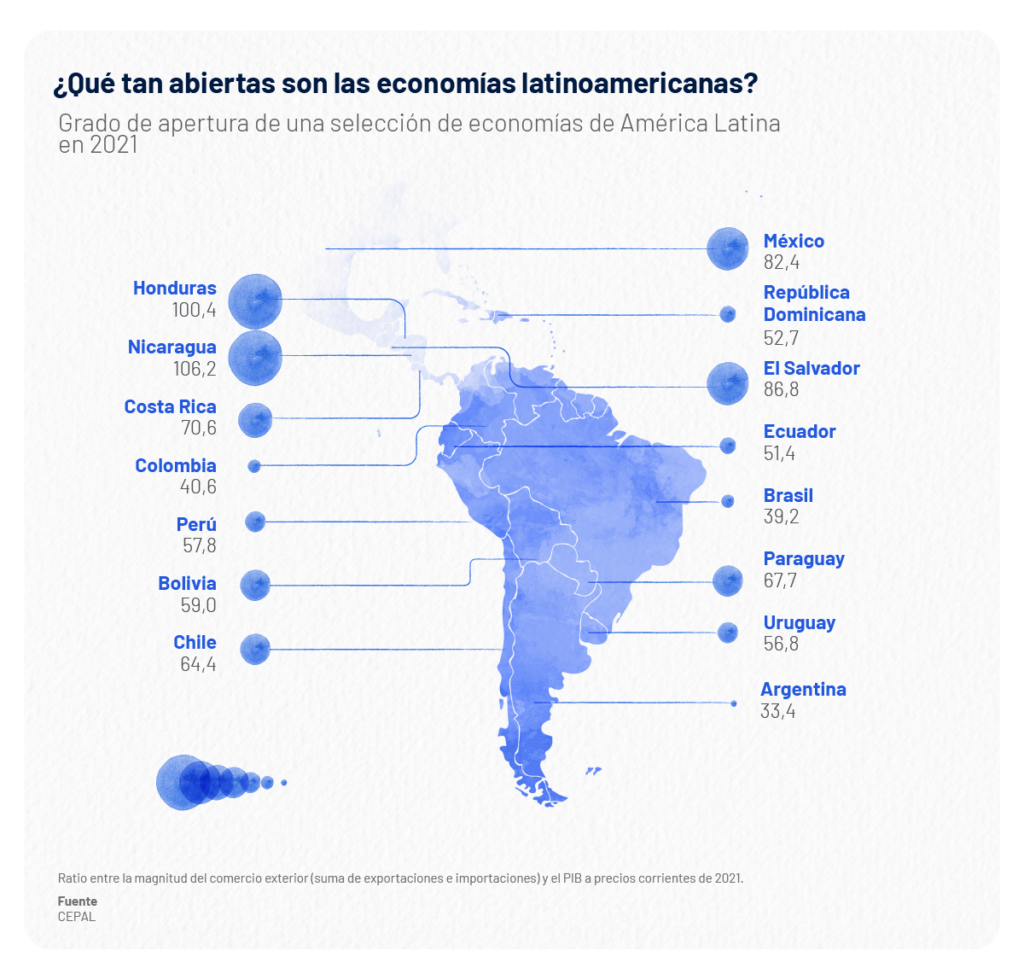
In 2021, 90% of Latin American foreign direct investment originated in Brazil, Mexico, Colombia and Argentina. 330 greenfield projects were announced from the region, with the potential to generate 36.000 jobs. Brazil, Mexico and Chile lead Latin American investment abroad, with US$277.454 million, US$178.947 million and US$145.333 million, respectively.
Regarding the Gross Domestic Product (GDP), Chile leads the cumulative placement of capital abroad, with 57% of the total, before Colombia (24%), Brazil (19%) and Mexico (16%).
These investments were mainly directed to the United States, with 56 projects, followed by Mexico (41), Colombia (29), Argentina (25), Spain (20), Chile (15), Brazil (14) and Peru (12), among others. At the same time, the Asian continent gained an important place as a target for investments. The report indicates that in 2021, 14 projects were registered in Asia, mostly associated with the software sector. & IT services.
SURA know-how and advice
El LATAM Free Trade Zone Service, provided by SURA as part of its regional service platform'Sura Enterprises', seeks to connect more than 35 million entrepreneurs throughout Latin America. “The goal is to show that you don't need to be a large company to be a multinational,” says Rave.
Regarding the program's operation, Andrés Rave explains: “At SURA we constantly study the markets where we operate. We have regional observatories throughout Latin America where we analyze economic, sectoral, social and consumer trends, and we put this market intelligence in the hands of all the entrepreneurs who participate in the program.”

This allows entrepreneurs to identify business opportunities in the region. “Not only do we provide this information,” Rave adds, “but we connect them through workshops with financial, legal and business experts from the country of interest so that they can learn first-hand about the advantages and requirements and, fundamentally, share experiences.”
“In our own region we can find great opportunities. We are Latin America, the fourth largest economy in the world, only below the USA, China, and Japan. Therefore, through this service, we create a space for leaders to rethink their company in this new global and connected environment,” concludes the Director of Solutions for Companies at Suramericana de Seguros SURA.
Seguros SURA has a regional team and hundreds of experts to make Latin America a free market zone. The program is currently active in Uruguay, Chile, Colombia, the Dominican Republic, El Salvador, Mexico and, starting next semester, in the main cities of Latin America.
The program seeks to support entrepreneurs in their expansion process with more than 10 company offices in the main cities of Latin America, a team of more than 60 internal experts and cooperation agreements with local entities promoting international trade.