


Economy, vaccines, poverty, migration, social movements, bioeconomy and democracy top the list of challenges for this year, following the rebound in economic activity in most countries in the region in 2021. The projections for this year look more challenging.
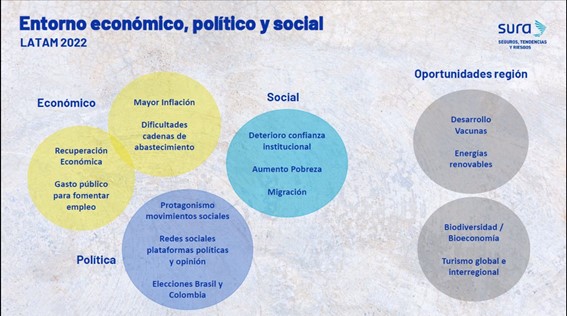
There are plenty of problems and challenges in a region where more than 650 million people live in 35 territories with marked inequality at multiple levels. The leaders and experts in social, political, economic and environmental issues of the SURA Trends Observatory, however, have no doubts in defining what the challenges will be. Main challenges for 2022 in Latin America:
From the economic point of view
- The economic recovery
- Public spending to promote employment
- The rise in inflation
- Difficulties in supply chains
From the political point of view
- The protagonism of social movements
- Social networks and political opinion platforms
- The elections in Brazil and Colombia
From the social point of view
- The deterioration of institutional trust
- The increase in poverty
- Migrations
This is confirmed by the experts of the SURA Latin American Environment Observatory, a group of specialists in economics, politics and social sciences attentive to the transformations in the region, leveraging their own observation platform that reveals in real time more than 15 thousand global signals identified by almost 1200 active observers in 9 Latin American countries.
For their part, the region's leading political analysts speak of the urgent need to consolidate democracy, amid growing uncertainty among the electorate, which in recent months has shown a change in political inclination in most countries. Below is a review of the main challenges for Latin America in 2022, as highlighted by expert organizations and the SURA Observatory for Make sure you live.
1) Economic recovery
According to the Economic Commission for Latin America and the Caribbean (ECLAC), Latin America will slow its overall growth rate to 2.1% in 2022, after having reached an average of 6.2% last year. It warns that the The slowdown is occurring amidst large disparities in the capabilities of developed countries, emerging and developing countries to implement fiscal, social, monetary, health and vaccination policies.
Brazil, the largest economy, is expected to grow the least, at just 0.5%. Mexico, for its part, will grow 2.9%, Colombia 3.7% and Chile 1.9%. Alicia Bárcena, executive secretary of ECLAC, points out that in a scenario like the one posed by 2022, creativity is crucial “to be able to articulate fiscal and monetary policies with greater coordination and with a medium-term view.”

2) Development and access to vaccines
The pandemic has claimed more than 1.5 million lives in Latin America and the Caribbean, and has resulted in more than 45.7 million confirmed cases since its emergence in the region in February 2020. The The region accounts for nearly a fifth of confirmed cases of Covid-19 and around 30% of deaths worldwide, despite constituting only 8.4% of the world's population.
By the end of 2021, 57% of people in Latin America and the Caribbean were fully vaccinated, meaning they had received two doses. Still, 20 of the 35 territories in the Americas have yet to reach the vaccination goal. World Health Organization to achieve a vaccination level of 40% by the end of 2021. And with new variants and the increased need for additional booster shots, vaccination challenges will continue in 2022.
A UNESCO report in 2021 noted that while one in four people in high-income countries had received a dose of the vaccine, in low-income countries the proportion was one in 350 people. And that was for several reasons: a heavy burden on health systems, which were already weakened by dealing with other endemic diseases; limitations in global vaccine production; and differences in negotiating capacities. In this regard, it is estimated that the 27 richest countries and territories in the world, which cover only 10% of the world's population, have administered 32% of the doses available in the world.”
Beyond the enormous resource and logistical challenge of administering the vaccines, the region is seeking to lay the groundwork for their development and manufacturing. article from Ocean Medicine, explains that some immunization projects “have advanced, while others have stopped or their development has been delayed, mainly due to lack of financing.”
The magazine explains that Argentina is making progress on six vaccine projects that are currently in the preclinical phase of research; in Colombia, work is being done on a proposal to manufacture a vaccine of national origin; and in Brazil, funding is maintained for nine anti-Covid-6 vaccine projects. In turn, in Mexico, the Livion.vac initiative hopes to obtain the necessary funding to begin human trials and the Chilean vaccine has already been approved in its first phase of trials, the scientific publication concludes.
3) Combat the increase in poverty
The slowing economy and the pandemic only worsened the conditions of poverty for millions of people in the most unequal region in the world, according to the United Nations. For ECLAC's Bárcena, labor markets have not recovered from the blow dealt to them by the health emergency: "The pandemic had a negative impact on the economy and the economy." The informality had a very strong impact, which is expected to increase with devastating social effects,” she explains. The effect is even worse for women and minorities.
The agency's figures are compelling: The total number of poor people rose to 209 million at the end of 2020, some 22 million more than the previous year.. This is an increase in poverty levels unprecedented in recent decades and has a strong impact on inequality and employment. For this reason, the Pan American Health Organization urges governments in the region to accelerate vaccination processes, transform health systems, strengthen public investment and consolidate welfare states, among other measures, to control the health crisis in the short term.

4) Consolidate democracies
“This year seems to be a challenging one for the region. Various studies are already predicting a process of democratic erosion, accompanied by greater restrictions on individual freedoms and threats to human rights,” Clarissa Demattei warns, Researcher at the Center for International Studies, from the Catholic University of Argentina. The annual report of Human Rights Watch It projects that by 2022 there will be more “limitations of basic civil rights such as freedom of expression and the press and the lack of independence of the judiciary.” It even warns of the systematic violation of human rights in countries such as Venezuela and Nicaragua.
For Michael Shifter, President of the Inter-American dialogue (Inter-American Dialogue), these years are characterized by a single word: 'uncertainty'. "Nobody knows what will happen in many countries. It is a time of change that has been demonstrated in many elections, there is alternation in power and thus expectations and demands are created. Governments have problems responding to people's expectations. This creates uncertainty about what might happen and how people will react. Looking to the future, the region is marked by uncertainty and the severe economic crisis it faces,” Shifter thinks.
The challenges in the region are the order of the day: they are not the only ones and they will not be resolved in the remaining months of 2022. But recognizing them, analysts say, is the first step to solving them.