



A promotion is a recognition that a company gives to an employee for how he or she performs in his or her job and the values he or she professes within an organization. Often, achieving professional growth is a more complex process for women than for men. This is what is known as the glass ceiling.
Diva Seluja, Master in Public Policies and Gender (FLACSO Mexico. Agreement between Uruguay and Mexico) and Tutor in the Diploma in Gender and Equality Policies at FLACSO Uruguay, explains to Make sure you live “It is called this in a symbolic way, because it is invisible but insurmountable. It is made up of beliefs, stereotypes and power relations that prevent women from reaching hierarchical positions.”
Alexandra Cano, Diversity and Inclusion Specialist at Seguros Sura Colombia, explains that glass ceilings are not created by men or women, but that both “can generate them, guided consciously or unconsciously by prevailing gender stereotypes, which make us assume characteristics, strengths and weaknesses associated with gender.”
“It is a tremendously effective and powerful barrier but invisible because, in truth, there is no written rule that prevents women from occupying leadership positions,” says Virginia García Beaudoux, Specialist in political communication and leadership with a gender perspective and member from the network of political scientists #Nosinmujeres. “Women at the base of organizations make up 50% and, based on certain positions, you will find that they represent 30%, 20%, 15%, 5% and even 1%,” she adds.
This is due, explains García Beaudoux, to the fact that there are gender stereotypes that have associated leadership skills more with the masculine.“People think of leadership and automatically think of a man. This is unfair and arbitrary, but it is cultural and feeds the glass ceilings,” she explains.
Another issue is that care tasks fall on women. “From a age they begin, together with their partners, to have children, But it turns out that they are the ones who have to take the licenses. Therefore, nor ask for promotions at the same rate as men. This weakens their position within organizations. and makes each child cost approximately between 2 and 3 years of delay in their careers compared to them,” he adds.

Just as in business, this glass ceiling applies to the world of politics. In this regard, Flavia Freidenberg, Researcher at the Institute of Legal Research of the National Autonomous University of Mexico (UNAM) and Network of Political Scientists, explain to Make sure you live that “in Latin America, the situation of women in politics is not the same as that of men.”
According to a survey by Freidenberg, Carlos Guadarrama Cruz and Karolina Gilas, “of 123 matches for 18 countries of In the region, only 19 political parties are led by women in their presidency or other position such as secretary general.”
Glass ceilings, in numbers
With the premise that gender equality is a primary factor for the economic development of countries, the Inter-American Development Bank (IDB) prepared a report in August 2021 entitled An unequal Olympiad: gender equality in Latin American and Caribbean companies. Some data on the subject.
- Men in the lead: Only 14% of companies are owned by women; 15% of boards of directors in the region have female participation; and in 11% of companies the position of chief executive is occupied by a woman.
About, Alexandra clarifies to Make sure you live that "more and more women have reached managerial positions, but there is still a long way to go. According to Club 30 dataIn Chile, there is 14% representation on the boards of directors; in Mexico, 8%, and in Colombia, 18.8%.”
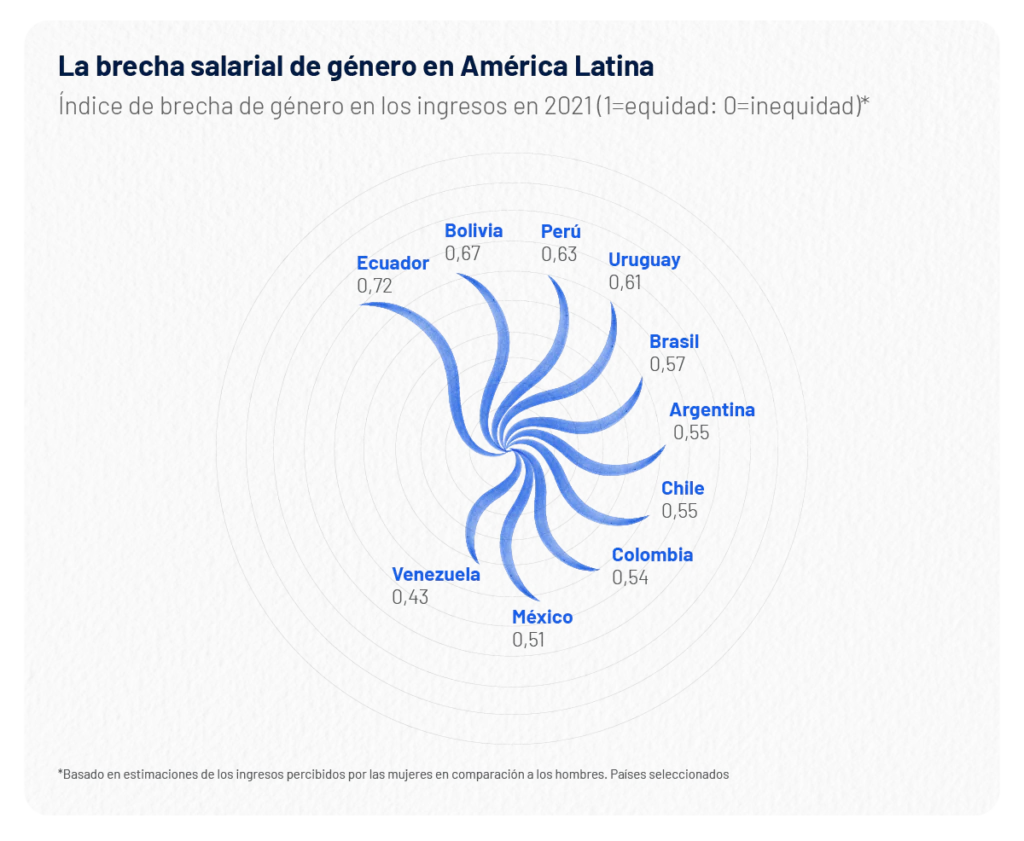
Faced with the number of them in a company, Luz Marina Velásquez, Vice President of Human Talent SURA Colombia, calls for questions about the context of these women in order to balance and have benefits that favor their development. “Sometimes, in sectors or industries, women are preferred, but that does not necessarily mean better working conditions,” she says.
- Soft areas: Most of them work in areas considered soft. They represent 64% of the total employees in Human Resources, 63% in Communications and Public Relations and 53% in Social Responsibility; while in hard areas such as Foreign Trade, Operations and IT their presence is less than 35%.
- Vertical segregation: 36% of the total workforce is in junior, administrative or supervisory positions, while the statistic is 25% in the most senior positions.
- Inwards: Only 15% of firms analyse the existence of wage gaps in their organisation. According to the report, the most affected are exporters (18% vs. 14% in non-exporters), the largest (23% vs. 10% in medium-sized companies) and those in services (18% vs. 13% in trade and 14% in manufacturing). 28% acknowledged maintaining lower salaries for women compared to men in positions of equal qualification.
Another study of PAR Ranking 2021 The study shows that the wage gap of 23% at the first job level, 54% at the second and 30,13% at the third level still persists. “Normally this gap tends to be greater at a hierarchical level, but these numbers break that rule a little,” says Cano, adding “these numbers show that the gap is greater than the wage gap at the third level. How women begin to reach different participation scenarios at the decision-making levels.”
On this point, Seluja argues that “the consequences of this wage inequality There are several: it perpetuates existing levels of poverty among women (the majority of the poorest sectors in a society are made up of women, children and adolescents), it generates fewer opportunities for development, independence, autonomy and empowerment, and ultimately affects the human rights of women as people."
Why glass ceilings are created
When it comes to advancing professionally, women have more difficulties to grow within companies. García Beaudoux believes that this happens because in these places “Women are seen as guests or guests. The culture of the organizations is a very masculinized culture, informal networks are between men, Recommendations and networking spaces They are more designed for men. Hence the glass ceilings, glass walls and glass labyrinths where a woman will take longer reach the goal.”
The expert says that the problem with the Women's leadership is not women, but the culture of organizations.We should start by changing that culture to break down the main obstacles that women face.”
This metaphor of the glass ceiling has existed for more than forty years and is still valid. Therefore, Cano, the Diversity and Inclusion specialist at Seguros Sura Colombia, invites us to “go from theory to action,” adding that “we have to be aware of our responsibility to make the invisible visible and break down the barriers that prevent gender equality. By working together we can guarantee equal opportunities in the professional development of women.”
Working towards greater gender equality in the companies, where everyone can grow according to their abilities and knowledge, is everyone's task. At SURA we understand that talking about the gender gap is the first step to transform this reality. It is by making the invisible visible that we can improve.