


The last presidential elections held in Colombia were another turning point in the international political scene. The pandemic increased the discontent of the population with the political class. And to the domestic institutional crises is added a complex international framework, such as the Russian invasion of Ukraine and the most important global inflationary process of the last forty years in the United States.
“All of this consolidates a discontent that was reflected in the electorate's decision to destroy consolidated political structures,” says Guido Saab, Master in International Economic Relations from the UBA and professor of International Relations Theory at the Catholic University of Argentina.
El The most characteristic fact of this period -insists the academic- has to do with the marked inclination of the regional electorate to remove the rulers in power. “People are making the rulers pay dearly for their meager management results,” adds Saab, and gives an illustrative fact: “Of the last nine presidential elections in the region, progressive options have won in six.”
At the same time, The last seven presidential elections were won by the opposition“This shows that the electorate has always been leaning towards the opposition, but not always towards the left. In fact, figures such as Javier Milei in Argentina or Kats in Chile, who represent extreme liberalism, have grown strongly,” he adds.
The vote of discontent
At the same time, Patricio Giusto, Executive Director of the Sino-Argentine Observatory, adds that this shift towards progressivism in Latin America has less to do with a conviction or infatuation with these ideas, “but rather it is a kind of vote to criticize and reject the current governments, many of which happen to be right-wing, as has been the case in the recent elections in Chile and Colombia.”
“A year ago, the opposite happened in Ecuador. To reject the government that was there before, more of a progressive line, a right-wing party won. The same thing is likely to happen in Argentina in 2023. And, following the same logic, Lula would win in Brazil,” explains Giusto.
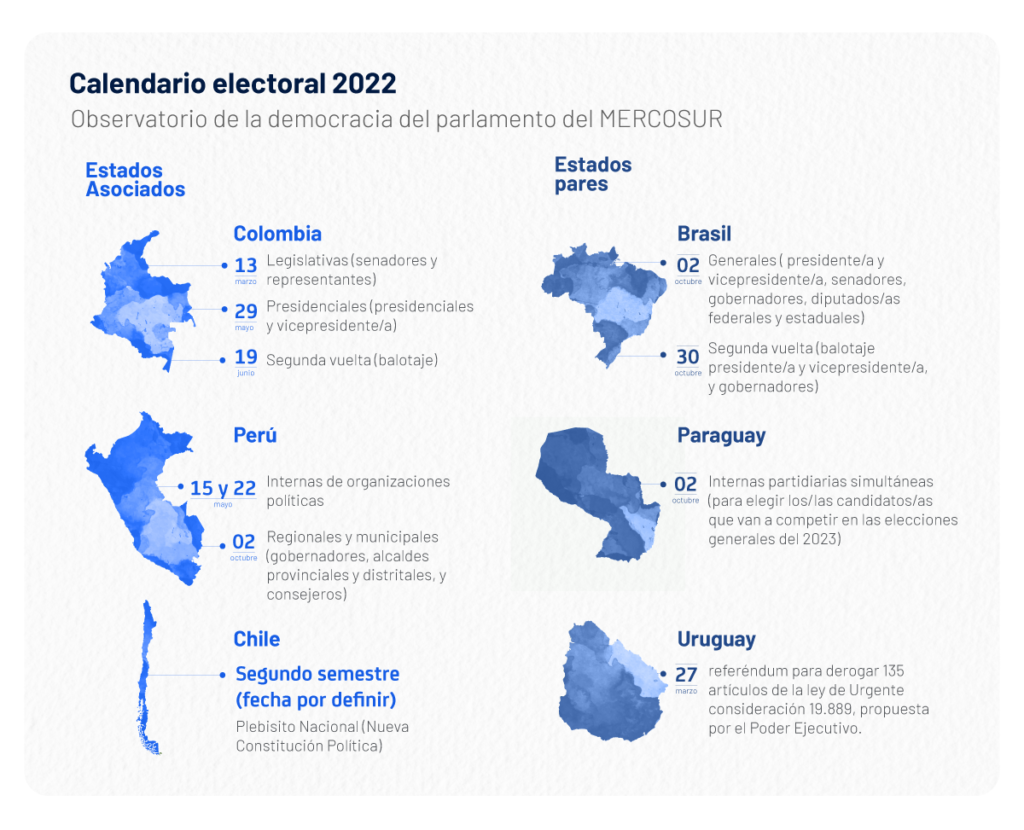
In some way, the specialist defines, “it is a very broad phenomenon in the region that is not due to a conviction or resurgence of center-left ideas, but rather an 'angry vote' against the system that, coincidentally in this case, coincides with several right-wing governments that fall under this punishment. And in Central America we have also seen that this has happened in countries like Costa Rica.”
Behind the 'angry vote', says Giusto, are the same old concerns (education, work, health, economy, access to housing), “with a more pressing social situation and a more critical economic situation in many of these countries,” with the notable cases of Argentina and Venezuela, “which are the most serious cases in the region.”
The aspirations of the middle class
In their trend observation processes, SURA has been studying some of the pillars that influence the quality of life of Latin Americans. Isabel Cristina Gutierrez Cadavid, Regional Director of Channels in Suramericana, explains that daily life cycles and habits are changing. Education, work and access to housing They are aspirational desires of the middle class that have undergone transformations in recent years.
“Nowadays, you can work anytime, anywhere, and you have the option to choose where, how and when you connect. It is the challenge for the person to choose and establish a routine of life. 86% of parents want to continue with a flexible work after the coronavirus, according to Visual Captalist. In turn, 63% say they started working as independent by choice and 79% said that this modality is better than a normal job, they indicate from Fastcompany“, adds Gutierrez Cadavid.

The way of living has also evolved. The coliving, properties intended 100% for rent with common areas and luxury amenities, emerge as a new lifestyle. “Its users are people who are looking for a new way of inhabiting spaces, where comfort and time efficiency are a priority,” highlights the director at Suramericana.
“In general, they are people who value freedom, with a strong link to sustainability and the environment,” the expert adds. “In the Latin American and Caribbean region, one in five households rents out your home, which are mostly young populations. In many of the main Latin American cities, people tend to rent their homes much more than ten years ago, according to data from the Inter-American Development Bank (IDB),” he adds.
Another way to learn
The learning processes They have been adapted over time according to the needs of the market and users. In this century, and particularly after the pandemic, technology has become the main tool for delivering knowledge, without neglecting pedagogical advances and adaptations.
74% of employees are ready to acquire new skills and completely retool themselves to be relevant and remain employable in the future, according to recent studies by PwC Consulting, says Gutierrez Cadavid.
“Eric Wyttynck, Director of Information, Innovation and Digital at Sommet Education, led an analysis forum last year to try to predict what the learning experience of students in 2050, identifying three key trends: personalization, digitalization and lifelong learning,” he introduces.
In turn, more than 50% of higher education institutions, according to a Gartner study, will begin to redesign their student experience with the aim of making it more integrated and personalized before 2021.
According to the firm Global Market Insights, the next Technological advances applied to education are getting closer. The analysts of the consultancy believe that the next step will be the incorporation of augmented reality to learning through the internet and the use of the cloud to store all our information. Another technology that could help is the blockchain, with which certificates, for example, will be impossible to falsify.
For this reason, SURA has been developing service platforms that aim to give visibility to these changes. These platforms are available in all countries where SURA is present, in order to support the decision-making of small and medium-sized businesses in this rapidly changing world. It is also involved in the design of service platforms for people.