

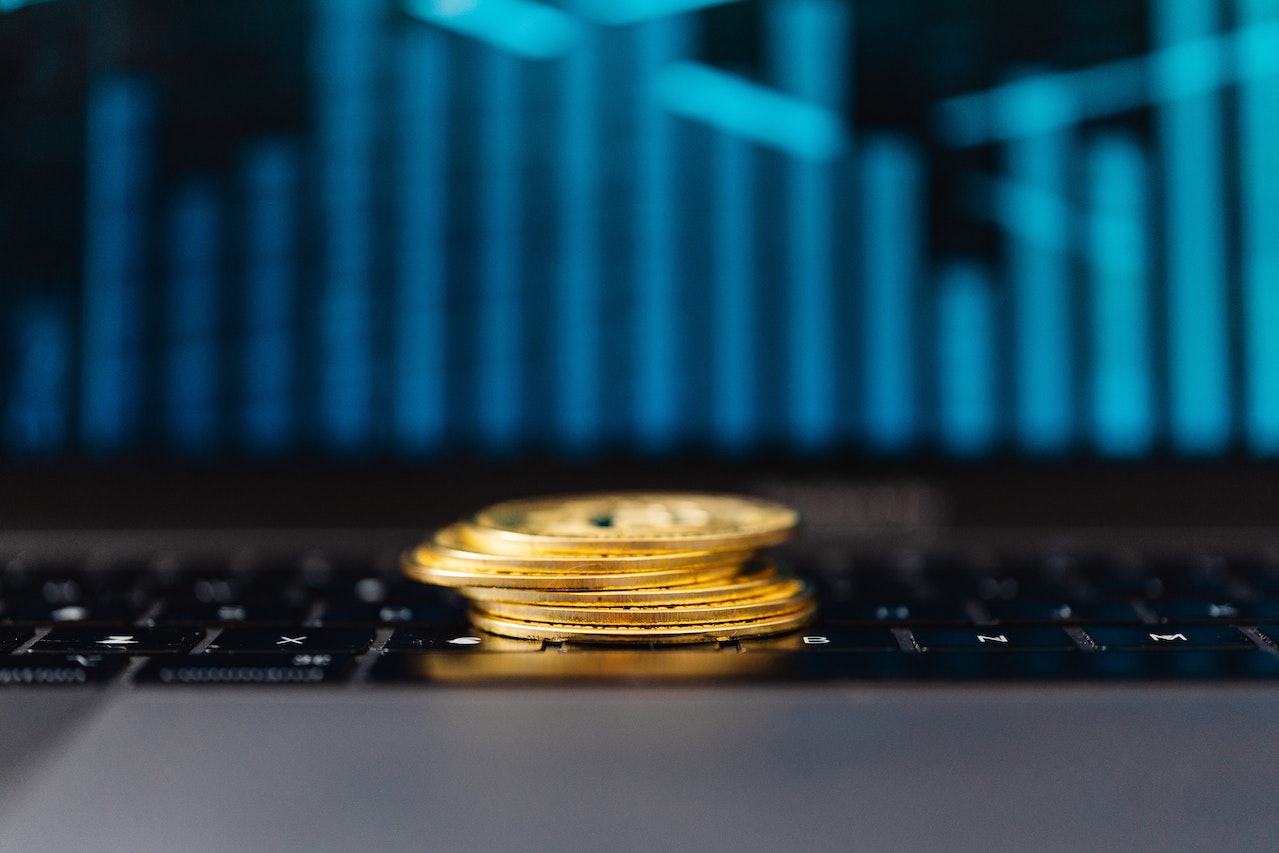
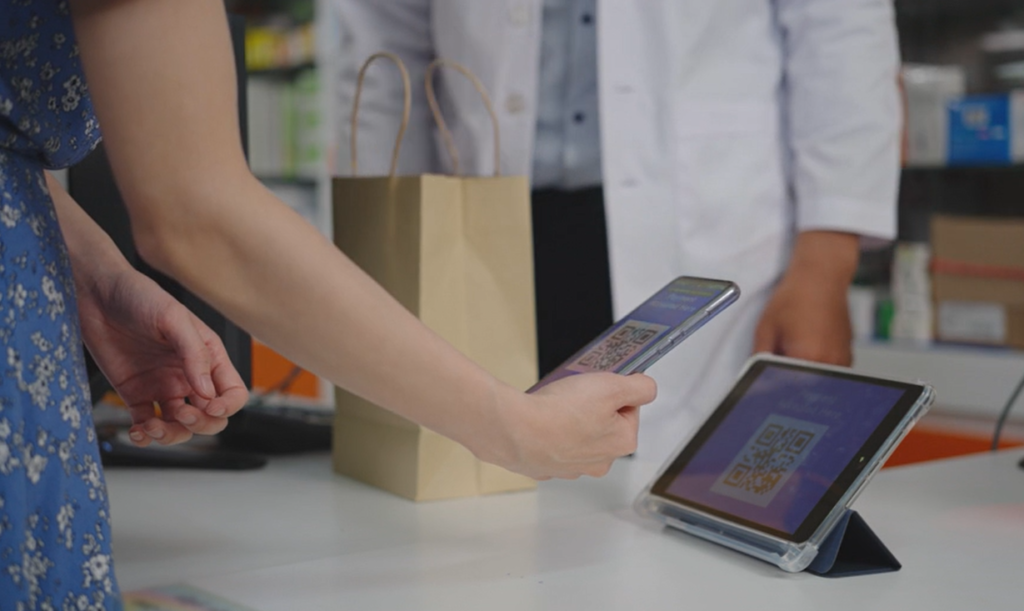
The pandemic worked as a great catalyst for the financial inclusion in Latin America. The way Latin Americans relate to money has changed as a result of the adoption of new technologies. From digital wallets to QR payments or cryptocurrencies, the alternatives for giving or receiving money have significantly expanded.
According to the Global Findex published by the World Bank, two-thirds of adults around the world now make or receive a digital transaction. In this regard, Latin America and the Caribbean has been one of the regions that has developed the most in this area: the proportion of adults who have an account rose 18 percentage points compared to the 2017 measurement, the last one that was carried out.
The data is quite illustrative: In 2021 alone, 40% of adults paid a merchant digitally. Of this percentage, 14% did so for the first time during the pandemic. For David Malpass, President of the World Bank, “the digital revolution has catalyzed increases in access to and use of financial services around the world, transforming the ways in which people make and receive payments, borrow and save.”
In turn, SURA identified 3 financial management trends which began to manifest themselves last year and have been consolidated in 2022. Verónica Vallejo Pizano, Director of Financial Relations and GTR at Suramericana, explains that they are framed within a transversal element: sustainable finance.
Sustainable finance
“Due to the urgency of preserving our planet, the issue has been deepened planetary boundary of climate change. Now, 'Net Zero' (actions to ensure that the earth does not warm more than 1.5 degrees Celsius by 2100) is the new normal. The number of countries that adhere to this commitment, which has doubled since 2020, today covers 20% of the world's GDP compared to 6% a few years ago," says the Suramericana specialist.
More than 668 of the world's 2000 largest companies have already committed to the Net Zero, adds Vallejo Pizano. “Beyond the promises, the important thing is that they are fulfilled and that the holistic vision of sustainability is not lost,” he emphasizes.
To promote environmental objectives, including climate change, not only governments but also companies are implementing new tools, guides, quantification, products and training to support employees, consumers and the general public to live in a more sustainable way. According to the director at SURA, the great challenge is to link individuals and consumers with this purpose, a segment in which there is growing skepticism.
“From the investment management perspective - the expert adds - the capital market is increasingly acquiring a higher level of awareness, deepening the integration of these criteria in management and developing assets that promote sustainability.”
According to Global Sustainable Investment Alliance (GSIA), at the beginning of 2020, the value of sustainable investments in the main global financial markets was $35,3 trillion, representing 36% of all professionally managed assets in United States, Canada, Japan, Australasia and EuropeAnd in the last two years alone there has been a growth of 15%.
Financial management trends in 2022
- Decentralized and without physical money
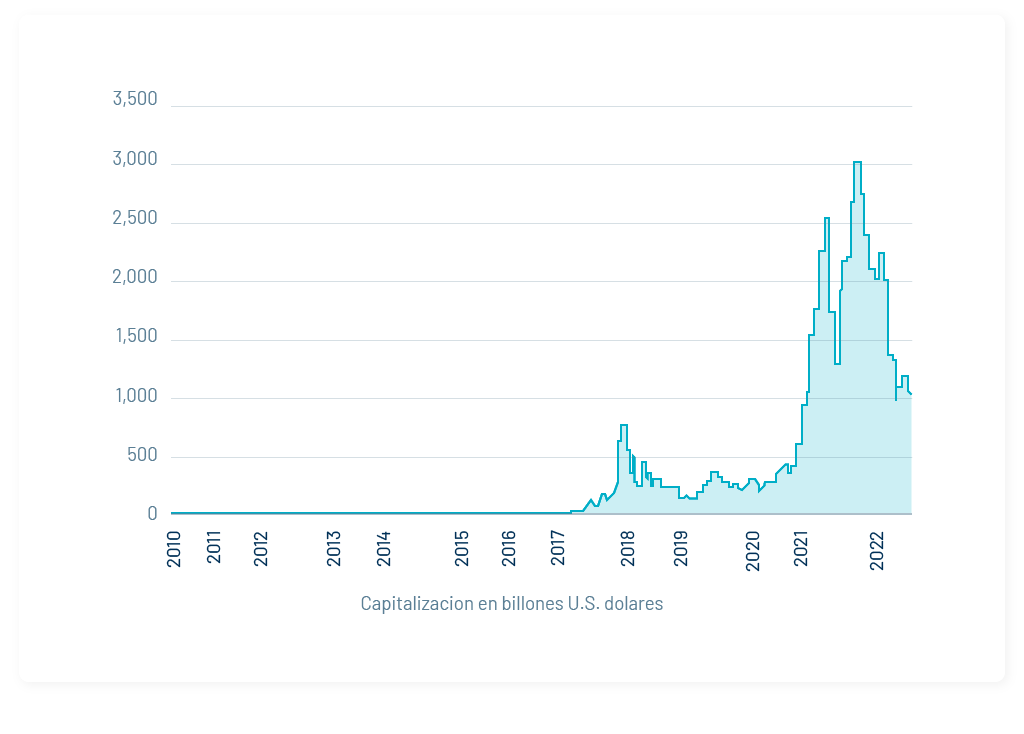
The first trend identified by SURA experts is becoming more and more widespread and adopted, but it is not alien to the challenges that are occurring worldwide. The market capitalization value of cryptocurrencies has been impacted by the desire of central banks and authorities to regulate or eliminate decentralization, changes in global monetary policy (given a widespread phenomenon of inflation), risk aversion and the arduous questions about the negative environmental impact of cryptocurrency mining, among other phenomena.
The capitalization of cryptocurrency market It went from USD 3.000 billion in November 2021 to USD 972 billion in September 2022. The world of decentralized finance is not far behind, whose market capitalization peaked around USD 100 billion and is now close to USD 28 trillion.
“The use of blockchain continues to increase due to its traceability, which leads to reducing corruption, increasing user confidence and empowering users. Spending on blockchain solutions worldwide went from USD 4.5 billion in 2020 to an estimated USD 24 billion by 2024,” Vallejo Pizano reinforces.
According to experts from Seguros SURA, progress is also being made significantly and at a faster pace in the development of central bank digital currencies, which are increasingly being incorporated into these developments, going from just 10 institutions to more than 80 this year. During the month of August 2022, Colombia announced that it is seeking to create a new digital currency.
Going forward, in addition to following the decentralization and digitalization of central bank currencies, it is necessary to understand the impact of metaverse in the financial field and how the sum of these worlds will transform finance around the world.
- Reengineering of financial processes
According to the Director of Financial Relations and GTR at Suramericana, the reengineering of financial processes where information, through technological developments, becomes a source of value, takes on a leading role and advances significantly. “Increasingly, it leads to the generation of predictive analysis with greater accuracy in forecasts and recognition of success patterns across the board, allowing for increased profitability of organizations,” the specialist adds.
In this way, he argues, “financial areas are progressively achieving greater participation and strategic impact because, with advances in the generation of valuable information, they guide decision-making based on facts and driven by data to transform.” Such is the value generated by information and data processing that it unleashes a voracious appetite, to the point of forming computer monopolies on which regulation increasingly seeks to act.
- Equity among stakeholders
Audiences are becoming not just passive actors, but active participants. In addition to shareholders, a new generation of collaborative, value-driven people, deeply connected to the brand and its purpose, are actively involved in the organization.
“Now the masses have the power and the feeling to be stakeholders and influence reputation,” say experts from Seguros SURA. “On social media, the general public can share their experiences, which gives them the ability and influence to change the sentiment of a brand and impact the perceptions of stakeholders,” they emphasize.
This forces companies to become increasingly transparent, authentic and good-generating. “Now people want companies that align with and embody their own personal values. There is support for sustainability and, in particular, social responsibility. Companies are expected to take responsibility for their impact on the world,” explains Verónica Vallejo Pizano.
In this way, stakeholders expect to invest not only money but also their time, focus and energy, expecting a comprehensive and responsible return on their impact. Today, more than ever, stakeholders expect to be seen, heard, taken into account and valued by companies. This invites companies to put the power and potential of stakeholders at the centre of their strategy.
From SURA Insurance, We understand that people's expectations and demands have changed. There is a continuous demand involving aspects such as equity, inclusion and transparency. This has led to the development of alternative solutions in financial management and the conception of value. We believe in a conscious and sustainable capitalism where, in addition to economic benefit, purpose, the protection of people and the environment take precedence.